
Rock Identify: Identify Rocks by Photo
Upload 1–3 photos of the same rock to explore possible matches, compare visible clues, and ask a follow-up question. Start for free—no sign-up or app download needed.
- Rocks, crystals & minerals
- Explains each match
- 3 free identifications per day
Upload rock photos
Drag your photos here, or choose a file to begin.
JPG, PNG, WebP or HEIC · Up to 3 photos · 40 MB each · You can also paste a photo
Azurite · photo by James St. John, CC BY 2.0
- 01
Upload Photos of One Rock
Add one to three views of a rock: the whole rock, a close-up and an edge. JPG, PNG and WebP files are supported, up to 40 MB each. A location and your own observations are optional.
- 02
Review Matches and Evidence
A result presents a suggested name alongside visible clues, limitations and possible alternatives. Read those explanations together. Compare the explanation with your own photographs and leave the name open when the visible evidence does not distinguish the candidates.
- 03
Ask a Follow-up Question
Use the available follow-up to ask about lookalikes, typical properties or care. The reply stays with that specimen. When you want to investigate another find, start a new identification with its own photos.
Photo-based identification can suggest possible matches, but it cannot definitively confirm a specimen’s actual composition.
Keep exploring
Identify Another Rock, Try a Sample, or View Your History
Choose an identification, a sample walkthrough, or your saved history.
Sample walkthrough
Try a provided photo to explore the result and follow-up flow.
How to photograph a rock for identification
Begin with the specimen you actually have, rather than a similar picture found online. A photo-based rock identifier needs a clear view of its surface. Place it against plain paper or another quiet background, use indirect daylight, and tap the screen to focus on the rock.
Different angles are more useful than several nearly identical shots. Include the overall shape, a close-up of grains or bands, and an existing edge. Keep all views on the same specimen so separate materials are not mistaken for one rock.
Add observations you can describe confidently: where you found it, approximate size, visible layers, or a smooth versus rough surface. In live mode, those notes provide context for the photo analysis. Avoid filters, strong glare and guesses presented as facts; the photo guide explains what to show.
Read the rock photography guideWhat can a rock identifier tell you from a photo?
Photo identification focuses on visible clues such as grain size, banding, surface texture and the shape of a specimen. A speckled surface gives different information from flat layers or glassy edges. Color helps describe a find, but several unrelated materials can share the same color.
The result brings a possible name together with the reasons and uncertainties behind it. Compare those observations with your own rock before accepting the label. A missing detail is a reason to take another view, not proof that a candidate is correct.
The reference cards describe typical properties of possible materials and link to educational sources. Those properties have not been measured on your specimen. The page keeps this general information separate from what the uploaded photographs actually show.
A shiny black piece illustrates why several clues matter. Natural volcanic glass and manufactured glass can look similar in a photograph; a dark color alone does not distinguish them. A pale, grainy specimen presents a different problem: visible grains may suggest sandstone, but a photograph may not resolve the grain boundaries needed to compare it with quartzite. Treat those alternatives as questions to investigate. Photograph an existing edge and note whether the pattern continues across it, without breaking or scratching the specimen. If the image cannot show the distinction, an uncertain answer is more useful than a confident guess.
Is It a Rock or a Mineral? Compare the Main Groups
A suggested match may be a rock type or a mineral name. Rocks can contain several minerals, while a mineral has its own composition and structure. Quartz is a mineral; granite is a rock that can contain quartz. Read the category as carefully as the name.
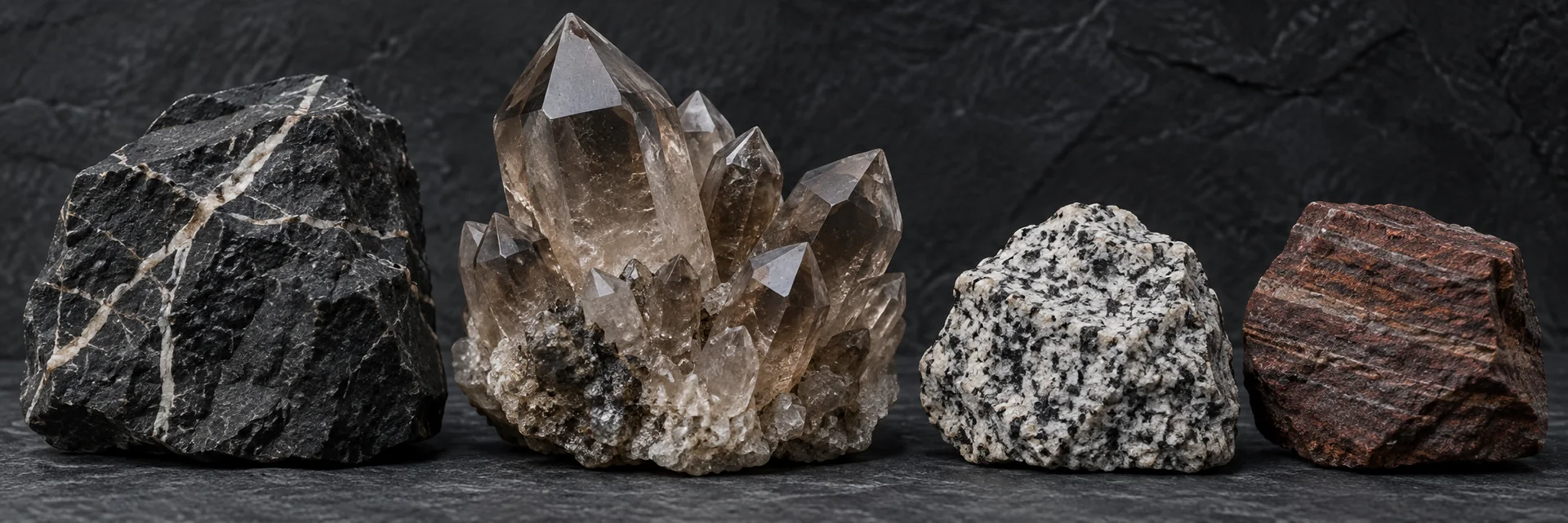
Igneous rocks form as molten material cools. For a granite or basalt suggestion, compare the grain size and overall texture rather than color alone. A coarse mixture of visible crystals and a fine textured surface provide different starting points for comparison.
Sedimentary rocks form from accumulated material or deposits. With a sandstone suggestion, look for grains and layering. Metamorphic rocks have been changed by heat or pressure; for a gneiss or slate suggestion, examine bands or flat surfaces. These clues guide comparison but do not prove an identity.
Learn the basic distinctions in the National Park Service rock guide and its mineral reference.
How accurate is photo-based rock identification?
No photo-based tool can guarantee a correct name from a photograph. Weathered surfaces, polished stones, poor lighting and similar looking materials can obscure the features needed to distinguish candidates. A detailed explanation is useful, but it is not independent confirmation of the suggested identity.
Check the availability notice beside the upload controls before starting. When identification is enabled, the tool uses AI photo analysis and presents each result as tentative. If analysis is paused, you can still read this guide and compare visible features yourself. No measured accuracy percentage is claimed here.
When a name matters, take the specimen and its location notes to a qualified geologist or appropriate laboratory. A photograph cannot measure hardness, density or chemical composition. Start with another angle or a ruler for scale; do not damage an unknown specimen just to complete an online check.
Free Identification Limits and Photo Privacy
Rock Identify works in your browser without registration. The upload panel shows the available daily allowance, and a result shows whether a free follow-up remains. A completed but uncertain analysis uses an identification; a technical failure does not. Repeatedly pressing a button does not create extra completed analyses.
Your conversation belongs to the current specimen. Ask which visible feature would separate two candidates, or what a suggested material is typically used for. Replies should explain uncertainty, especially when a question concerns treatments, authenticity or a possible lookalike.
Unsaved photos, results and conversations become unreadable after 24 hours. A specimen saved to an account collection is stored privately until you delete it or the account. You can reopen the most recent valid temporary result in the same browser, and deletion does not renew the daily allowance. Read the privacy explanation for the difference between access expiry and subsequent storage cleanup.
How your photos and results are handledRead the usage limitations
Rock identification questions, answered
Can I use Rock Identify without an account?
Yes. The tool uses an anonymous browser session, so you can begin without an email address or password. Keep using the same browser to access an unexpired result. This temporary session is not a permanent collection account.
Can I identify rocks by photo on my phone?
The mobile layout includes a camera option where your browser supports it. You can also upload a saved picture. Export HEIC files as JPG first, and photograph the specimen in focus rather than using a distant scene.
Can I upload several different rocks together?
Use one specimen per identification request. The photo slots are for different views of that same find, not a whole collection. Start a new identification for another rock so its notes, possible matches and conversation stay separate.
Why does a result say the match is uncertain?
Some photos do not contain enough distinguishing evidence. An uncertain result can still point out visible features and suggest another useful view. Compare the alternatives, improve the photos and leave the name open when the clues disagree.
Can a photograph tell me what my rock is worth?
The report includes separate AI estimates for market price and specimen value, with the assumed size, condition and sale context stated alongside them. Identification, weight and provenance may need further assessment. These approximate ranges are a starting point for collecting, rather than a professional appraisal or proof of authenticity.
Where can I learn more about my result?
Follow the educational reference links attached to a suggested match, when available. They describe the material in general. Use the photo guide for another attempt, and compare your actual specimen with the stated observations instead of relying on the name alone.
Sources and guide updates
The National Park Service rock and mineral guides linked above explain the general categories and properties discussed here. They are learning resources, not confirmation of an uploaded specimen. This overview has not been reviewed by a geologist; no professional accuracy claim is made for the tool.
Guide updated .
Upload Your Rock Photos to Get Started
Choose clear views of one specimen, add your observations, and compare the possible matches with your rock.
Start with Rock Identify