
Granite identifier by photo
Look at interlocking grains and distinguish a field specimen from decorative stone.
- Granite & similar rocks
- Explains each match
- 3 free identifications per day
Upload rock photos
Drag your photos here, or choose a file to begin.
JPG, PNG, WebP or HEIC · Up to 3 photos · 40 MB each · You can also paste a photo
Azurite · photo by James St. John, CC BY 2.0
- 01
Upload Photos of One Rock
Add one to three views of a rock: the whole rock, a close-up and an edge. JPG, PNG and WebP files are supported, up to 40 MB each. A location and your own observations are optional.
- 02
Review Matches and Evidence
A result presents a suggested name alongside visible clues, limitations and possible alternatives. Read those explanations together. Compare the explanation with your own photographs and leave the name open when the visible evidence does not distinguish the candidates.
- 03
Ask a Follow-up Question
Use the available follow-up to ask about lookalikes, typical properties or care. The reply stays with that specimen. When you want to investigate another find, start a new identification with its own photos.
Photo-based identification can suggest possible matches, but it cannot definitively confirm a specimen’s actual composition.
Keep exploring
Identify Another Rock, Try a Sample, or View Your History
Choose an identification, a sample walkthrough, or your saved history.
Sample walkthrough
Try a provided photo to explore the result and follow-up flow.
Photo guide updated
How to use the granite identifier
Use this free online granite identifier to explore granite by photo. Upload a whole rock or stone surface and a sharp grain close-up, then compare possible matches with nearby rock types. The tool separates visible texture questions from commercial stone naming; it does not certify countertop material or performance.
Granite is an intrusive igneous rock. The U.S. Geological Survey explains that magma cooling slowly below ground has time to grow visible mineral grains, producing coarse-grained plutonic rocks. A granite identification therefore depends on an interlocking mineral texture and mineral proportions, not simply a pale background with black spots.
The word granite is also used for decorative slabs and building products. A supplier’s label can be useful context, but it does not settle the geological name. A polished countertop may be granite, granodiorite, gneiss, another rock, or an engineered material. Start by separating the commercial question from the field-specimen question.
Photograph granite grains at two scales
Take a whole view that shows whether the item is a loose rock, a cut slab, a tile, or a weathered outcrop fragment. Then take a sharp close-up with scale. A third image should show an unpolished edge, naturally weathered face, or a different area of the same specimen. Upload one to three JPG, PNG, or WebP images of the same object, with each file no larger than 10 MB.
Avoid relying on a wet or mirror-polished surface. Polish can intensify color and sparkle while hiding grain boundaries; weathering can stain or roughen a surface. Include any veins, dark inclusions, bands, or patches rather than cropping them away. Those features can be important when granite is not the best comparison.
Look for an interlocking granite grain mosaic
Describe light and dark grains separately. Granite commonly contains visible light feldspar, quartz-like grains, and darker minerals such as mica or amphibole, but a photograph cannot reliably measure their proportions or confirm their chemistry. Look for grains that meet one another in a coarse mosaic instead of a uniform fine groundmass or a layered sedimentary surface.
Quartz may look glassy or gray, feldspar may be pale or pink, and dark flakes or prisms may be mica or amphibole. Those are visual possibilities, not laboratory determinations. Note whether grains are similarly sized, exceptionally large, stretched into a direction, or surrounded by a fine matrix. Grain relationships often matter more than one attractive mineral color.
Compare granite with gneiss, diorite and gabbro
Diorite and gabbro can also be coarse grained but often look darker because their visible mineral mix differs. Pegmatite has unusually large crystals. Granodiorite overlaps with granite and may be difficult to distinguish from ordinary photos. Keep these alternatives visible when the image cannot show enough detail for a proportional mineral classification.
Gneiss is a particularly useful comparison when light and dark minerals appear aligned or banded. A close crop of gneiss may resemble granite, while the wider view reveals planar fabric or repeated bands. Photograph across the apparent banding and along it. A decorative slab can also be cut to emphasize patterns that do not represent the rock’s original orientation.
For a dark, fine-grained volcanic rock, compare it with the basalt identifier. For glassy surfaces rather than visible crystals, try the obsidian identifier.
Granite specimens and countertop examples
A loose, speckled hand specimen with separate grains may support a broad granitic-rock comparison if the texture is coarse and interlocking. A slab with bold alternating pale and dark stripes deserves a granite-versus-gneiss comparison. A very dark coarse stone should remain open to gabbro or diorite. These are evidence-based routes, not promises that a phone image can choose among every intrusive rock name.
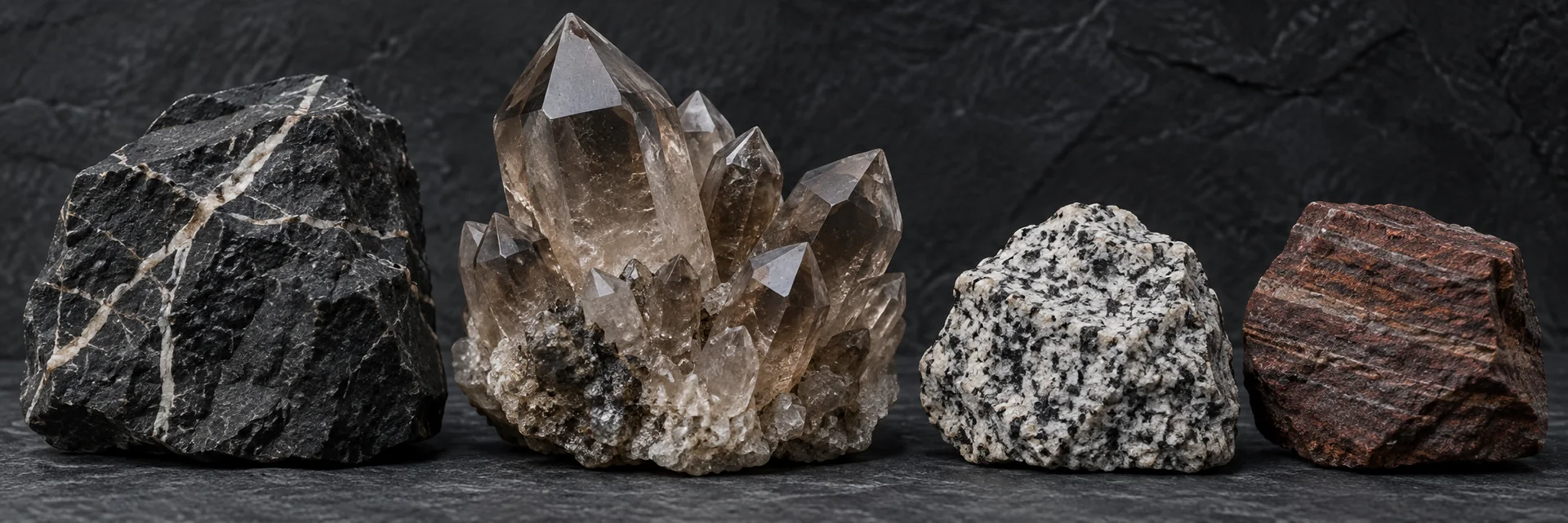
If the specimen contains a white vein cutting through the coarse grains, photograph both the vein and host. The vein may be quartz-rich material added later, not the main rock type. If the surface is made of small chips bound by cement, it may be aggregate or manufactured material. Context and a whole view prevent those details from being mistaken for granite texture.
Granite photo limits and safe follow-up
Use a ruler and a hand lens to document grain size, but do not scratch, chip, or chemically test the material for an online result. Granite cannot be confirmed from a countertop color chart, and a photograph does not establish quarry, engineering suitability, radioactivity, structural condition, or market value. Those claims need their own methods and records.
For a better comparison, take a dry close image in diffuse daylight, another at a different point on the specimen, and a view of any texture that appears aligned. Preserve the original note if a later expert changes the name. It is useful to know whether an earlier photo supported a broad granitic texture even when the final geological classification is more precise.
Keep grain evidence with your granite result
Save which image shows the grain mosaic, whether bands were visible, and which alternatives remained open. A note such as “coarse light and dark grains, no clear banding in available faces” is stronger than simply writing granite. Add location as context only; landscaping stone, gravel, and building material may have been transported far from their source.
A result should explain what in the photograph supports a candidate and what is missing. If the available surface is polished, too weathered, or too small to show grains, an uncertain result is appropriate. That keeps a future in-person inspection focused on the needed texture rather than on defending an unsupported photo label.
FAQ: why can a countertop label be misleading? Stone suppliers may use granite as a commercial category for several hard-looking slab materials. The label belongs in the record, but the photograph should still show grain texture, possible banding, and an unpolished edge if one is available. A field rock and an architectural surface call for different levels of confidence.
When comparing a hand sample, place a millimeter scale beside the driest representative face. First describe grain size, then whether grains interlock, then whether they align. Only after those steps compare the light and dark mineral mix. This sequence prevents a pink feldspar-rich patch or black mica-rich patch from deciding the name by itself.
If the sample has both fresh and weathered faces, photograph each and identify which one is used for the comparison. Weathering can make feldspar look chalky, dark minerals rusty, and an otherwise even mosaic uneven. A record that separates surface alteration from the interior texture gives the next observer a clearer geological starting point. Record both faces.