
Photo guide updated
What Type of Rock Is This? Start with Visible Clues
What type of rock is this? Start with the features you can see: separate grains, repeating bands, small holes, a glassy edge or a smooth surface. Upload a clear photo in the tool above to compare possible matches. You do not need a guessed name first; use the explanation to connect each candidate with the visible features of your specimen.
For a beach pebble or a garden stone, begin with one clear photo of the whole specimen. Additional views are optional: add a close-up of its texture and a photo of another side or an already exposed edge. Include a ruler when practical, and keep the same specimen in every image so its shape and grain pattern can be compared.
Use indirect daylight and a plain background. Tap the rock on your camera screen to focus; move back slightly if the close-up becomes blurry. Show it dry first, since water and polish can make colors darker and surfaces shinier. Add where you found it, whether it was loose or attached to an outcrop, and whether it was purchased.
Compare these visible clues before choosing a name
Color is a useful description, but texture usually gives you a better starting comparison. Two pink stones may have completely different structures, while one rock type can occur in several colors. Look across the whole specimen rather than choosing the brightest patch. The table gives possible comparisons and a practical next photo; it is not a checklist that confirms a rock from one feature.
What you can see | Candidates to compare | Next photo to take |
|---|---|---|
Mixed, interlocking crystals | Granite or another coarse igneous rock; banded gneiss can look similar. | A focused grain close-up, then a wider view for bands. |
Sand-sized grains or rounded fragments | Sandstone for sand grains; conglomerate for rounded clasts. | An existing edge showing grains inside the rock. |
Light and dark mineral bands | Gneiss; compare mineral bands with sedimentary layers. | Two sides showing whether the pattern continues. |
Dark, fine texture with rounded holes | Basalt or scoria; industrial slag can also contain holes. | Holes, surrounding material and an existing broken edge. |
A glassy surface or curved fracture | Obsidian, manufactured glass or slag. | An existing thin edge in daylight; avoid handling sharp edges. |
One distinct crystal or crystal cluster | A mineral specimen such as quartz, rather than a whole rock type. | Natural faces and the material attached beneath them. |
Rock groups explain how a rock formed
Igneous rocks form when molten material cools. Slowly cooled rocks such as granite can have visible crystals; rapidly cooled volcanic rocks can be fine grained or glassy. Sedimentary rocks form from accumulated sediment or material precipitated from water. Sandstone may show cemented sand grains, while conglomerate contains larger rounded fragments. Metamorphic rocks develop as existing rocks change under heat and pressure; gneiss can display mineral bands.
A group name and a specific name answer different questions. “Possibly igneous” is a broad interpretation; “granite” is a narrower candidate that needs compatible grain relationships and composition. Not every sedimentary rock has obvious layers, and not every metamorphic rock has bands. If the surface is polished, weathered or too fine to resolve, keep the broader answer until you have another useful clue.
Two reference photos: crystals versus bands
These National Park Service specimens show the features described below. Compare their structures with your own photos, rather than expecting an exact color match. The labels come from the source material; these are reference examples, not results produced by the identifier.
Mixed crystals: could your rock be granite?
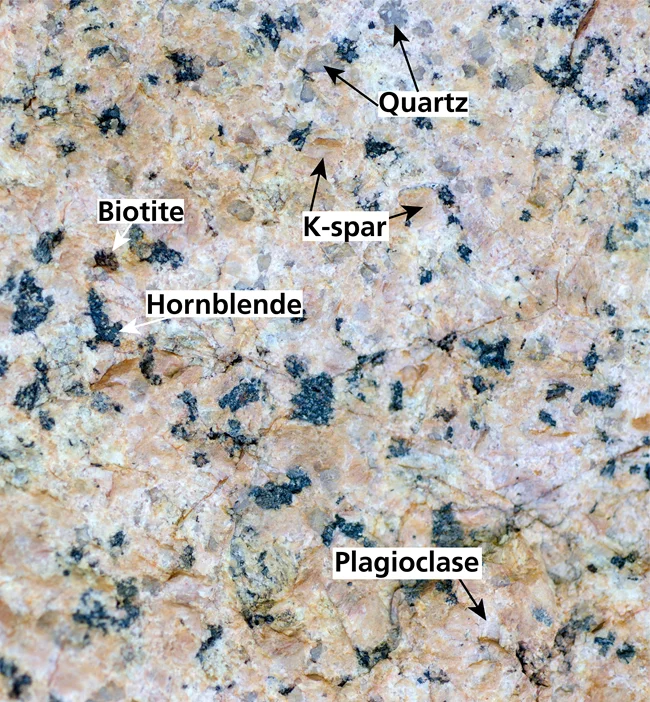
The source identifies this specimen as Pikes Peak Granite. Its labeled minerals occupy distinct patches across a coarse texture. For a similar-looking stone, photograph several neighboring grains together rather than a single pink crystal. A granite comparison becomes more useful when you can see how the light and dark grains meet.
Now check the wider view. Are the dark grains scattered, or do they repeatedly collect into bands? Banding would make gneiss an important alternative to compare. Ask which grain relationships support the suggested name instead of accepting a match because both rocks look pink.
Photo and mineral labels: NPS, Florissant Fossil Beds National Monument. View source.
Light and dark bands: gneiss or a layered rock?
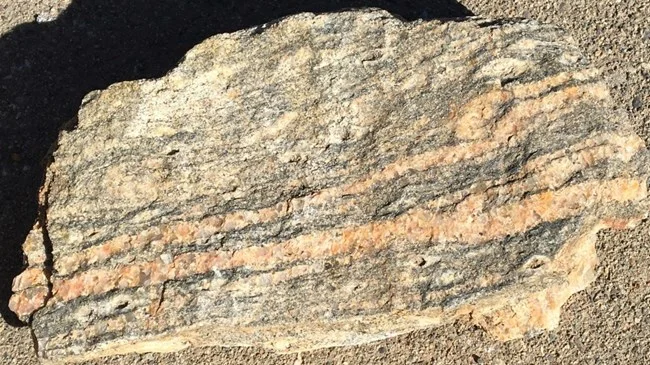
The source identifies this example as gneiss. Pale and darker mineral-rich bands extend across the exposed face. If your rock has a similar pattern, capture the entire sequence of bands and then a closer view of the minerals within them. This gives you more to compare than one stripe.
Look at a second side before calling the pattern a layer. Mineral bands, sedimentary bedding, surface staining and veins can all create lines in a photo. Their arrangement and surrounding texture matter. A useful follow-up asks whether the visible evidence favors gneiss or a layered sedimentary rock, and what view would distinguish them.
Photo: NPS/A. Fitzgerald, Black Canyon of the Gunnison. View source.
A sandy stone needs a different close-up
For a gritty pebble, focus on the grains rather than its overall color. A sandstone candidate should explain the sand-sized particles held together in the specimen. Photograph several grains in focus, then show an existing edge if available. This helps distinguish the internal texture from loose sand stuck to the outside.
If the result also suggests quartzite, compare whether individual particles remain visibly distinct or the surface appears more tightly interlocking. A phone photo may not resolve that distinction. Keep both candidates when the detail is insufficient; a brighter picture alone does not settle the question. Ask for the specific missing observation rather than repeating the same wide shot.
Use the result to choose your next observation
Read the explanation alongside each possible match. A useful answer connects the candidate to something visible in your image and names an alternative when the clues overlap. Compare those claims with your specimen: does the reported banding actually appear on more than one side? Can you see the grains the answer describes? If a claimed feature is absent, say so in the follow-up.
Ask a specific follow-up, such as “Are the dark marks surface staining or minerals inside the rock?” or “Which photo would help separate granite from gneiss?” You can also ask whether the object resembles a single mineral or a manufactured material. Describe the new observation in plain language so the comparison can address it directly.
What a photo can and cannot establish
Photos can show shape, surface texture, visible grains, bands and existing fractures. They cannot directly measure hardness, streak, density or chemical composition. A weathered exterior can hide the interior, and similar materials can remain unresolved even with several good images. Treat the answer as a visual comparison to check, not a certificate of identity, origin or value.
Common questions about identifying a found rock
How can I identify a smooth, rounded pebble?
Rounding describes wear, not a particular rock type. Start with a dry close-up of the surface and any existing chip. Grains, bands or internal texture can be more informative than the pebble shape. Mention whether you found it on a beach, riverbank or landscaped path.
What makes a rock sparkle?
Sparkle can come from different minerals or reflective surfaces. Photograph the whole stone and the sparkling area without direct glare. Notice whether the bright patches are flat flakes, distinct crystals or a coating. The arrangement helps you compare candidates; sparkle alone does not identify the rock.
Can I use the identifier without knowing geology?
Yes. Upload a clear photo and describe what you notice in everyday words. Location and notes are optional. Use the explanation to compare visible clues, and add another view if it helps distinguish the possible matches. You can start without an account.
Why do I get more than one possible match?
Several rock types share visible features. Alternatives show which distinctions remain unresolved. Ask what separates the leading candidates and provide the requested view when available. If your photos cannot show the needed feature, retaining an uncertain answer is more useful than forcing a specific name.