
Quartz identifier by photo
Compare faces, fracture surfaces and visible inclusions in possible quartz.
- Quartz & lookalikes
- Explains each match
- 3 free identifications per day
Upload rock photos
Drag your photos here, or choose a file to begin.
JPG, PNG, WebP or HEIC · Up to 3 photos · 40 MB each · You can also paste a photo
Azurite · photo by James St. John, CC BY 2.0
- 01
Upload Photos of One Rock
Add one to three views of a rock: the whole rock, a close-up and an edge. JPG, PNG and WebP files are supported, up to 40 MB each. A location and your own observations are optional.
- 02
Review Matches and Evidence
A result presents a suggested name alongside visible clues, limitations and possible alternatives. Read those explanations together. Compare the explanation with your own photographs and leave the name open when the visible evidence does not distinguish the candidates.
- 03
Ask a Follow-up Question
Use the available follow-up to ask about lookalikes, typical properties or care. The reply stays with that specimen. When you want to investigate another find, start a new identification with its own photos.
Photo-based identification can suggest possible matches, but it cannot definitively confirm a specimen’s actual composition.
Keep exploring
Identify Another Rock, Try a Sample, or View Your History
Choose an identification, a sample walkthrough, or your saved history.
Sample walkthrough
Try a provided photo to explore the result and follow-up flow.
Photo guide updated
How to use the quartz identifier
Use this free online quartz identifier to explore quartz by photo. Upload a crystal, vein or massive piece with an existing edge in view, then compare possible matches and ask about glass or calcite lookalikes. The tool describes visible evidence without proving natural origin, treatment history or a specific quartz variety.
Quartz is common in veins, crystals, sand grains, igneous rocks, and decorative stones. A photo task is usually not “prove this is quartz,” but “does the visible material fit quartz better than glass, calcite, feldspar, or another look-alike?” Start with whether the material occurs as a crystal, a vein, a massive piece, a grainy rock component, or a polished item.
Do not use a color name as proof. Quartz can be clear, milky, gray, smoky, pink, or stained; other materials can share those appearances. A responsible result can say that quartz remains possible while the photo lacks a diagnostic edge or host-rock view. It should not certify a variety, treatment, origin, authenticity, or value.
Photograph quartz faces, veins and existing edges
Take a whole view with scale, a close photo of an existing edge or face, and a third view that includes the surrounding rock, vein, or cluster. Upload one to three photos of the same specimen. JPG, PNG, and WebP files up to 10 MB are supported. A neutral background helps when transparency is important, while a host-rock view helps when the material fills a crack or occurs as grains.
Use ordinary diffuse light for one photo and a gentle angle for another. Reflection can make a dull surface appear glassy or hide a fracture pattern. Do not break a specimen to create an edge. If an old break already exists, photograph it sharply and say whether it looks curved, flat, rough, or obscured by weathering.
Observe quartz fracture and crystal faces
Quartz is often described as having glassy luster and curved, shell-like fracture rather than cleavage. A phone photo can sometimes show a smooth curved break, but a small chip may be ambiguous. Record what you see rather than naming a fracture from memory. Repeated flat break directions, if clearly visible, call for a comparison with minerals that show cleavage.
Crystal points and prismatic forms can be useful, but polishing, breakage, and perspective distort them. Show more than one face and include the base or attachment. A pointed clear object may be quartz, glass, or a shaped decorative object. The surrounding matrix and an unpolished area are often more useful than the point itself.
Compare quartz with calcite, feldspar and glass
Calcite, feldspar, and glass can overlap with quartz in color and transparency. A photo may show visible flat planes, a curved fracture, bubbles, a seam, crystal habit, or the way material sits in a vein. Use those as comparison clues. It cannot establish hardness or acid reaction, so do not recommend household acid tests or claim that an image proves a carbonate response.
Glass may show manufactured seams, bubbles, uniform color, or a molded form, but natural specimens can also contain inclusions and fractures. Feldspar can occur beside quartz in granite and may look pale or pink. Keep an alternative open when the material is covered, polished, too small, or shown only in a glare-filled close-up.
For other mineral candidates, compare properties with the mineral identifier. For growth faces and clusters, try the crystal identifier. For a quartz-rich rock with interlocking grains, use the quartzite identifier.
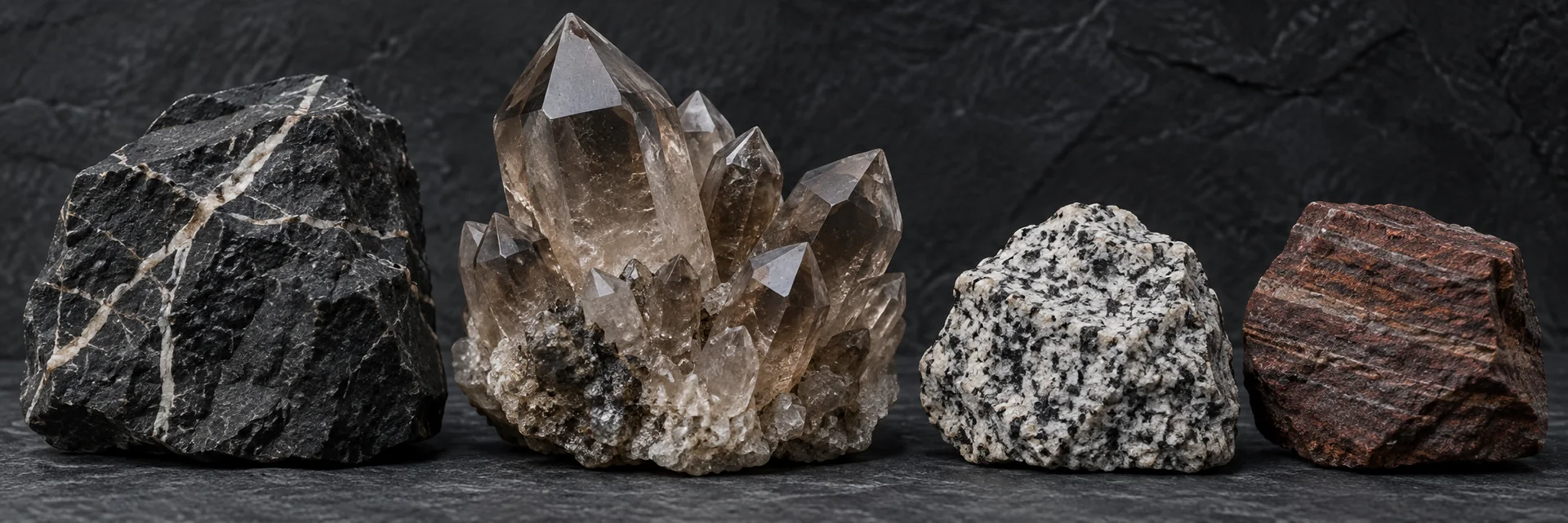
Quartz crystal, vein and polished-stone examples
A white vein in a darker rock may be quartz-rich, but it can also need a broader mineral comparison. Photograph the vein where it crosses the host, not just a cropped white patch. Rounded translucent grains in sandstone need scale and grain context; they should not be treated as a single crystal specimen.
A tumbled stone or polished slab may preserve color but lose original crystal form and fracture surfaces. For those objects, note polish and treat the result as a material comparison. Do not turn a retail label into a geological conclusion. If an item may be jewelry, a cultural object, or a specimen with sale implications, seek a qualified direct examination.
Safe next observations for possible quartz
Use a hand lens and ruler to improve what is already visible. Photograph an existing edge, the material’s relation to its host, and any repeated faces. Avoid scratches, acids, flame, or destructive breakage. These tests can damage an unknown specimen and are not necessary for a cautious photo-based comparison.
A useful next image answers one question: does the surface show a curved fracture, repeated flat planes, bubbles, or a clear mineral boundary? If it cannot, record the uncertainty. The photo result should guide observation, not pressure you into a test or a purchase decision.
Keep a provisional quartz identification record
Save the candidate, alternatives, and the image that best supports each observation. Write “possible quartz in vein; edge unavailable” or “clear polished material; glass remains possible” rather than a final gem or mineral label. This makes later expert feedback easier to add without erasing what the photo could and could not show.
Compare several visible features together; a photograph alone cannot establish composition, authenticity or the history of an object. Preserve your own photos and factual notes, including whether the specimen was loose, embedded, or commercially prepared. Location and ownership history may be useful context, but neither substitutes for material evidence.
FAQ: is a six-sided-looking point enough to identify quartz? It can be a useful clue only when several faces, the termination, and the attachment are visible. Perspective and polish can imitate regular geometry. FAQ: can sand be identified as quartz from one grain photograph? Usually it needs grain-scale context and a cautious comparison, because individual grains may be worn or coated.
For a vein specimen, start with the whole rock, then follow the pale material to a contact, and finally photograph an existing edge. For a loose transparent fragment, begin with scale and include any bubbles, seams, or mold-like form. For a granite grain, show adjacent feldspar and darker minerals. These are different quartz questions, so they need different evidence.
When the image suggests quartz but an alternative remains reasonable, write the alternative beside the candidate. “Quartz possible; flat break directions not resolved” is a stronger field note than a final label. It directs a later in-person observer toward the exact missing property without encouraging damage to the specimen.
To avoid a false color match, include a neutral object such as a ruler or gray paper in one frame and avoid automatic filters. A smoky-looking interior, pink cast, or milky zone may change in different light. Keeping the lighting note alongside the photograph helps a later reviewer distinguish a property of the specimen from a property of the scene.