
Crystal identifier by photo
Explore natural faces, clusters and translucency without relying on a shop label.
- Natural & polished crystals
- Explains each match
- 3 free identifications per day
Upload rock photos
Drag your photos here, or choose a file to begin.
JPG, PNG, WebP or HEIC · Up to 3 photos · 40 MB each · You can also paste a photo
Azurite · photo by James St. John, CC BY 2.0
- 01
Upload Photos of One Rock
Add one to three views of a rock: the whole rock, a close-up and an edge. JPG, PNG and WebP files are supported, up to 40 MB each. A location and your own observations are optional.
- 02
Review Matches and Evidence
A result presents a suggested name alongside visible clues, limitations and possible alternatives. Read those explanations together. Compare the explanation with your own photographs and leave the name open when the visible evidence does not distinguish the candidates.
- 03
Ask a Follow-up Question
Use the available follow-up to ask about lookalikes, typical properties or care. The reply stays with that specimen. When you want to investigate another find, start a new identification with its own photos.
Photo-based identification can suggest possible matches, but it cannot definitively confirm a specimen’s actual composition.
Keep exploring
Identify Another Rock, Try a Sample, or View Your History
Choose an identification, a sample walkthrough, or your saved history.
Sample walkthrough
Try a provided photo to explore the result and follow-up flow.
Photo guide updated
How to use the crystal identifier
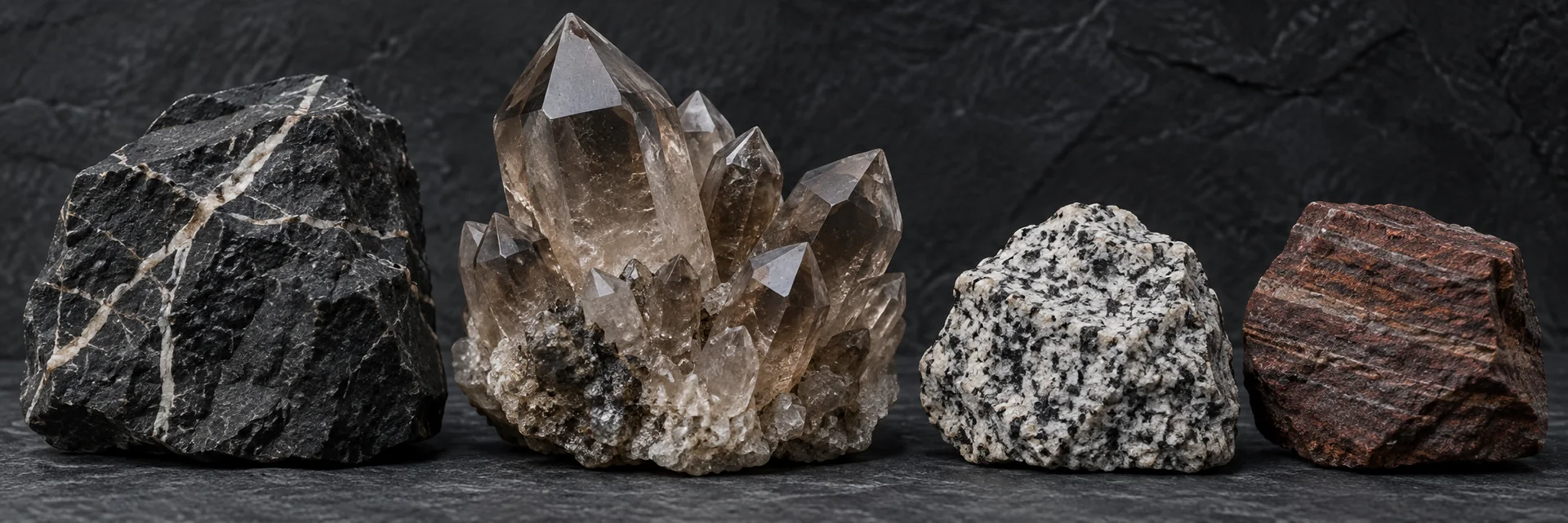
Use this free online crystal identifier to explore crystals by photo. Upload clear views of a point, cluster or polished piece, then compare possible matches, natural faces and visible lookalikes. A crystal name is provisional: this tool cannot certify authenticity, treatments or a commercial crystal label.
A crystal may be a naturally grown mineral, a cluster lining a cavity, a loose point, a tumbled decorative stone, a bead, or a manufactured object described with crystal language. Begin with the complete object. Show whether it is attached to rock, drilled, mounted, cut, glued, polished, or loose. This context matters before any discussion of mineral identity.
Natural-looking points alone are not proof of natural growth. Polishing can create regular tips, and molded or cut glass can look transparent and faceted. The goal is to identify visible structure and plausible alternatives, not to certify an object as natural, untreated, rare, or valuable. A careful answer can still help you choose a better photo or a qualified in-person examination.
Photograph a crystal point, cluster or polished stone
Photograph the full object with scale, then take an angled close view of a face, tip, or cluster. Use the third photo for the base, attachment, or side. Upload one to three photos of the same specimen in JPG, PNG, or WebP format up to 10 MB each. Use diffuse daylight for one view; strong backlighting can hide surface detail even when it makes a transparent object look dramatic.
Put the object against a neutral background when you want to show transparency or internal features. If it is mounted or wrapped, include the setting rather than removing it. A drilled hole, a glue line, a flat cut base, or a mold seam may be more informative than an attractive close-up. Photograph those features without trying to disassemble the object.
Look for crystal growth geometry
Compare repeated faces, terminations, radiating groups, parallel needles, plates, or blocky forms. Natural crystal faces can be flat and repeated, but chips, weathering, and polish may interrupt them. Describe what is visible: “several similar flat faces,” “a rounded polished point,” or “many small points attached to a matrix.” Avoid assigning an exact crystal system from a single distorted view.
A cluster can offer stronger context than a lone point. Look for whether similar crystals grow from one surface, line a cavity, or appear randomly embedded. Show the transition from crystal to host rock. A cluster fixed on a display base, or a specimen with a coated surface, deserves an alternative explanation before it is described as a natural growth feature.
Read crystal luster, translucency and inclusions
Luster, transparency, color zoning, inclusions, fractures, and visible bubbles can be documented in photos. They do not independently identify a mineral. Glass may contain bubbles or flow marks; natural minerals may contain fractures and inclusions; resin can have very different aging features. Use observations to build a comparison rather than treating any one clue as a certificate.
Take one photo without glare. A reflective polished surface can disguise scratches, seams, and uneven color. If you see a rainbow effect, dark coating, waxy film, or unusually even color, record it as a surface observation. Do not infer heat treatment, dye, coating chemistry, or origin from it. Those questions require evidence beyond an ordinary photograph.
Compare mineral crystals with glass and resin
For a clear or translucent object, compare possible mineral crystal, glass, resin, and cut or molded decorative material. For a cluster, compare a natural matrix-attached growth with an assembled or repaired display piece. Ask which explanation accounts for the base, the repeated faces, and the internal appearance at the same time. A candidate that explains only the color is not strong.
If the item is tumbled or highly polished, the original crystal form may have been removed. The proper result may then be a broad material family or an unknown rather than a precise mineral. Do not use an online photo result to claim gem grade, commercial variety, therapeutic effect, source locality, authenticity, or resale value.
For cleavage and luster comparisons, use the mineral identifier. For a possible quartz point, try the quartz identifier. For a grainy rock rather than a distinct crystal, use the quartzite identifier.
Safe next observations for a crystal
Use a ruler, a hand lens, and ordinary lighting. Photograph a naturally exposed edge instead of breaking the object. Rotate it slowly and note whether faces repeat, whether the color is concentrated near fractures, and whether the surface is uniformly polished. These checks are non-destructive and make a later comparison easier.
Do not perform scratch, acid, flame, or chemical tests on an unknown crystal or jewelry item. Do not remove material from a possible archaeological object or a specimen collected in a protected area. If a safety, cultural, insurance, or sale decision depends on the identity, preserve the object and consult the relevant qualified professional.
Interpret a provisional crystal result
A useful result should point to visible evidence, alternatives, and one missing observation. It may say that the object appears polished, that a base is needed to assess a cluster, or that glass remains plausible. Check that each stated observation is visible in your photos; a useful candidate still needs supporting evidence from the object itself.
Save the photos with a note about the object’s form and setting. If later evidence establishes a mineral, keep the photo-based observation as a provisional stage rather than rewriting history. That distinction is especially important for crystals sold under trade names, where appearance and mineral identity are often not the same question.
For a cluster from a geode or cavity, a useful follow-up image shows several points and the supporting wall together. For a loose point, show the tip, base, and one side to distinguish a natural-looking surface from a fully shaped object. For a bead or pendant, show the drill hole or bezel. Each case changes which visual evidence can be weighed.
FAQ: can a clear photograph prove a crystal is natural? No. The picture may make a natural-mineral explanation more or less plausible, but it cannot establish production history. FAQ: should an uncertain result be saved? Yes, if it states the visible features and missing view. A dated provisional record is more useful than a confident name with no supporting observation.
When light passes through a transparent object, move the light source around it rather than relying on one bright backlit image. Note whether apparent color comes from the whole body, a surface film, an inclusion, or the background. This small change in viewing angle can reveal what the first photograph concealed, while leaving the object intact.