
Fossil identifier by photo
Compare shells, stems, corals, plant prints and bone by photo. Explore fossil groups and the mineral patterns that look like fossils, then ask a follow-up.
- Fossils & pseudofossils
- Explains each match
- 3 free identifications per day
Upload fossil photos
Drag your photos here, or choose a file to begin.
JPG, PNG, WebP or HEIC · Up to 3 photos · 40 MB each · You can also paste a photo
Ammonite fossil · photo by James St. John, CC BY 2.0 · Resized and converted to WebP.
- 01
Upload Photos of One Fossil
Add one to three views of a fossil: whole find beside a ruler, the other side or the rock it sits in and sharp close-up of the surface pattern. JPG, PNG and WebP files are supported, up to 40 MB each. A location and your own observations are optional.
- 02
Review Matches and Evidence
A result presents a suggested name alongside visible clues, limitations and possible alternatives. Read those explanations together. Compare the explanation with your own photographs and leave the name open when the visible evidence does not distinguish the candidates.
- 03
Ask a Follow-up Question
Use the available follow-up to ask about lookalikes, typical properties or care. The reply stays with that specimen. When you want to investigate another find, start a new identification with its own photos.
Photo-based identification can suggest possible matches, but it cannot definitively confirm a specimen’s actual composition.
Keep exploring
Identify Another Find, Try a Sample, or View Your History
Choose an identification, a sample walkthrough, or your saved history.

Sample walkthrough
Try the ammonite fossil photo and review its result.
Ammonite fossil · photo by James St. John, CC BY 2.0 · Resized and converted to WebP.
Photo guide
Get practical tips for showing shape, surface details and different angles.
Read the guidePhoto guide updated
How to use the fossil identifier
The fossil identifier compares photos of your find with the fossil groups beginners most often pick up and with the mineral patterns that only look like fossils. Upload one to three photos of the same object: the whole find beside a ruler, the other side or the rock it sits in, and a sharp close-up of the surface pattern. Then pick the closest option: a shell or shell print, a plant, wood or leaf print, bone or tooth, or not sure it is a fossil.
The result lists possible matches, the visible clues behind each one, the lookalikes that still fit, and what the photos could not settle. It ends with a follow-up question you can answer or ask about, often where the piece was found. Photograph it dry, in daylight, and leave it as it is, since scrubbing or gluing can erase the texture that matters.
Fossil or mineral pattern: the first question
The fossil identifier starts by asking whether a living thing made the pattern at all. Living things leave repeated, symmetrical structure: ribs that match on both halves of a shell, stem discs of one size stacked in a row, coral cups packed into a honeycomb. Minerals leave branching, concentric or crystal patterns instead.
Black, fern-like branches across a flat rock face are manganese dendrites, a mineral that crystallized in a thin crack. Round or egg-shaped lumps are usually concretions, mineral layers that grew around a grain in soft sediment. The Kentucky Geological Survey says none of the many fossil eggs and turtle shells reported in Kentucky has proved real; all were concretions or man-made objects. Cracked nodules with yellow-brown calcite in the cracks are septarian nodules, often sold as dinosaur eggs.
Wavy ridges on a slab are ripple marks, and cracked polygons are mud cracks. Both record old water and mud, not a plant or animal.
Fossil groups beginners find most often
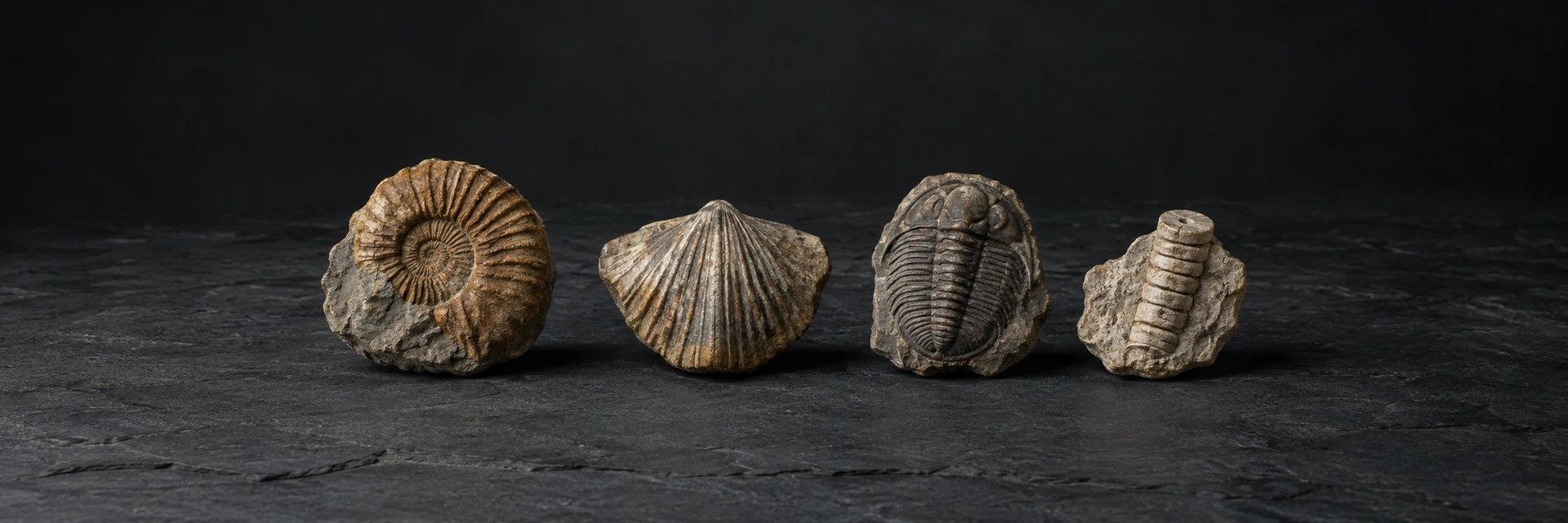
A brachiopod has two unequal shells, each symmetrical down its middle, often ribbed, with a small beak at the hinge. A clam is the reverse: two mirror-image shells, each one lopsided. A flat coil with frilly, branching suture lines points toward an ammonite. Simple curved sutures fit a nautiloid, such as the straight Orthoceras cones polished in black limestone.
Crinoid stems are small round or star-shaped discs with a hole in the center, loose like beads or stacked in a column. A horn-shaped cone with radiating partitions is a horn coral, and a honeycomb of polygons is a colonial coral. On Michigan beaches, a pebble covered in six-sided rings with star-like centers fits the Petoskey stone, a Devonian coral in the genus Hexagonaria. A trilobite shows three lengthwise lobes, a segmented body and a head shield.
Plant fossils appear as black or rust-brown leaf films on shale or inside ironstone nodules that have already split. Petrified wood keeps wood grain, growth rings, bark or knots. Bone shows a porous, spongy lattice inside a smooth, dense outer layer, and a tooth has a glossy enamel crown on a root.
For a pointed tooth with a crown and root, use the shark tooth identifier. For gray rock packed with shell bits, try the limestone identifier.
Fossil identifier clues and the next photo to take
Start with the clue you can see most clearly.
What you see | What it may point to | Photo that helps next |
|---|---|---|
Black fern-like branches on a flat face | Manganese dendrites; plant prints show veins | Close-up beside a coin |
Round nodule, maybe cracked with yellow-brown filling | Concretion or septarian nodule | Whole piece with a ruler, then the other side |
Wavy ridges or cracked polygons on a slab | Ripple marks or mud cracks | Whole slab lit from one side |
Round, separate holes in dark rock | Vesicular basalt; bone has a fine lattice of tiny pores | Close-up of the holes beside a coin |
Small discs with a hole in the center | Crinoid stem pieces | One disc seen end-on |
Six-sided rings with star-like centers | Petoskey stone (Hexagonaria coral) | Close-up of the rings, dry and then wet |
Replicas and restored fossils
Moroccan trilobites and ammonite plates sold in shops are often restored, and some are cast or carved outright. Warning signs include fossil and rock of identical color and texture, no shell texture, mold seams, identical repeated pieces and painted or carved outlines. When those show, the fossil identifier names a replica or restored fossil candidate.
Keep a seller’s label separate from what the pictures show, and photograph the back, the edges and any repair line.
What the fossil identifier cannot settle from a photo
The fossil identifier often stops at a broad group, such as brachiopod, crinoid stem or ammonite, and adds a genus only when its defining feature shows. Species, geological age, locality, authenticity and value all need more than a picture. A photo also cannot tell fossil bone from modern bone, or amber from copal or plastic. For those questions, take the find to a natural history museum, a university geology department or your state geological survey, with notes on exactly where it was found.
Fossil collecting rules on US public land
The fossil identifier cannot tell you who manages the ground you stood on, and that decides what you may keep. The National Park Service prohibits collecting fossils for recreational, commercial or educational use in every unit of the National Park System, national lakeshores included. If you spot one there, photograph it, note the location, leave it and tell a ranger.
On Bureau of Land Management land, anyone may collect a reasonable amount of common invertebrate fossils such as mollusks and trilobites, plant fossils and petrified wood for personal use without a permit: up to 25 pounds of invertebrate and plant fossils per person a day, and 25 pounds plus one piece of petrified wood a day, up to 250 pounds a year. Use only non-powered hand tools, and do not sell or barter the finds. Vertebrate fossils such as dinosaurs, mammals, fish and reptiles need a research permit, and a fossil shark tooth counts as one.
Michigan limits rock collecting on state-owned land, Petoskey stones included, to 25 pounds per person per year. On private land, ask the owner first.
Common questions about fossil finds
Is my round, cracked rock a dinosaur egg?
Almost certainly not; it is most likely a concretion or septarian nodule. The Kentucky Geological Survey notes that North American dinosaur eggs come from nesting sites in the West, with many eggs together, not as single loose stones.
Can a photo tell me how old my fossil is?
No. Age comes from the rock layer a fossil came from, not from its color or shape. Note exactly where you found it so a state geological survey or museum can match the place to the local rock layers.
Can I keep a fossil I found?
It depends on the land. Fossils stay in place in national parks and lakeshores. BLM land allows common invertebrate and plant fossils in reasonable amounts, but vertebrate fossils need a permit. Private land needs the owner’s permission.