
Gemstone identifier by photo
Compare rough, tumbled and cut gemstones by photo. Explore color, luster, optical effects and common imitations, then ask a follow-up.
- Rough, polished & cut gems
- Explains each match
- 3 free identifications per day
Upload gemstone photos
Drag your photos here, or choose a file to begin.
JPG, PNG, WebP or HEIC · Up to 3 photos · 40 MB each · You can also paste a photo
Grossular garnet · photo by James St. John, CC BY 2.0 · Resized and converted to WebP.
- 01
Upload Photos of One Gemstone
Add one to three views of a gemstone: stone on white paper in daylight, side view showing its shape and close view of the surface or inside. JPG, PNG and WebP files are supported, up to 40 MB each. A location and your own observations are optional.
- 02
Review Matches and Evidence
A result presents a suggested name alongside visible clues, limitations and possible alternatives. Read those explanations together. Compare the explanation with your own photographs and leave the name open when the visible evidence does not distinguish the candidates.
- 03
Ask a Follow-up Question
Use the available follow-up to ask about lookalikes, typical properties or care. The reply stays with that specimen. When you want to investigate another find, start a new identification with its own photos.
Photo-based identification can suggest possible matches, but it cannot definitively confirm a specimen’s actual composition.
Keep exploring
Identify Another Find, Try a Sample, or View Your History
Choose an identification, a sample walkthrough, or your saved history.

Sample walkthrough
Try the grossular garnet photo and review its result.
Grossular garnet · photo by James St. John, CC BY 2.0 · Resized and converted to WebP.
Photo guide
Get practical tips for showing shape, surface details and different angles.
Read the guidePhoto guide updated
How to use the gemstone identifier
The gemstone identifier compares photos of a rough, tumbled, polished or cut stone and suggests possible matches. Upload one to three photos of the same stone: the stone on white paper in daylight, a side view showing its shape, and a close view of the surface or inside. Then pick the form that fits best: rough crystal or pebble, tumbled or polished, faceted or set in jewelry, or not sure.
The result lists the gem materials that fit, the visible clues behind each and the lookalikes that remain. It also says what the photos could not settle. A follow-up question closes the result; answer it or ask your own. Where you found or bought the stone is the most useful note you can add.
Start with the form of the stone
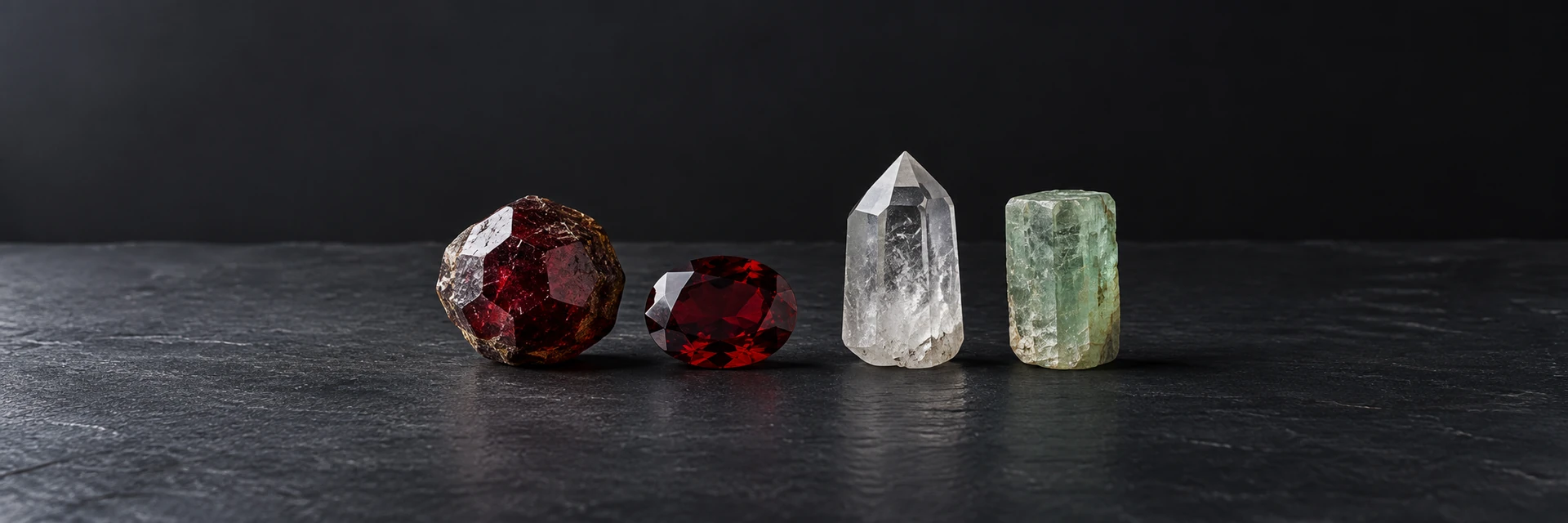
Form comes first because it decides which clues are left to see. A rough crystal still has its natural faces, so its shape can point toward a group: ball-like garnets, barrel-shaped six-sided corundum, flat-topped six-sided beryl, striated tourmaline prisms or the double points of quartz. A water-worn pebble has lost those faces and shows only color, luster and what light does at a thin edge.
Tumbled stones, cabochons and beads are named mostly by pattern and luster. Agate, jasper, tiger’s eye, rose quartz, aventurine, sodalite and howlite each have a recognizable look. A cabochon, the smooth domed cut, is where most optical effects show best. Faceted stones give the least, because the cut hides crystal form. In jewelry, judge the stone, not the metal, stamp or tag.
For a rough crystal still attached to its rock, the crystal identifier compares its faces and shape.
Optical effects the gemstone identifier looks for
Optical effects come next, because several are tied to one material. Rainbow patches that shift as you tilt the stone are play of color, found mainly in opal. A floating blue-white glow is adularescence, the sheen of moonstone. Broad blue, green or gold flashes across dark gray are labradorescence, seen in labradorite.
A single bright line across a domed stone is a cat’s-eye effect. Chrysoberyl, quartz and tourmaline can all show it, and a photo cannot separate them; golden-brown bands point toward tiger’s eye. A six-rayed star appears in star corundum and star garnet, another pair a photo cannot split. Tiny red-orange plates fit sunstone, green with small sparkles fits aventurine, and copper glitter in brown or blue is goldstone, a manufactured glass. Take two photos at slightly different tilts under one light to show any of these.
Inclusions, bubbles and doubled facet edges
Next come transparency and what sits inside. Natural stones often hold small crystals, feathery cracks or cloudy patches. Round gas bubbles and curved swirls point toward glass or a synthetic stone instead. A large, perfectly clean stone with intense color can be natural, but it is also how many synthetics and glass look, so the gemstone identifier keeps those open.
Look straight down through the top facet of a cut stone. If the back facet edges look doubled, the stone is doubly refracting, like zircon, moissanite, peridot or tourmaline; diamond and glass are not. Color comes last, because one color spans many gems. Red can be garnet, ruby, spinel or tourmaline, and blue can be sapphire, aquamarine, topaz or tanzanite.
Where the gemstone identifier meets glass and imitations
GIA notes that glass can be made in nearly any color and that plastic imitates amber, turquoise, jade and lapis in inexpensive jewelry. Plastic often feels warm and light for its size. The table pairs common clues with what they may point to.
What you see | What it may point to | Photo that helps next |
|---|---|---|
Colorless stone with strong rainbow fire | Diamond or a simulant such as cubic zirconia, moissanite or glass; a photo cannot separate them | Face-up and side views on white paper in daylight |
Back facet edges look doubled | A doubly refracting stone such as zircon, moissanite, peridot or tourmaline | Sharp view looking straight down through the top facet |
Round bubbles or curved swirls inside | Glass or a synthetic stone | Close view with daylight beside or behind the stone |
Bright color that collects in cracks | Dyed material | Sharp close-up of a crack or drill hole |
Perfectly even color with a seam along the edge | Molded glass or plastic | Side view showing the edge and any seam |
Why a rough “diamond” found outdoors is usually quartz
Clear, shiny pebbles from a driveway, creek or beach are nearly always quartz, calcite, glass or a lost cubic zirconia. Quartz crystals with a point at each end are sold as Herkimer diamonds, but they are quartz. A rough diamond typically grows as an octahedron, shaped like two pyramids set base to base, often with curved faces and a greasy look.
The Arkansas Geological Survey describes diamonds found at Crater of Diamonds State Park as small and usually rounded, clean and slick, with an oily metallic luster. Visitors there may keep what they find; the other diamond-bearing bodies nearby are private land. The survey warns against striking a suspected diamond with a hammer, because diamonds cleave and break. Keep any candidate whole and show it to a gemologist.
For clear six-sided points, try the quartz identifier.
What a gemstone identifier cannot tell you about a cut stone
A photo cannot prove the species of a faceted stone. Expect two candidates that fit the color and look, with the note “cut stone, treatment unknown.” Diamond, ruby, sapphire and emerald always stay unverified, and so does any claim that a stone is natural, synthetic, heated, dyed, filled or irradiated. The gemstone identifier never gives carat weight, clarity grade, origin or value.
GIA lists heating, dyeing, fracture filling, impregnation, irradiation and coating among common treatments, and notes that many are not apparent to the unpracticed eye. GIA also states that sellers are legally required to disclose treatments. A qualified gemologist with instruments gives the final answer on species and treatment. Check any lab report with the lab that issued it.
Common questions about gemstone photos
Can a photo tell a diamond from cubic zirconia or moissanite?
No. All three can be colorless with strong fire, and doubled facet edges in moissanite are hard to see in a phone photo. The gemstone identifier lists diamond or simulant together. A gemologist or jeweler with simple instruments can separate them.
Is my stone natural or lab-grown?
A photo cannot tell. Lab-grown stones share the chemistry of natural ones, and many look cleaner. Bubbles and curved swirls can hint at glass or some synthetics, but a clean stone proves nothing either way. Natural or synthetic origin needs laboratory testing.
Why did I get two possible matches for one faceted stone?
Cutting removes crystal form, and many gems share a color. Garnet and spinel, or sapphire and tanzanite, can look alike face-up. A side view or a close view of the inside sometimes narrows the pair.