
Shell identifier by photo
Compare a seashell by photo. Explore shape, opening, ribs and color pattern to narrow the shell family and lookalikes, then ask a follow-up.
- Seashells & beach finds
- Explains each match
- 3 free identifications per day
Upload shell photos
Drag your photos here, or choose a file to begin.
JPG, PNG, WebP or HEIC · Up to 3 photos · 40 MB each · You can also paste a photo
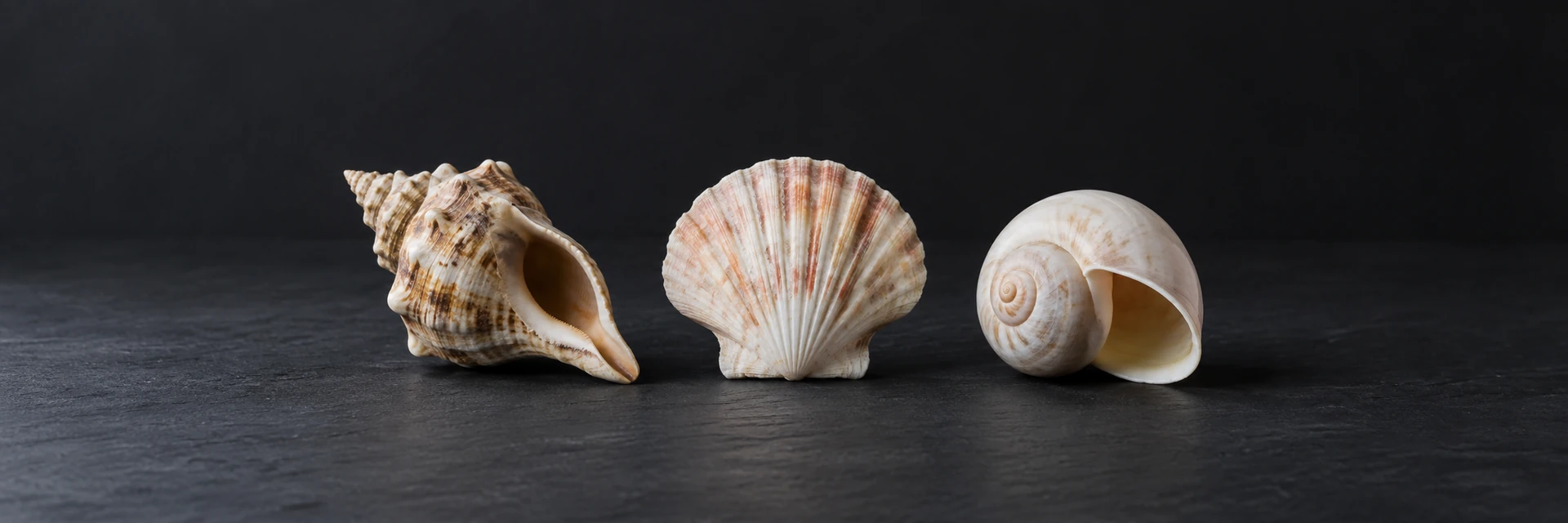
Common whelk shell · photo by H. Zell, CC BY-SA 3.0 · Cropped to one view; resized and converted to WebP.
- 01
Upload Photos of One Shell
Add one to three views of a shell: outside of the shell beside a ruler, inside or the opening and close view of the ribs or pattern. JPG, PNG and WebP files are supported, up to 40 MB each. A location and your own observations are optional.
- 02
Review Matches and Evidence
A result presents a suggested name alongside visible clues, limitations and possible alternatives. Read those explanations together. Compare the explanation with your own photographs and leave the name open when the visible evidence does not distinguish the candidates.
- 03
Ask a Follow-up Question
Use the available follow-up to ask about lookalikes, typical properties or care. The reply stays with that specimen. When you want to investigate another find, start a new identification with its own photos.
Photo-based identification can suggest possible matches, but it cannot definitively confirm a specimen’s actual composition.
Keep exploring
Identify Another Rock, Try a Sample, or View Your History
Choose an identification, a sample walkthrough, or your saved history.

Sample walkthrough
Try the common whelk shell photo and review its result.
Common whelk shell · photo by H. Zell, CC BY-SA 3.0 · Cropped to one view; resized and converted to WebP.
Photo guide
Get practical tips for showing shape, surface details and different angles.
Read the guidePhoto guide updated
How to use the shell identifier
The shell identifier compares photos of a seashell or beach find with shell families and the lookalikes that wash up beside them. Upload one to three photos of the same shell: the outside beside a ruler, the inside or the opening, and a close view of the ribs or pattern. Then say where it was found: an ocean beach, a lake or river, bought or gifted, or not sure.
The result lists possible matches and the visible clues behind each, names the lookalikes that still fit, says what the photos could not settle, and ends with a follow-up question you can answer or ask about. Add the coast, lake or river if you can, because region helps more than color. Each name is a possible match, not a confirmed identity.
One coiled shell or two halves
Start with the body plan. Snails, or gastropods, build one shell that grows in a spiral. Clams, scallops, oysters and mussels are bivalves; the National Park Service at Assateague Island describes them as encased by two shells attached by a hinge. A beach find is usually a single half, so look for the hinge: a thick edge near the pointed top, often with small teeth.
Next the shell identifier compares shape and the opening, then ribs and spines, and only then color, which fades in the sun and varies within one species. Photograph a snail shell tip up with the opening facing the camera, and a bivalve half from both sides.
Snail shells the shell identifier compares
A long, tapering spiral with many whorls fits an auger or turret shell. A heavy shell with a large opening and a flared lip fits a conch. A pear shape with a long canal fits a whelk; the Assateague park notes that knobbed and channeled whelks are often mistaken for conchs. With the tip up, an opening on the left fits a lightning whelk, which the Florida Museum says coils the opposite way from nearly all other snails and is most common from the Florida Keys to Texas.
A smooth, round shell with a wide, round opening fits a moon snail. A glossy cylinder with a narrow slit fits an olive, and a glossy oval with a toothed slit underneath fits a cowrie. A cone with a narrow opening fits a cone snail, and rows of spines and frills fit a murex. A simple cap is a limpet, and a flat ear shape with a row of holes and a pearly inside is an abalone.
Clam, scallop, cockle and oyster halves
For one half of a bivalve, the outline and the ribs carry most of the answer. A fan with radiating ribs and two small ears at the hinge fits a scallop. A heart shape seen from the side, with strong ribs, fits a cockle. Thick, rough and layered fits an oyster, and long, blue-black outside and pearly inside fits a mussel. A heavy, smooth clam with a purple stain inside fits a quahog, a small, colorful wedge fits a coquina, and a thin, golden, see-through shell fits a jingle shell.
A neat, round, beveled hole near the hinge fits a clam drilled by a moon snail, which bores through the shell to feed. Photograph the inside too: muscle scars, a purple stain or a pearly layer all help. A worn fragment can often still be named to its group by its ribs, such as “shell fragment (scallop family).”
Sand dollars, urchins and other shell identifier lookalikes
Some common beach finds are not mollusks. Sand dollars and sea urchins are echinoderms, relatives of sea stars, and Florida’s wildlife agency groups sand dollars with starfish as echinoderms. Their skeletons, called tests, are fused plates rather than a coil or two halves. A live sand dollar is covered in short, moving spines like fuzz, so leave it in the water.
What you see | What it may point to | Photo that helps next |
|---|---|---|
Flat, round disc with a five-petal pattern | Sand dollar skeleton, an urchin relative | Top and underside beside a ruler |
Round globe with rows of knobs or tiny holes | Sea urchin test | Side view and the underside |
Small curved tube, open at both ends | Tusk shell, a mollusk that is neither snail nor clam | Both ends in a close view |
Cone of overlapping plates | Barnacle, a crustacean | Top view of the plates |
Chalky, porous piece covered in tiny cups | Coral piece | Close view of the cups beside a coin |
Frosted pebble of colored glass | Sea glass | Light through the piece in daylight |
Fossil shell or beach-worn shell
Fossil shells are stone-like and often heavier than they look, gray, tan or white, sometimes filled with mineral or set in rock. Beach-worn modern shells are chalky, faded and rounded at the edges, yet still light. In many photos the two look alike, so the shell identifier may say “fossil or beach-worn shell.” How heavy it feels and where you found it help: a bluff of shell-rich rock points toward fossils.
Painted, dyed, polished and plastic shells come from gift shops and craft bags; bright, even color sitting on the surface points toward a worked shell. For species, age or value, a natural history museum or shell club can look at a puzzling shell in person.
For a shell set in rock or a shell print, use the fossil identifier.
Occupied shells and collecting rules
Before you keep a shell, check whether it is occupied. A soft body, a hermit crab, or a trapdoor called an operculum in the opening means something lives inside, and two halves still clamped tight usually hold a live clam. When a photo shows these signs, the shell identifier says the shell looks occupied.
Rules differ by place. At Padre Island National Seashore in Texas, the National Park Service allows a one-gallon container of shells, asks that any shell with a living animal be put back, and prohibits commercial collecting. In Florida, the Fish and Wildlife Conservation Commission requires a recreational saltwater fishing license to take a shell with a living animal inside, even from shore, and prohibits possessing a live queen conch at any time. In Lee County, which includes Sanibel Island, live shells may not be taken except oysters, hard clams, sunray venus clams and coquinas. Check the rules wherever you collect.
Keep a useful shell comparison record
Keep the outside and opening photographs together so a later comparison does not treat them as different shells. Note the measured length, whether the tip or lip is broken, and which ribs or color marks remain visible. If a photograph reverses the image, record that before comparing the side of the opening. A missing tip, sand in the opening or a worn hinge should stay a missing observation rather than become a guessed feature.
For a follow-up, choose one unresolved detail: the hinge of a bivalve, the canal below a snail opening, or a closer view of a repeated surface pattern. Keep location broad, such as a coast or river, without sharing a private address. Save the original tentative group and the new observation together. If the evidence still supports several shell families, preserve those alternatives instead of selecting the most colorful online photograph.
Common questions about the shell identifier
Can the shell identifier name the exact species?
Sometimes. A species name appears when shape and color pattern match a well-known shell from your region; otherwise the result stops at the family, such as “scallop (Pectinidae).”
Is my seashell worth anything?
Ordinary beach shells have little money value. Rare species and perfect specimens interest collectors, but a photo cannot settle condition, legal origin or price.
Is a sand dollar a shell?
Not in the mollusk sense. A sand dollar is the skeleton of an urchin relative, and the white discs on beaches are dead ones bleached by the sun.