
Tooth identifier by photo
Compare a tooth by photo. Explore crown shape, roots and enamel to narrow the animal group, fossil or modern clues and lookalikes, then ask a follow-up.
- Animal, human & fossil teeth
- Explains each match
- 3 free identifications per day
Upload tooth photos
Drag your photos here, or choose a file to begin.
JPG, PNG, WebP or HEIC · Up to 3 photos · 40 MB each · You can also paste a photo
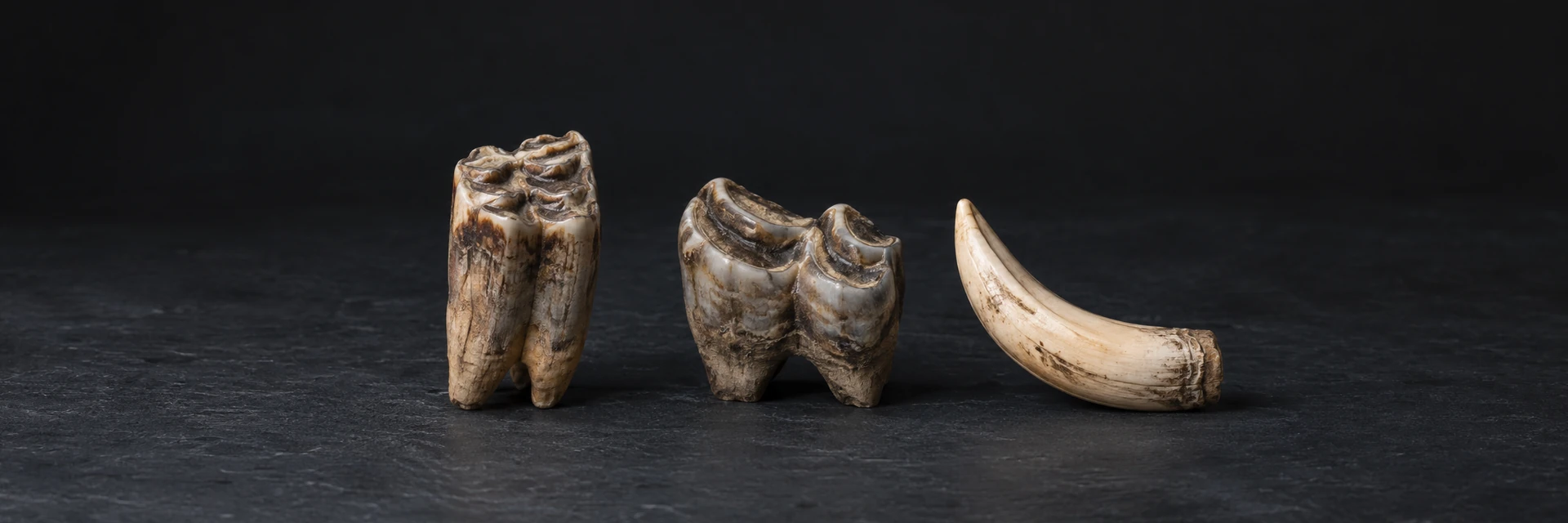
Horse molar · photo by Stephen Auker, CC BY 2.0 · Cropped to one view; resized and converted to WebP.
- 01
Upload Photos of One Tooth
Add one to three views of a tooth: whole tooth beside a ruler, chewing surface straight on and side view showing the root. JPG, PNG and WebP files are supported, up to 40 MB each. A location and your own observations are optional.
- 02
Review Matches and Evidence
A result presents a suggested name alongside visible clues, limitations and possible alternatives. Read those explanations together. Compare the explanation with your own photographs and leave the name open when the visible evidence does not distinguish the candidates.
- 03
Ask a Follow-up Question
Use the available follow-up to ask about lookalikes, typical properties or care. The reply stays with that specimen. When you want to investigate another find, start a new identification with its own photos.
Photo-based identification can suggest possible matches, but it cannot definitively confirm a specimen’s actual composition.
Keep exploring
Identify Another Rock, Try a Sample, or View Your History
Choose an identification, a sample walkthrough, or your saved history.

Sample walkthrough
Try the horse molar photo and review its result.
Horse molar · photo by Stephen Auker, CC BY 2.0 · Cropped to one view; resized and converted to WebP.
Photo guide
Get practical tips for showing shape, surface details and different angles.
Read the guidePhoto guide updated
How to use the tooth identifier
The tooth identifier compares photos of a tooth with the animal, human and fossil teeth people most often find, and with the pebbles, shells and bone that only look like teeth. Upload one to three photos of the same tooth: the whole tooth beside a ruler, the chewing surface seen straight on, and a side view that shows the root. Then choose where it came from: a river, creek or beach, a field or yard, a person or a pet, or not sure.
The result lists possible matches, the visible clues behind each one, the lookalikes that still fit, and what the photos could not settle. It ends with a follow-up question you can answer or ask about, most often where the tooth was found. Photograph it dry, in daylight, with the ruler level with the tooth.
Tooth or lookalike: enamel, crown and root
The crown of a tooth is covered in glossy enamel, and the root below it is duller, often with a small canal opening at its tip. A tooth may have one root or several, and the number helps later. Without that glossy crown, the lookalikes come first.
A pebble or a flint chip has no enamel and one even texture all through. A shell fragment is layered, curved and pearly on one side. Bone shows a porous lattice of tiny cells where it is broken. Made items come up too: a pink acrylic base holding a row of even teeth is a denture, and mold seams with an even color point to a replica.
Is it a human tooth? Baby teeth and teeth found outdoors
Human teeth come in four shapes. Incisors are flat with a chisel edge, canines have a single point, premolars have two cusps, and molars have four or five low, rounded cusps on two or three roots. A small tooth with almost no root is usually a baby tooth, because its root dissolved before it fell out. A tooth that came from you, your child or your pet gets no reporting warning.
A tooth found outdoors with bones is different. If it looks human, the result leads with possible human tooth. Leave it and any bones in place, note the spot and call your local police or the county medical examiner or coroner. Washington State’s Department of Archaeology and Historic Preservation says state law requires anyone who finds human remains, or suspected human remains, to notify the medical examiner or coroner and local law enforcement.
Crown shape and diet: what the tooth identifier reads next
The crown shows what the animal ate. Low, rounded cusps belong to omnivores such as pigs, bears, raccoons and people. Blade-like cheek teeth and long canines belong to carnivores such as dogs, foxes and the cat family. Tall crowns with a flat grinding surface of folded enamel belong to grazers that chew tough grass.
Rodent incisors are their own type: long, curved chisels with orange enamel on the front face. A large one fits a beaver. Heavy wear can flatten any crown.
Horse, deer, bison, mammoth and mastodon teeth
A tall, square column with a flat top of complex, folded enamel loops fits a horse tooth. Crescent-shaped enamel loops fit a ruminant: a deer, cow, bison, sheep or goat. A photo often cannot separate those animals, so the tooth identifier may name a ruminant cheek tooth and stop there.
Two Ice Age elephant relatives are easier to separate. A large block of many thin, parallel enamel plates is a mammoth molar. Rows of big, rounded cones fit a mastodon. The Illinois State Museum links this to diet: mammoths grazed grass on molars whose plates join into a grinding surface, while mastodons browsed twigs and brush with high-ridged molars.
Alligator, fish, ray and shark teeth
A cone that is round in cross-section, with a hollow base and often fine ridges, fits an alligator or crocodile tooth. A cone with two cutting ridges and flat facets fits a mosasaur, an extinct marine reptile. Rounded, button-like domes are crushing teeth from fish such as drum or sheepshead, and flat, six-sided plates fitted together are ray tooth plates. A slender fang with a hollow base fits a fish tooth.
A flattened triangular blade with an enamel crown on a two-lobed or flat root is a shark tooth. The result gives only a broad group here, such as requiem shark.
For crown, edge and root detail, use the shark tooth identifier.
Tooth identifier clues and the next photo
Start with the chewing surface, then check the root.
What you see | What it may point to | Photo that helps next |
|---|---|---|
Tall square column, flat top with folded enamel loops | Horse tooth | Chewing surface straight on, beside a ruler |
Crescent-shaped enamel loops | Deer, cow, bison, sheep or goat tooth | Side view showing the roots |
A block of many thin, parallel plates | Mammoth molar or plate fragment | Side view with the plates edge-on |
Rows of big, rounded cones | Mastodon tooth | Side view beside a ruler |
Cone, round in section, hollow base | Alligator or crocodile tooth | The base seen end-on |
Flat six-sided plates fitted together | Ray tooth plate | Close-up of the plates beside a coin |
Keep crown and root observations together
Photograph one tooth at a time and keep its chewing-surface image beside the whole-tooth view. A close crop should show which side faces the camera; otherwise a broken edge can be mistaken for the outline of a complete crown. Record the measured length separately from the image and say whether any root is missing. Do not assemble loose fragments or clean away attached material just to obtain a clearer online comparison.
When asking a follow-up, identify the feature that remains uncertain: the number of visible roots, the arrangement of enamel folds, or whether the surface is enamel at all. Compare the answer with the same photograph rather than introducing a different tooth without explanation. Keep the first candidate, the alternative group and the missing view in your notes. A broad animal group with a useful next photograph is a better record than an unsupported species label.
Fossil or modern, ivory and other tooth identifier questions
Fossil teeth are often black, gray, brown or tan and stone-like, while modern teeth are white to cream with a chalky root. A stained river or beach tooth can be either, and the tooth identifier then calls it a tooth, fossil or modern. Species, age and authenticity need a natural history museum or a university paleontology department, not a photo.
A cross-hatched pattern on a cut section marks elephant or mammoth ivory rather than bone. The US Fish and Wildlife Service says a near-total ban on commercial trade in African elephant ivory took effect in 2016, though personal possession is not restricted, and that the Marine Mammal Protection Act prohibits selling whale, walrus and other marine mammal parts, with narrow exceptions. State laws can go further, and the result never suggests selling a tooth from a protected species.
Is this my child’s baby tooth?
Probably, if it is small and has almost no root, since a baby tooth’s root dissolves before it falls out. The tooth identifier can also name the tooth type, such as an incisor or a molar, from the chewing surface and a side view.
Can I keep fossil teeth from a Florida river?
Shark and ray teeth need no permit, according to the Florida Museum of Natural History, but other vertebrate fossils from state-owned or leased land, such as horse or mammoth teeth, need a Florida Fossil Permit. Private land needs the owner’s permission.
Is it a deer tooth or a cow tooth?
Often a photo cannot say. Both show crescent-shaped enamel loops and their sizes overlap, so a ruler, the number of roots and where it was found matter most.
Further reading
- Illinois State Museum: Mammoth versus mastodon
- Florida Museum: Florida Fossil Permit questions and answers
- U.S. Fish and Wildlife Service: Can I sell it? A guide to wildlife and plant protection laws
- Washington State Department of Archaeology and Historic Preservation: What do I do if I’ve found human remains?