
Geode identifier by photo
Compare a geode’s rind, lining and crystals by photo, or check what a closed nodule may be. Explore geode lookalikes, then ask a follow-up.
- Geodes, nodules & concretions
- Explains each match
- 3 free identifications per day
Upload geode photos
Drag your photos here, or choose a file to begin.
JPG, PNG, WebP or HEIC · Up to 3 photos · 40 MB each · You can also paste a photo
Opened amethyst geode · photo by James St. John, CC BY 2.0 · Resized and converted to WebP.
- 01
Upload Photos of One Geode
Add one to three views of a geode: open face or whole outside beside a coin, opposite side and close view of the crystals or the rind. JPG, PNG and WebP files are supported, up to 40 MB each. A location and your own observations are optional.
- 02
Review Matches and Evidence
A result presents a suggested name alongside visible clues, limitations and possible alternatives. Read those explanations together. Compare the explanation with your own photographs and leave the name open when the visible evidence does not distinguish the candidates.
- 03
Ask a Follow-up Question
Use the available follow-up to ask about lookalikes, typical properties or care. The reply stays with that specimen. When you want to investigate another find, start a new identification with its own photos.
Photo-based identification can suggest possible matches, but it cannot definitively confirm a specimen’s actual composition.
Keep exploring
Identify Another Rock, Try a Sample, or View Your History
Choose an identification, a sample walkthrough, or your saved history.

Sample walkthrough
Try the opened amethyst geode photo and review its result.
Opened amethyst geode · photo by James St. John, CC BY 2.0 · Resized and converted to WebP.
Photo guide
Get practical tips for showing shape, surface details and different angles.
Read the guidePhoto guide updated
How to use the geode identifier
The geode identifier compares a rounded rock, an open geode or a crystal-lined hollow with geodes and the nodules that look like them. Upload one to three photos of the same piece: the open face or the whole outside beside a coin, the opposite side, and a close view of the crystals or the rind. Then say whether it is already open or cut, a closed round nodule, a cavity inside a larger rock, or not sure.
The result lists possible matches and the visible clues behind each, names lookalikes that still fit, says what the photos could not settle, and ends with a follow-up question you can answer or ask about. Each name is a possible match, not a confirmed identity.
Open or closed: the first question the geode identifier asks
A geode is a rounded rock with a hollow center lined with crystals, although the Kentucky Geological Survey notes that “geode” is often used for any quartz nodule, hollow or not. So the geode identifier first asks whether the piece is open. For an open piece it looks at whether it is hollow or solid, then the rind, the lining and the crystals; for a closed piece, only the shape and outer texture. Color and signs of dye or coating come last.
A crystal-lined hole inside a bigger rock, rather than a separate nodule, is a vug.
Naming an open geode by its crystals
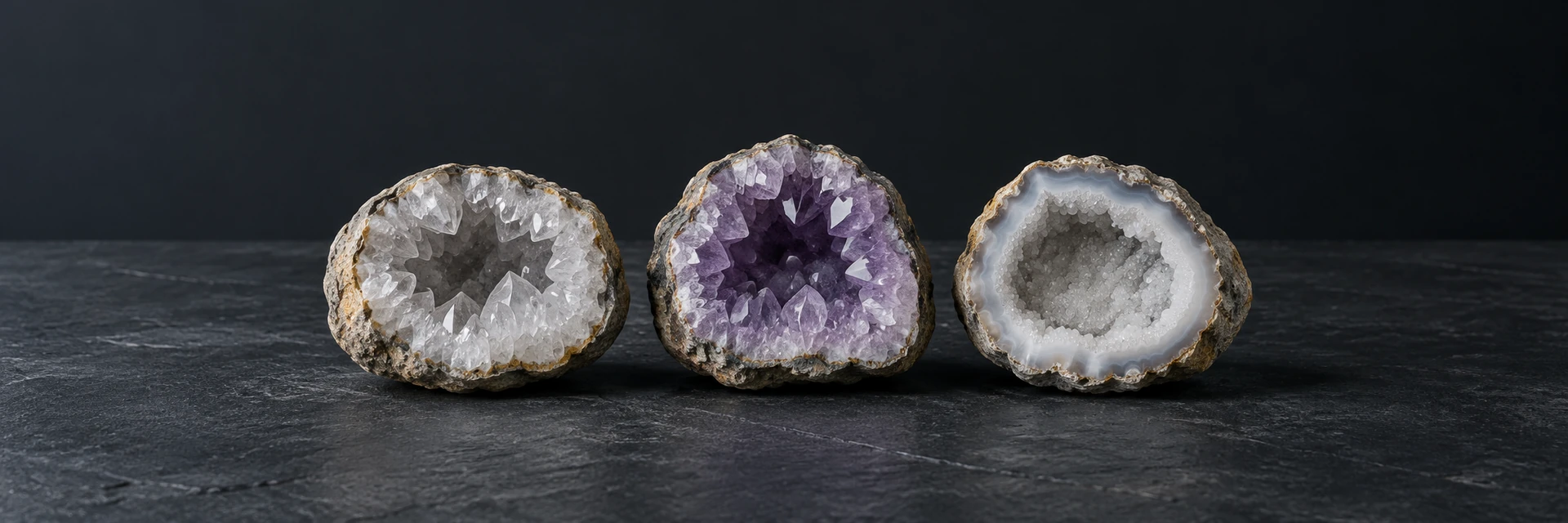
An open geode takes its name from the crystals inside. Clear to white, pointed, six-sided crystals fit a quartz geode, and purple points fit an amethyst geode. Rhombs, dog-tooth points or golden blades fit a calcite geode. Pale blue blades fit celestine. Brassy cubes fit pyrite, a carpet of tiny sparkling crystals fits druzy quartz, and brown needles or black tufts fit goethite.
The Iowa Geological Survey says quartz is dominant in most Keokuk geodes, calcite is common, and 17 more minerals have been found in them. For the close-up, light the crystals from one side, tilt the piece until the faces catch the light, and keep a coin in the frame for size.
The rind and the chalcedony lining
Most geodes have a bumpy or cauliflower-like outside, tan to gray. The Kentucky Geological Survey explains that the bumpy surface of the Kentucky geodes it describes is a chalcedony rind, chalcedony being quartz in crystals too small to see. On an open face, a thin translucent band between the rind and the crystals is the chalcedony lining.
Not every geode is hollow. The Iowa Geological Survey notes that many geodes are solid, with crystal growth filling most or all of the inside. Concentric bands filling the center instead of crystals fit an agate nodule.
Closed nodules: what the outside can and cannot show
A round to oval stone with a bumpy rind may be an unopened geode, and the result calls it a possible geode whose inside stays unknown. The geode identifier never suggests opening, cracking or cutting a nodule to find out.
Weight gives a hint, not an answer. A hollow geode often feels light for its size, while a solid nodule or a concretion feels heavy. Compare it in your hand with an ordinary rock of similar size, and photograph the whole outside from two sides beside a coin.
Geode identifier lookalikes: thundereggs, septarian nodules and concretions
A thunderegg forms in volcanic rock; the USGS describes Oregon’s thundereggs as forming in soft volcanic ash beds, not thrown out of volcanoes. A concretion is a hard mass that grew within sediment, and a septarian nodule is a concretion split by cracks that later filled with minerals. From the outside alone, a closed geode and a concretion can look the same, so weight and where it was found help.
For a dark rock full of holes, compare it with the basalt identifier.
What you see | What it may point to | Photo that helps next |
|---|---|---|
Star-shaped agate or opal core in a brown or red shell | Thunderegg | An already cut face beside a coin |
Nodule split by cracks filled with yellow-brown or white calcite | Septarian nodule | The filled cracks up close |
Solid, layered rusty or gray inside with no crystals | Concretion or ironstone nodule | The layers in daylight, then the outside |
Crystal-lined hole in a larger rock | A vug in limestone or another host rock | The whole rock, so the host shows |
Many small or mineral-filled holes in dark rock | Vesicular or amygdaloidal basalt | A wider view of the rock with a coin |
Solid, waxy gray to black inside | Chert or flint nodule | An existing broken face at a low angle |
Dyed, coated and made geodes, and place names
Unusually even color or color concentrated in cracks can raise questions about dye, but color alone cannot establish a treatment. Natural amethyst may be strongly purple. GIA documents dyeing of chalcedony and quartz, so a vivid display piece deserves comparison rather than an automatic treatment label. A metallic surface may suggest a coating, while visible paint, glitter, plaster or resin can suggest decoration or manufacture. A photograph cannot confirm the treatment process.
Place names are claims unless your own find supports them. The Iowa Geological Survey places Keokuk geodes within about 35 miles of Keokuk, Iowa, especially in Lee, Henry and Van Buren counties. Labels such as Las Choyas “coconut” geodes, Brazilian amethyst or Moroccan geodes describe what a seller says. The survey adds that most Iowa collecting sites are on private land, permission must be secured first, and geode collecting is not permitted in state parks.
For a local find, a state geological survey or natural history museum can say what occurs nearby; for a dyed or coated piece sold as natural, ask a gemologist.
For a single point or cluster, try the crystal identifier.
Keep the outside and interior views connected
For an already open piece, take one view that shows the entire cut or broken face and a second that follows the boundary between the rind and the crystals. Keep the scale in the same plane as the face. A close crop of purple points can support a crystal comparison, but it loses the context needed to decide whether they line a separate nodule, a cavity in a larger rock or a mounted decorative object.
For a closed nodule, keep both outside views together and record which parts are weathered, coated or attached to another material. A rounded outline is an observation, not evidence of a hidden cavity. If the specimen came from a shop, retain its label as an unverified description. A useful follow-up asks which visible feature separates the remaining candidates, while leaving the unseen interior, source locality and treatment history unresolved.
Common questions about the geode identifier
How can I tell if a geode is hollow without opening it?
You cannot be sure from the outside. A hollow geode often feels light for its size, and a bumpy, cauliflower-like rind fits a geode better than a smooth, rusty shell. The geode identifier treats a closed nodule as a possible geode and says what the outside photos can and cannot show.
Are bright blue or pink geodes natural?
Usually not. Natural geode crystals run from clear and white to gray, purple, honey, brown and the pale blue of celestine. Vivid pink, bright blue, teal or green crystals fit dye, and a metallic rainbow fits a coating. A photo can only raise the question; a gemologist can confirm a treatment.
What is the difference between a geode and a thunderegg?
A geode is a rounded rock with a crystal-lined hollow. A thunderegg forms in volcanic rock and usually has a solid, star-shaped core of agate or opal inside a brown or red shell, although some have a hollow center. A photo of an already cut face usually shows which one you have.