
Silver hallmark identifier by photo
Read silver hallmarks by photo. Compare British, American and continental marks, fineness numbers and silver-plate marks, then ask a follow-up.
- Silver hallmarks & maker’s marks
- Explains each match
- 3 free identifications per day
Upload marked silver item photos
Drag your photos here, or choose a file to begin.
JPG, PNG, WebP or HEIC · Up to 3 photos · 40 MB each · You can also paste a photo
Silver fineness mark (Ag 925) · photo by Chatsam, CC BY-SA 3.0 · Cropped to the marked pendant; resized and converted to WebP.
- 01
Upload Photos of One Marked Silver Item
Add one to three views of a marked silver item: whole item in daylight, close-up of the full row of marks and sharp close-up of each mark. JPG, PNG and WebP files are supported, up to 40 MB each. A location and your own observations are optional.
- 02
Review Matches and Evidence
A result presents a suggested name alongside visible clues, limitations and possible alternatives. Read those explanations together. Compare the explanation with your own photographs and leave the name open when the visible evidence does not distinguish the candidates.
- 03
Ask a Follow-up Question
Use the available follow-up to ask about lookalikes, typical properties or care. The reply stays with that specimen. When you want to investigate another find, start a new identification with its own photos.
Photo-based identification can suggest possible matches, but it cannot definitively confirm a specimen’s actual composition.
Keep exploring
Identify Another Rock, Try a Sample, or View Your History
Choose an identification, a sample walkthrough, or your saved history.

Sample walkthrough
Try the silver fineness mark (ag 925) photo and review its result.
Silver fineness mark (Ag 925) · photo by Chatsam, CC BY-SA 3.0 · Cropped to the marked pendant; resized and converted to WebP.
Photo guide
Get practical tips for showing shape, surface details and different angles.
Read the guidePhoto guide updated
How to use the silver hallmark identifier
The silver hallmark identifier reads the small marks on silver and silver-colored pieces and explains which marking system they belong to. Upload one to three photos of the same item: the whole item in daylight, a close-up of the full row of marks, and a sharp close-up of each mark. Then choose where it may be from: British or Irish, American, European or other, or not sure.
The result quotes each mark, gives possible readings with the visible clues behind them, and names lookalikes such as imitation hallmarks on silver plate. It says what the photos could not settle, often the year or maker, and ends with a follow-up question you can answer or ask about. Where the piece came from is the most useful note you can add.
Shoot each mark straight on in daylight without glare, using macro mode and tilting the piece slightly so the punch edges show. Keep the whole item in view in another photograph; findings, clasps and repaired parts can carry different marks from the main body.
How a British hallmark is built
A British hallmark combines separate information about the submitter, the metal standard and the testing office. The Goldsmiths’ Company describes three compulsory components in the modern UK system: sponsor’s mark, millesimal fineness mark and assay office mark. A traditional fineness symbol and date letter are optional. A sponsor identifies who submitted the item and need not be the person who made it.
On sterling, the traditional fineness mark is the lion passant, a lion walking to the left, used since 1544 according to the Goldsmiths’ Company. A seated Britannia figure marks Britannia silver, 95.8 percent pure, required from 1697 and an alternative to sterling since 1720. The Birmingham Assay Office notes that a lion rampant has marked Edinburgh sterling since 1975; older Edinburgh silver often shows a thistle.
Assay Office Ireland explains that the Dublin office opened in 1637 and used a crowned harp for sterling, added date letters in 1638, and introduced the seated Hibernia figure in 1730 to show that duty had been paid. Hibernia is now the Dublin office’s own mark.
Assay office marks and duty marks
The assay office mark shows where the piece was tested. The Goldsmiths’ Company gives a leopard’s head for London, an anchor for Birmingham, a rose for Sheffield and a castle for Edinburgh. Older Sheffield silver carries a crown instead of the rose. Antique silver can also carry marks of closed offices such as Chester and Glasgow, and the silver hallmark identifier compares those too.
The duty mark is a monarch’s head in profile. The Goldsmiths’ Company explains that it showed a duty on silver and gold had been paid, from 1784 until the duty was withdrawn in 1890.
Date letters and why the silver hallmark identifier needs every part
The date letter, a single letter in a shaped shield, is the mark people most want to read and the easiest to misread. The Goldsmiths’ Company explains that today the letter changes every year on 1 January, and that each new alphabet brings a new font, case and shield shape. The same letter therefore appears in many cycles, and for most of their history the offices each ran their own cycle.
So the silver hallmark identifier gives a year only as “about”, and only when the letter, its font, the shield shape and the assay office mark are all legible. If any part is worn, cut off or blurred, the result says the date needs a reference table. The Birmingham Assay Office notes that the date letter was compulsory until 1999 and that a specialist chart is usually needed to read it.
American sterling and maker’s marks
American silver rarely carries a full hallmark set. Look instead for a word or number: “Sterling” or “925” on most pieces from the late 1800s on, and “Coin” on older ones, usually beside a maker’s name. Sterling means 925 parts silver per thousand.
Makers such as Gorham, Tiffany & Co., Reed & Barton, Towle and Wallace used their own marks; Gorham’s, for example, combines a lion, an anchor and the letter G. The silver hallmark identifier names a maker only when the mark is legible and never confirms that a piece is authentic, because well-known marks are copied.
Continental and other silver marks
Continental European silver usually pairs a fineness number with a national symbol. Silver made in Germany from the late 1800s often shows a crescent moon and a crown beside a number such as 800. French silver carries a woman’s head in profile, Minerva, and Dutch silver a small lion. Russian silver often shows “84”, meaning 84 zolotniks or about 87.5 percent silver, next to a profile head.
Mexican and Chinese silver objects may carry national, maker or export marks alongside fineness numbers. Marking systems changed over time; a number such as 925 or 90 alone cannot establish a country or a date. The result should name a possible system only when the accompanying symbols are legible and consistent.
A photo cannot confirm silver content, age, maker or value, and marks can be faked. A silver dealer, auction house or assay office can examine the piece; the Birmingham Assay Office checks silver with X-ray fluorescence (XRF). Do not scratch, file, use acid or polish hard on the marks.
Silver hallmark identifier: real hallmarks and imitations
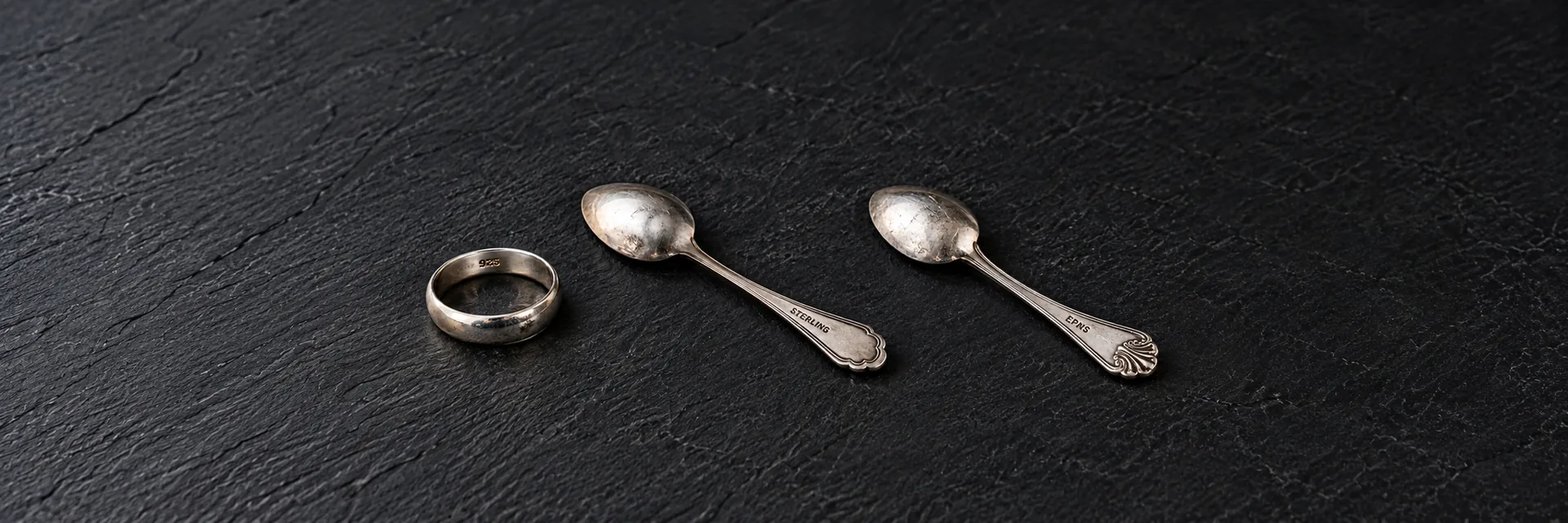
Plated ware can carry small marks in shields that resemble hallmarks. Explicit terms such as EPNS, EPBM or Silver Plate indicate plating, according to the Birmingham Assay Office. Missing a lion alone does not establish plate: traditional fineness symbols are optional in modern UK hallmarks, and other countries use different systems. Read the entire group before interpreting it.
What you see | What it may point to | Photo that helps next |
|---|---|---|
Lion passant, leopard’s head, date letter and maker’s initials | British sterling hallmark from London | Close-up of the date letter and its shield |
Lion passant with an anchor | British sterling hallmark from Birmingham | The full row, straight on, without glare |
Crowned harp with a seated Hibernia figure | Irish sterling from Dublin | Each mark on its own, in focus |
Crescent and crown with 800 | Silver made in Germany, 800 standard | Any maker’s mark nearby |
Explicit EPNS, EPBM or Silver Plate alongside small shields | Mark indicating plated ware; confirm the letters are legible | The entire group and a naturally worn area, without polishing |
Sterling or 925 with a maker’s name | Sterling fineness claim; country and authenticity remain open | The complete mark and nearby symbols or pattern name |
Keep a mark-by-mark record for follow-up
Number the punches from left to right in your note and distinguish a readable character from a possible reading. For example, record an uncertain letter as an open question rather than silently changing it to the initial of a familiar maker. Keep the full row beside every close-up so a tiny shield is interpreted in its original order. A rotated letter, glare across a number or a worn border can change the comparison.
On a multi-part item, state whether the mark is on the main body, lid, clasp or detachable fitting. Save any family story or seller description as unverified context. A useful follow-up asks which visible feature would separate two readings, while leaving silver content and authenticity for examination. Avoid polishing or enlarging a punch just to make the photograph clearer.
Questions about silver hallmarks
How can I tell if my silver hallmarks are fake?
A photo cannot settle it. Marks can be faked, added later or cut from another piece. The silver hallmark identifier checks whether the set is consistent, and a silver dealer, auction house or assay office can examine the item in hand.
What does a king’s or queen’s head mean on British silver?
Usually it is the duty mark, used from 1784 to 1890 to show that tax had been paid. It places the piece in that span but does not give a year.
Does a 925 mark mean the piece is British?
No. 925 is used worldwide, and the Birmingham Assay Office notes that many pieces stamped 925 lack a full UK hallmark. A full British hallmark adds a sponsor’s mark and an assay office mark.
Further reading
- The Goldsmiths’ Company (London Assay Office): A field guide to hallmarking
- The Goldsmiths’ Company: The history of hallmarking, lion passant, Britannia and the duty mark
- Birmingham Assay Office: Silver assay and hallmarking, date letters and plated-ware marks
- Assay Office Ireland: History of the Dublin Assay Office, the crowned harp and Hibernia