
Coral identifier by photo
Compare a coral piece by photo. Explore growth form, the pattern of tiny cups and fossil or dyed clues, then ask a follow-up.
- Coral, fossil coral & imitations
- Explains each match
- 3 free identifications per day
Upload coral piece photos
Drag your photos here, or choose a file to begin.
JPG, PNG, WebP or HEIC · Up to 3 photos · 40 MB each · You can also paste a photo
Fossil honeycomb coral · photo by John Alan Elson, CC BY-SA 4.0 · Cropped to one view; resized and converted to WebP.
- 01
Upload Photos of One Coral Piece
Add one to three views of a coral piece: whole piece beside a ruler, focused view of surface cups or pores and already exposed end or underside. JPG, PNG and WebP files are supported, up to 40 MB each. A location and your own observations are optional.
- 02
Review Matches and Evidence
A result presents a suggested name alongside visible clues, limitations and possible alternatives. Read those explanations together. Compare the explanation with your own photographs and leave the name open when the visible evidence does not distinguish the candidates.
- 03
Ask a Follow-up Question
Use the available follow-up to ask about lookalikes, typical properties or care. The reply stays with that specimen. When you want to investigate another find, start a new identification with its own photos.
Photo-based identification can suggest possible matches, but it cannot definitively confirm a specimen’s actual composition.
Keep exploring
Identify Another Rock, Try a Sample, or View Your History
Choose an identification, a sample walkthrough, or your saved history.

Sample walkthrough
Try the fossil honeycomb coral photo and review its result.
Fossil honeycomb coral · photo by John Alan Elson, CC BY-SA 4.0 · Cropped to one view; resized and converted to WebP.
Photo guide
Get practical tips for showing shape, surface details and different angles.
Read the guidePhoto guide updated
How to use the coral identifier
Use this free coral identifier to compare a beach fragment, fossil coral or bead with coral groups and their lookalikes. Upload one to three photos of the same piece: an overview with a ruler, a focused surface detail, and an already exposed end or underside. Select whether it is a beach piece, fossil or stone, jewelry or an uncertain object. Do not break or collect a piece to obtain a photograph.
The result lists possible matches and the visible clues behind each, names the lookalikes that still fit, says what the photos could not settle, and ends with a follow-up question you can answer or ask about. Where the piece was found or bought is the most useful note to add. Each name is a possible match, not a confirmed identity or legal status.
Small cups with radiating walls
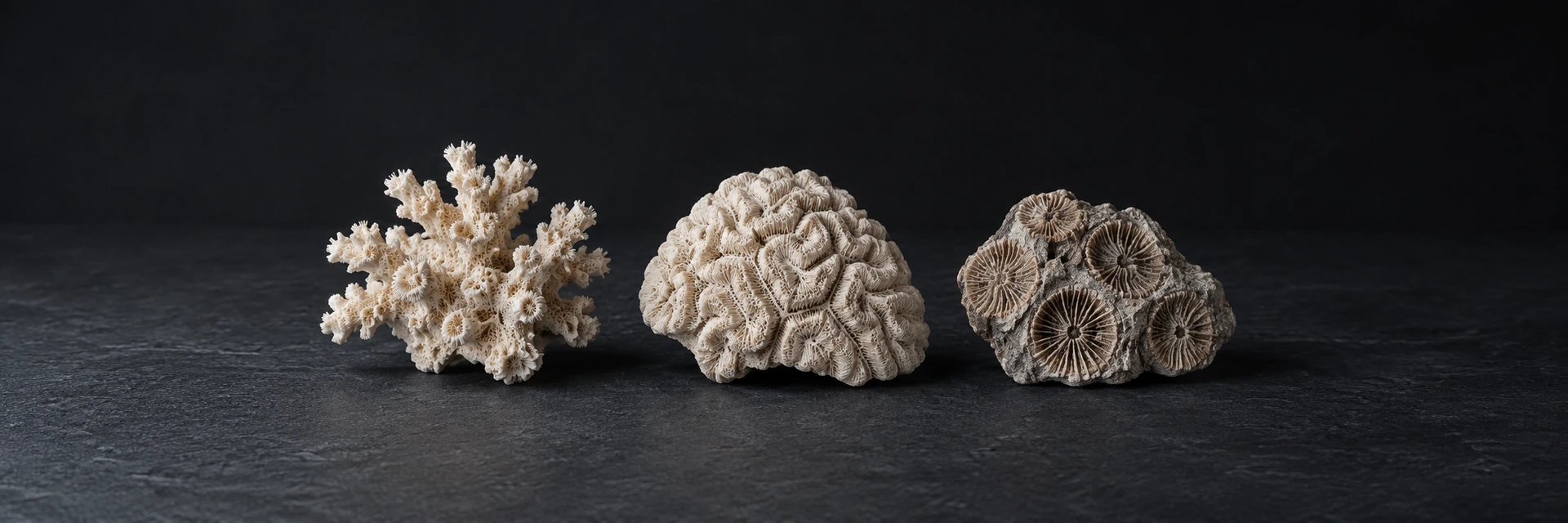
Many stony coral skeletons preserve repeated cups called corallites. In some groups, thin internal partitions radiate toward the middle; other corals, including honeycomb-like tabulate fossils, may show weak or absent partitions. The useful observation is the arrangement of the cups or tubes, their walls and any internal detail that the photograph actually resolves. Missing spokes do not automatically rule coral out.
Photograph a representative surface straight on with a millimeter scale. Then use a second angle to show whether apparent circles are shallow pits, tubes or reflections. Worn surfaces can lose internal structure. A fine net of pores, fibrous texture or irregular gas holes deserves comparison with bryozoans, sponges and pumice, without treating one blurry feature as a final diagnosis.
Beach coral shapes the coral identifier compares
Beach fragments may preserve branching, domed, grooved or plate-like forms. Branching growth can support a broad coral comparison, but several unrelated groups share it. Winding ridges may suggest a brain-coral growth form, while star-like cups or radiating blades invite other comparisons. The photograph should show both the overall form and its repeated structures before the tool proposes a narrower group. Color and branching alone are insufficient.
A photo usually supports the growth form and sometimes the genus, but rarely the species. One species can grow in different shapes in calm and rough water, and wave wear removes fine detail. So the coral identifier names the form, such as “brain coral (skeleton),” and leaves the species open.
Fossil coral: Petoskey stones, horn coral and agatized coral
Fossil coral may preserve tubes, cups or an individual horn-like form within rock. Polygonal honeycomb tubes can support a Favosites comparison, and linked chains of tubes may suggest chain coral. An isolated horn-like shape needs an existing end view before a rugose-coral interpretation. Mineral replacement, weathering and polish can obscure the structures, so modern skeleton versus fossil can remain unresolved.
A polished pebble with repeated hexagonal outlines and internal radial detail may resemble a Petoskey stone, commonly associated with Hexagonaria fossil coral. A closer, tighter honeycomb can suggest a different fossil-coral group. Compare the internal architecture rather than the trade name. Some fossils are replaced by silica and sold as agatized coral, but translucency or a Florida label does not prove that origin or replacement history. The National Park Service prohibits removing stones from Sleeping Bear Dunes National Lakeshore.
For shells, stems or other fossils in the same rock, use the fossil identifier.
Coral identifier lookalikes: bryozoans, sponges, algae and pumice
Compare the whole piece and a focused detail. Several rows may remain plausible when the surface is worn or the scale is unclear. Heft is a user observation, not something the photograph measures.
What you see | What it may point to | Photo that helps next |
|---|---|---|
A very fine, lacy net of tiny pores, no spokes | Bryozoan colony | Sharp close-up of the pores beside a coin |
Fibrous or spongy texture with no cups | Sponge | Already exposed end or underside |
Pink or purple chalky crust or branches, no cups | Coralline algae | Close view of the surface in daylight |
Frothy, very light stone full of gas holes, no cups | Pumice | Already exposed end beside a coin |
Smooth outer layer over a spongy lattice inside | Bone | Already exposed end in sharp focus |
Cone of overlapping plates | Barnacle | Top view of the plates |
Precious, black and dyed coral in jewelry
Polished jewelry material may have little resemblance to a porous beach skeleton. Red, pink, orange, white or dark material can support several possibilities. GIA describes coral jewelry and treatments, but an image alone cannot establish a precious-coral species or distinguish every natural material from an imitation. Photograph visible growth texture, the whole object and any existing drill hole without removing a setting.
Dyes, fillers, coatings and reconstructed material can alter appearance. Glass, plastic and other carved or colored materials may imitate coral. Very even bright color is a reason to consider these alternatives, not proof of dye. Record color concentrations, seams, pits or a chipped coating only when visible. A gemologist may need direct examination to determine material and treatment; do not use heat, solvents, acids or a scratch to decide.
For other stones set in the same piece, try the gemstone identifier.
Protected coral and trade rules
Living coral is a colony of animals, and many places protect it. In the Florida Keys National Marine Sanctuary, NOAA lists removing, injuring or possessing coral or live rock among the activities banned throughout the sanctuary. Leave living coral in the water, and check local rules before you keep even a dead beach piece.
International movement and sale may require documentation. Requirements depend on the species, origin, object and destination, and a photo result cannot determine them. The U.S. Fish and Wildlife Service explains the CITES appendix system; consult the relevant wildlife authorities before transporting or trading an uncertain coral item. Keep any legitimate acquisition records with the object, and do not turn a possible photo match into a permit or provenance claim.
Keep one piece connected across the photographs
Start with an overview that includes a ruler and the full outline. Use the next image to show one small patch of cups or pores, then an underside that is already accessible. State where each detail belongs. A bead and a loose fragment should be separate tasks, since their scale, preparation and useful observations differ.
For a follow-up, ask which visible structure separates the remaining candidates. Keep the answer provisional if the wall pattern is unresolved. A seller name, beach location or old label belongs in the context note, separate from what the photographs show. Preserve the original images so a later expert can review the same evidence.
Common questions about the coral identifier
Is my coral real or plastic?
Visible cup patterns, growth texture, seams or bubbles can guide a comparison, but polish and wear can hide them. A smooth or evenly colored bead is not automatically plastic, and a textured bead is not automatically coral. Direct gemological examination may be needed.
Can I keep coral I found on the beach?
It depends on where you found it. Some parks and marine sanctuaries ban removing or possessing coral, and some countries limit its export. Check the rules for that beach first.
What is the difference between a Petoskey stone and a Charlevoix stone?
These names are used for different fossil-coral patterns. Petoskey stones commonly show larger hexagonal outlines with radial internal detail; Charlevoix stones have a finer honeycomb appearance. Wear and polish can prevent a confident distinction in a photo.
Why does my coral feel so light?
Porosity, mineral infill, size and moisture all affect perceived heft. Report what you observed, but do not use lightness alone to distinguish modern coral, fossil coral and pumice. A photograph cannot measure density.