
Amethyst identifier by photo
Compare purple crystals, clusters and polished stones by photo. Explore amethyst, fluorite, glass and dyed lookalikes, then ask a follow-up.
- Amethyst & purple stones
- Explains each match
- 3 free identifications per day
Upload purple stone photos
Drag your photos here, or choose a file to begin.
JPG, PNG, WebP or HEIC · Up to 3 photos · 40 MB each · You can also paste a photo
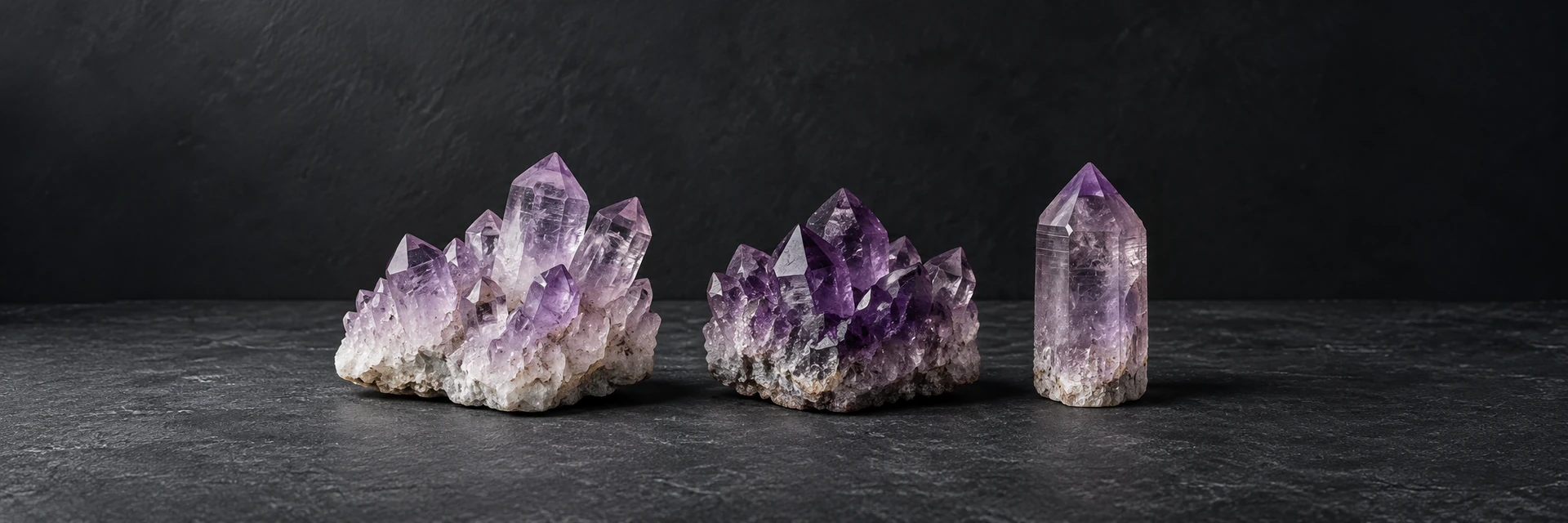
Amethyst cluster · photo by James St. John, CC BY 2.0 · Resized and converted to WebP.
- 01
Upload Photos of One Purple Stone
Add one to three views of a purple stone: whole piece in daylight, side view of the points or edges and close view of the tips or surface. JPG, PNG and WebP files are supported, up to 40 MB each. A location and your own observations are optional.
- 02
Review Matches and Evidence
A result presents a suggested name alongside visible clues, limitations and possible alternatives. Read those explanations together. Compare the explanation with your own photographs and leave the name open when the visible evidence does not distinguish the candidates.
- 03
Ask a Follow-up Question
Use the available follow-up to ask about lookalikes, typical properties or care. The reply stays with that specimen. When you want to investigate another find, start a new identification with its own photos.
Photo-based identification can suggest possible matches, but it cannot definitively confirm a specimen’s actual composition.
Keep exploring
Identify Another Rock, Try a Sample, or View Your History
Choose an identification, a sample walkthrough, or your saved history.

Sample walkthrough
Try the amethyst cluster photo and review its result.
Amethyst cluster · photo by James St. John, CC BY 2.0 · Resized and converted to WebP.
Photo guide
Get practical tips for showing shape, surface details and different angles.
Read the guidePhoto guide updated
How to use the amethyst identifier
The amethyst identifier compares photos of a purple crystal, cluster or polished stone and suggests possible matches. Upload one to three photos of the same piece: the whole piece in daylight, a side view of the points or edges, and a close view of the tips or surface. Then choose the form that fits: cluster or geode piece, single point, tumbled, carved or cut, or not sure.
The result lists what the piece may be, the visible clues behind each candidate and the purple lookalikes still in play. It also says what the photos could not settle, such as heating or synthetic origin. A follow-up question comes last; answer it or ask your own. Saying whether light passes through a thin edge, and where the piece was found or bought, often helps more than another photo.
First check: is the purple stone quartz?
Amethyst is purple quartz, so the first thing the amethyst identifier checks is whether the piece looks like quartz at all. GIA describes the typical quartz crystal as a six-sided column with a pyramid-shaped tip. In a cluster you may see only the tips, but count the faces around one point if you can. Quartz has a glassy luster, breaks with curved, shell-like surfaces and shows no flat cleavage cracks.
Photograph a naturally thin edge near an ordinary window, without strong glare. Light transmission can be useful, but clouds, inclusions, coatings and thickness change what the camera records. Clearly resolved cubes, flat cleavage surfaces or flaky layers invite comparison with other minerals; a distorted point or one blurred edge does not rule quartz out. Do not chip the piece or perform a scratch test to make the image more diagnostic.
Geode clusters, single points and polished pieces
Form comes next. Many amethyst clusters are pieces of geodes that formed in basalt lava. The outer rind is usually a gray-green or brown layer of chalcedony, and the inside may also hold white calcite crystals or small dark goethite. GIA notes that amethyst geodes from Brazil can be large enough to stand in. Points coated in many tiny points are sold as spirit quartz or cactus quartz.
Tumbled, carved and faceted pieces have lost their crystal form, so the result leans on color zoning, inclusions and transparency instead. A faceted purple stone with no visible zoning or inclusions stays “amethyst or other purple gem, cut stone, treatment unknown,” because iolite, tanzanite and synthetic amethyst can look the same face-up.
For a round nodule that has not been opened, the geode identifier compares the outer rind.
Color zoning the amethyst identifier looks for
Amethyst can show angular bands or patches of stronger and weaker purple, as GIA describes. Photograph the same area from two directions to separate a color zone from a reflection. Zoning can support a comparison, but its presence does not prove natural origin, and its absence does not prove glass or synthetic material. Pale lilac and deeper purple appearances can both remain candidates.
Some zoning patterns have their own names. V-shaped bands of purple and white quartz are chevron amethyst. Purple and yellow zones in one crystal are ametrine. Natural ametrine comes mainly from one mine in eastern Bolivia, but synthetic ametrine also exists and a photo cannot separate the two. Green quartz sold as prasiolite is usually heated amethyst, which a photo cannot confirm either.
Heat-treated amethyst sold as citrine
GIA explains that much commercial citrine results from heating amethyst. An orange or brown cluster can therefore raise a treatment question, but iron staining, lighting and other materials can also affect its appearance. The tool describes visible color and the possible explanation without presenting a photograph as a heat-treatment test. Ask for existing documentation if treatment matters to your decision.
Heat is also used on amethyst itself. GIA explains that heating can lighten very dark amethyst but cannot make pale amethyst darker, and that some amethyst fades with long exposure to strong light. Do not heat, bleach or soak a piece to test it. Those steps can change the color for good.
Purple lookalikes the amethyst identifier compares
Several purple materials share shelves with amethyst. The Illinois State Museum notes that fluorite often forms cube-shaped crystals, one of the quickest separations a photo can make.
What you see | What it may point to | Photo that helps next |
|---|---|---|
Cubes or eight-sided crystals, triangular cracks, purple with green or blue bands | Purple fluorite | Side view showing crystal shape and any bands |
Lilac stone with a pearly shine and thin flaky layers | Lepidolite, a mica, sometimes with pink tourmaline | Close view of the surface at a low angle |
Opaque swirled purple with a silky, fibrous sheen | Charoite | Close view in daylight, turned to catch the sheen |
Opaque magenta-purple with a waxy polish | Sugilite | Back or edge of the polished piece |
Even color with round bubbles or a mold seam | Purple glass | Close view with daylight behind the piece |
Color that collects in cracks or only some bands | Dyed quartz or dyed agate | Sharp close-up of a crack or drill hole |
What a photo cannot show about amethyst
Heating, irradiation and natural versus synthetic origin cannot be seen in a photo. GIA notes that synthetic amethyst has been known since the 1970s and that it can be very difficult to separate from natural amethyst without advanced gemological testing. For a cut stone or a costly piece, a qualified gemologist is the right next step.
Source is another limit. Brazil, Uruguay, Zambia and Mexico all produce amethyst, and a locality on a label is the seller’s claim. If you collected the piece yourself, keep a note of where. A natural history museum, a university geology department or a state geological survey can help with a locality question. Value is a question for an appraiser, not for an amethyst identifier.
Keep crystal structure separate from polish and color
Begin with the whole cluster or stone beside a ruler. For a cluster, choose one intact point and show its side and termination rather than counting the outlines of several overlapping crystals. Keep the attachment or any already exposed rind in view. A polished tower has a manufactured shape, so its six-sided outline is not evidence of a naturally grown quartz crystal.
A useful follow-up describes the feature that remains unclear. For example, ask whether the visible planes look like growth faces or an existing fracture, and which next view would separate those explanations. If the stone is mounted, photograph the accessible face and edge without removing it. Keep a seller label as context, separate from the observations supported by the images.
Preserve the first photographs if you add a new lighting angle. A phone may change exposure automatically between frames, making one area look darker or warmer. Include a plain background and the same ruler in both views. A record that says purple polished material, quartz and glass still possible is more useful than converting a tentative color match into a certificate of natural amethyst.
Common questions about amethyst photos
Is my amethyst real or glass?
Visible point geometry, zoning, inclusions, bubbles or seams can guide a comparison, but none is a universal shortcut. Polish and photography can hide the useful features. A purple cut or tumbled stone may remain unresolved, and direct gemological examination may be needed.
Why are the tips of my cluster orange?
Orange or brown areas can raise a treatment question, but they may also involve surface staining or lighting. GIA explains that heating amethyst produces much commercial citrine; that fact does not establish what happened to your piece. Keep treatment unknown without suitable evidence.
Does amethyst fade in sunlight?
GIA notes that some amethyst fades with long exposure to strong light. Normal indoor display is usually fine. If the color matters to you, keep the piece off a sunny windowsill.
Can a photo tell me where my geode came from?
No. Geodes from different countries can look alike, and a photo cannot read a locality. A label or your own collecting note is the best record.