
Bone identifier by photo
Compare a bone or bone fragment by photo. Explore which bone it may be, the animal group, fossil or modern clues and lookalikes, then ask a follow-up.
- Bones & bone lookalikes
- Explains each match
- 3 free identifications per day
Upload bone photos
Drag your photos here, or choose a file to begin.
JPG, PNG, WebP or HEIC · Up to 3 photos · 40 MB each · You can also paste a photo
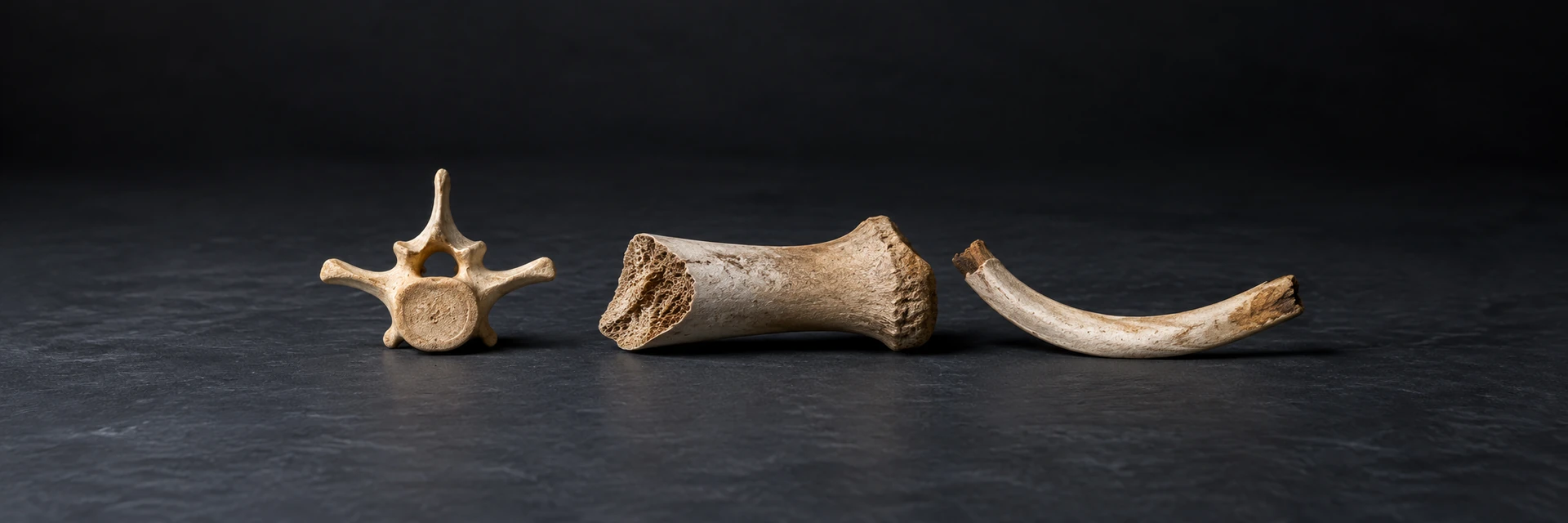
Deer vertebra close-up · photo by USGS Bee Inventory and Monitoring Lab, Public domain · Resized and converted to WebP.
- 01
Upload Photos of One Bone
Add one to three views of a bone: whole appropriately documented piece beside a ruler, opposite side without further disturbance and already exposed end or joint surface. JPG, PNG and WebP files are supported, up to 40 MB each. A location and your own observations are optional.
- 02
Review Matches and Evidence
A result presents a suggested name alongside visible clues, limitations and possible alternatives. Read those explanations together. Compare the explanation with your own photographs and leave the name open when the visible evidence does not distinguish the candidates.
- 03
Ask a Follow-up Question
Use the available follow-up to ask about lookalikes, typical properties or care. The reply stays with that specimen. When you want to investigate another find, start a new identification with its own photos.
Photo-based identification can suggest possible matches, but it cannot definitively confirm a specimen’s actual composition.
Keep exploring
Identify Another Rock, Try a Sample, or View Your History
Choose an identification, a sample walkthrough, or your saved history.

Sample walkthrough
Try the deer vertebra close-up photo and review its result.
Deer vertebra close-up · photo by USGS Bee Inventory and Monitoring Lab, Public domain · Resized and converted to WebP.
Photo guide
Get practical tips for showing shape, surface details and different angles.
Read the guidePhoto guide updated
How to use the bone identifier
Use this free bone identifier to compare an animal-bone-like object with bones, rocks, wood and replicas. Upload one to three views of the same piece: an overview with a ruler, its opposite side, and an already exposed end or joint surface. Do not break, scrub or move a find to obtain a view. If human remains are a reasonable possibility, leave the find undisturbed and seek local official guidance before using an online tool.
The result lists possible matches, the visible clues behind each one, the lookalikes that still fit, and what the photos could not settle. It ends with a follow-up question you can answer or ask about, most often where the bone was found or how heavy it feels for its size. Photograph it dry, in daylight, and leave it unscrubbed.
Bone or lookalike: what the bone identifier checks first
Bone has a build that rock rarely copies: a smooth, dense outer layer around a spongy lattice of tiny cells, best seen at a broken end. Joint surfaces are smooth and rounded, with small holes for blood vessels and rough ridges where muscles attached. The Kentucky Geological Survey adds that real bones have specific shapes, such as the bulges at each end of a shin bone.
Separate rounded holes in a rock can support vesicular volcanic material; concentric layers can support a concretion; preserved grain can support wood. These are comparisons rather than proof. A damaged or mineral-filled fragment may not show enough structure to separate bone from a lookalike. Do not use licking, burning or an improvised test to decide.
Antler has a rough, beaded base, tines and a solid spongy core, while horn is a hollow, layered sheath.
For a shell, coral or leaf print in rock, use the fossil identifier.
What to do if a bone may be human
A photograph of a fragment may be insufficient to distinguish human from other animal bone. Straightness, size, color or a small rounded end is not a reliable rule by itself. The tool must keep that distinction unresolved when the relevant anatomy is absent; it cannot exclude human remains or identify an individual. A cautious photo comparison is separate from a forensic examination.
If a bone found outdoors may be human, leave it in place, note the spot and call your local police or the county medical examiner or coroner. Washington State’s Department of Archaeology and Historic Preservation says state law requires anyone who finds human remains, or suspected human remains, to notify the medical examiner or coroner and local law enforcement. A possible human bone never gets a value in the result.
Which bone is it? Shapes to look for
A long shaft with rounded joint ends is a long bone, and the bone identifier names a femur, humerus or tibia only when the joint shape shows it. A flat, curved plate may be a rib, a shoulder blade or a piece of skull. A spool with projecting spines is a vertebra, and an hourglass-shaped disc with a deep cup on each face is a fish vertebra.
An existing cut-like area, polish or a drilled-looking hole may raise a worked-material question, but wear and natural damage can imitate tool marks. The photograph cannot establish butchery, cultural use or age. Preserve the complete surface and its context, and let qualified examination address consequential interpretations.
For a single loose tooth, try the tooth identifier.
Bird, mammal or fish bone
Wall thickness, a visible cavity and preserved joint anatomy can guide a broad comparison, but no one feature establishes an animal group. Some bird bones have hollow spaces, and many mammal bones also have cavities. Size and apparent thickness change with viewpoint. Name a particular bone or group only when enough matching anatomy is visible, and explain which features support it.
Dense-looking fragments, ribs and mineral-filled material can be especially ambiguous. A river location, a heavy feel or a seller’s sea-cow label does not establish a manatee, dugong or other species. Keep those notes as unverified context. The useful outcome may be a bone-like fragment requiring direct review rather than a species name.
Bone identifier lookalikes and the next photo
Start with the clue you can see most clearly.
What you see | What it may point to | Photo that helps next |
|---|---|---|
Spongy lattice inside a smooth, dense outer layer | Bone | Already exposed end close up, beside a ruler |
Round, separate holes in dark rock | Vesicular basalt or scoria | Close-up of the holes beside a coin |
Concentric layers with no lattice | Concretion or chert nodule | The already exposed end or the other side |
Wood grain or growth rings | Wood or petrified wood | The end of the piece, straight on |
Rough beaded base, tines, solid spongy core | Antler | The base and any broken tine |
Even color, mold seams, no lattice | Plaster, resin or plastic replica | The underside and any seam |
Fossil or modern: what the bone identifier cannot settle
Mineral infill, surface staining, weathering and preparation can all change a bone’s appearance. A dark, heavy fragment is not automatically fossil, and a pale piece is not automatically recent. River staining can mimic older material. Record the visible structure and any attached sediment without assigning an age from color or apparent weight.
A honeycomb-like internal texture does not establish a dinosaur. Several kinds of bone and some lookalikes can show porous structure, while fossil preservation varies. Geographic context may guide a specialist’s review but cannot supply anatomy missing from the image. Do not name a dinosaur group or fossil age from an isolated texture.
Species, age, fossil status and whether you may keep a bone need more than a photo. A natural history museum, a university anthropology or paleontology department or your state geological survey can examine it in hand.
Keep anatomy and collection context in the same record
For an ordinary animal specimen that you can appropriately document, begin with the whole outline and a ruler in the same plane. Use another view to show the opposite surface and a third for a joint or an end that is already exposed. Record which end is being shown; two close-ups of unrelated fragments cannot establish one complete bone.
State whether the object was loose, attached to rock, purchased or part of an existing collection. Keep the location note separate from any proposed animal or age. If it remains embedded, document only what is visible without excavation. An expert may need the surrounding context as much as the surface texture, so preserve that information rather than cleaning it away.
A useful follow-up asks what preserved feature separates the remaining possibilities. If the joint is missing, the answer may remain a broad long-bone fragment. If a surface is coated, the answer may remain bone or rock. Keep the earlier candidate provisional when adding a photograph; a second view should improve the evidence rather than merely repeat a confident label.
Collecting rules and common questions
On Bureau of Land Management land, collecting vertebrate fossils, such as dinosaurs, mammals, fish and reptiles, is illegal without a permit. The BLM asks finders to leave a notable fossil in place, take pictures, record its location and report it to a local BLM office. Never offer remains of protected species for sale, and ask the owner before collecting on private land.
Is my bone from a dinosaur?
A dark or porous fragment is not enough to identify dinosaur bone. The preserved anatomy, geological context and direct expert review matter. The tool may leave the result as bone-like material or an unresolved bone fragment rather than assigning an animal or age.
Can I keep fossil bones from a Florida river?
Requirements depend on the land, jurisdiction and kind of find. The Florida Museum publishes current permit guidance for vertebrate fossils on state-owned or leased land, including listed exceptions. Consult the responsible authority before collecting; a photo result cannot grant permission.
How do I tell bone from a rock with holes?
An already exposed end may show a denser outer wall around an internal lattice, while some volcanic rocks show separate vesicles. Wear or mineral filling can obscure this distinction. Photograph existing surfaces without making a new break, and keep alternatives open when structure is unresolved.