
Agate identifier by photo
Compare bands, translucency and the outer husk of a possible agate. Explore agate types, jasper and banded lookalikes, then ask a follow-up.
- Agates & banded stones
- Explains each match
- 3 free identifications per day
Upload agate photos
Drag your photos here, or choose a file to begin.
JPG, PNG, WebP or HEIC · Up to 3 photos · 40 MB each · You can also paste a photo
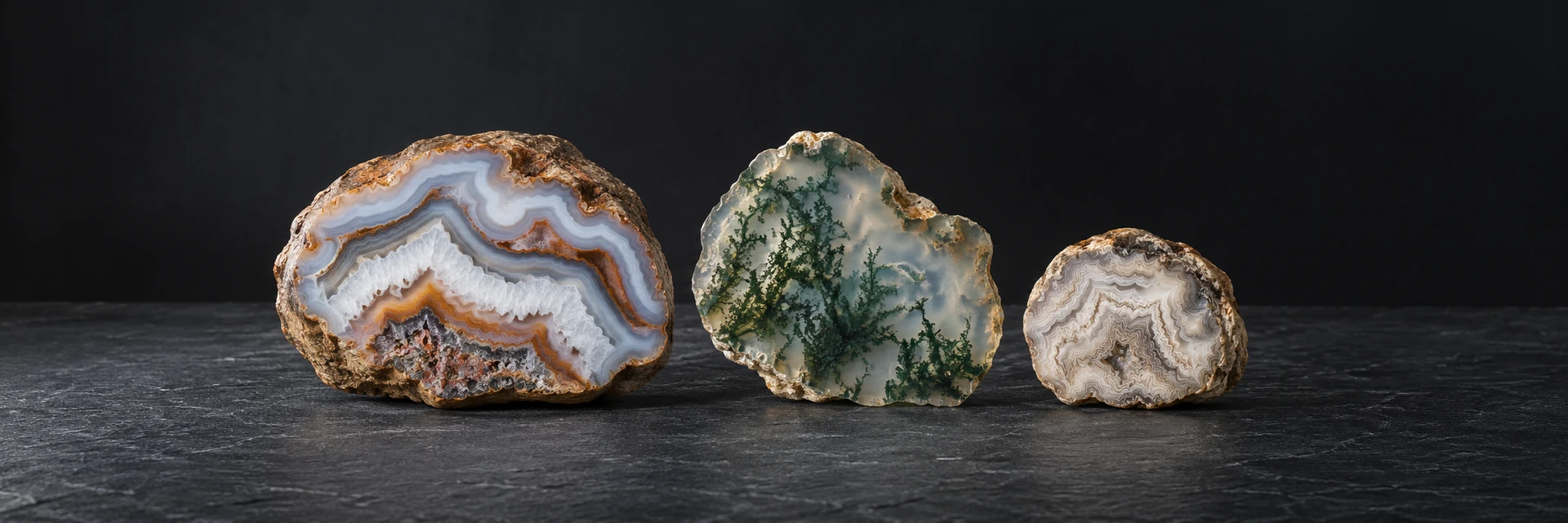
Banded agate · photo by James St. John, CC BY 2.0 · Resized and converted to WebP.
- 01
Upload Photos of One Agate
Add one to three views of an agate: whole stone in daylight, thin edge held against daylight and outer husk or rough side. JPG, PNG and WebP files are supported, up to 40 MB each. A location and your own observations are optional.
- 02
Review Matches and Evidence
A result presents a suggested name alongside visible clues, limitations and possible alternatives. Read those explanations together. Compare the explanation with your own photographs and leave the name open when the visible evidence does not distinguish the candidates.
- 03
Ask a Follow-up Question
Use the available follow-up to ask about lookalikes, typical properties or care. The reply stays with that specimen. When you want to investigate another find, start a new identification with its own photos.
Photo-based identification can suggest possible matches, but it cannot definitively confirm a specimen’s actual composition.
Keep exploring
Identify Another Rock, Try a Sample, or View Your History
Choose an identification, a sample walkthrough, or your saved history.

Sample walkthrough
Try the banded agate photo and review its result.
Banded agate · photo by James St. John, CC BY 2.0 · Resized and converted to WebP.
Photo guide
Get practical tips for showing shape, surface details and different angles.
Read the guidePhoto guide updated
How to use the agate identifier
The agate identifier compares a banded or see-through stone with agate, its close relatives and its common lookalikes. Upload one to three photos of the same stone: the whole stone in daylight, a thin edge held against daylight, and the outer husk or rough side. Then say where it came from: a beach, river or gravel pit, a rock shop or gift, a cut slice or polished piece, or not sure.
The result lists possible matches and the visible clues behind each, names the lookalikes that still fit, says what the photos could not settle, and ends with a follow-up question you can answer or ask about. Each name is a possible match to check against your stone, not a confirmed identity.
First check: waxy, translucent chalcedony
Agate is banded chalcedony, quartz made of crystals too small to see. The Minnesota Department of Natural Resources describes Lake Superior agates as concentric bands of fine-grained quartz called chalcedony. So the agate identifier first looks for the material: a waxy shine, light through thin edges, no visible grains, and smooth, curved, shell-like breaks.
Hold the thinnest edge up to a bright window or the sky and look at the edge, not the thick center. A glow fits chalcedony; an edge that stays dark even where it is thin points toward jasper or chert. Photograph the stone dry, because water makes any pebble look clearer. Translucent chalcedony without bands is plain chalcedony, carnelian when it is orange to red, or chrysoprase when it is apple green.
Agate patterns the agate identifier compares
Once chalcedony fits, the pattern gives the type name. Fortification agate has concentric, angular bands like the plan of a fort; the Minnesota DNR notes that each band, traced around the face, connects with itself. Straight, parallel bands are onyx when black and white, sardonyx when red-brown and white, and water-level agate when they sit beside curved bands.
Moss agate holds green or black moss-like growths, and dendritic agate shows black branches that the USGS describes as included minerals of manganese and iron. Plume agate has feathery plumes, eye agate has round eyes, and lace agate has tight, wavy loops, pale blue in blue lace agate. Fire agate shows rainbow colors under a brown, grape-like skin, which the USGS links to iron oxide inclusions. Wood grain in chalcedony fits petrified wood, and a star-shaped agate core in a brown rock shell fits a thunderegg.
The outer husk and where the stone was found
A rough agate rarely shows its bands on the outside. The Minnesota DNR lists the husk clues hunters use: a peeled texture where bands broke along their planes, rust-red or yellow iron staining, a waxy look on chipped spots, and a pitted surface. Photograph the husk as well as the best face.
Red, orange and brown fortification bands under a pitted rind fit a Lake Superior agate. These formed over a billion years ago in lava flows, and glaciers spread them across central and northeastern Minnesota and northwestern Wisconsin. Similar agates occur elsewhere; the USGS notes that South Dakota’s Fairburn agates are similar to Lake Superior agates. So the agate identifier names a locality only when your location supports it, as in “possible Lake Superior agate.” Shop names such as Botswana, Laguna or Crazy Lace are the seller’s claims.
In Minnesota, rock collecting is not allowed in state parks, state recreation areas or state scientific and natural areas, and gravel pits on private land need the owner’s permission. The DNR names the public beaches along Lake Superior as a popular place to hunt.
Dyed agate and natural agate colors
Natural agate runs through white, gray, blue-gray, cream, yellow, orange, red, brown and black. Vivid pink, purple, bright blue, electric green or a deep, even black, especially in thin slices or beads, is a strong sign of dye, which soaks into some bands more than others.
GIA lists chalcedony among materials dyed since ancient times and notes that a qualified gemologist can spot dyed gems in most cases. A photo can show that a color looks dyed, but it cannot confirm a treatment.
Agate identifier lookalikes: jasper, chert, calcite and glass
Most lookalikes fail the edge test or show a texture chalcedony lacks. Polished banded calcite and polished agate can look alike in a photo, so the result may read “banded calcite or agate.” Opaque bright green bands fit malachite, and pink and white bands fit rhodochrosite.
What you see | What it may point to | Photo that helps next |
|---|---|---|
Opaque even at a thin edge | Jasper; part clear and part opaque fits jasp-agate | A thin edge against daylight |
Opaque gray to black, plain or faintly banded | Chert or flint | A chipped edge and the rind |
Pearly shine with flat glints, often carved and sold as “onyx” | Banded calcite or aragonite | The surface at a low angle |
Fine, opaque flow bands in a dull rock | Banded rhyolite | The texture between the bands |
Dark rock with small agate-filled holes | Basalt with agate fillings | The whole rock, then one hole |
Even color, bubbles or mold seams; feels light | Glass, resin or plastic | Bubbles or seams beside a coin |
What a photo of an agate cannot tell you
Photos cannot establish where a stone was found, whether its color is natural, its age or its value. For a local find, ask a state geological survey, a natural history museum or a university geology department; for a purchased stone, ask a gemologist. Use only gentle checks, such as daylight, a coin for scale, light through a thin edge and how heavy it feels for its size. Do not scratch, heat or break a stone to test it.
For a cut or set stone, use the gemstone identifier. For a round nodule with a hollow center, try the geode identifier.
An example with bands on a polished slice
Suppose a polished slice has cream and rust-colored bands, but the photo shows only a reflective front face. Add an edge view in diffuse light, with a ruler for scale, and a backlit photo of the thinnest existing edge. Compare how far light travels through the bands and whether they curve around a center or follow straight layers. That comparison can narrow the possibilities to agate, another form of chalcedony or a banded lookalike such as calcite. If the slice stays opaque at the edge, retain opaque alternatives such as jasper and check whether the edge is simply too thick for the test.
Common questions about the agate identifier
How can I tell if my agate is real?
Natural agate shows a waxy shine, light through a thin edge and bands that follow the stone’s shape. Glass and plastic tend to show round bubbles, even color and seams. The agate identifier can point toward or away from agate, and a gemologist can examine a purchased stone in person.
Is my agate a Lake Superior agate?
The look fits when red, orange or brown fortification bands sit under a pitted, rust-stained husk, but the name also depends on where you found it. Add your location so the result can say “possible Lake Superior agate” when it fits.
Why does my agate look better wet?
Water fills fine roughness on the surface, so more light enters the stone instead of scattering. Colors deepen and bands look sharper. Photograph it dry first, add a wet view if you like, and say which is which.