
Turquoise identifier by photo
Compare turquoise color, matrix and edges by photo. Explore dyed howlite, reconstituted stone and natural blue-green lookalikes, then ask a follow-up.
- Turquoise & imitations
- Explains each match
- 3 free identifications per day
Upload turquoise stone photos
Drag your photos here, or choose a file to begin.
JPG, PNG, WebP or HEIC · Up to 3 photos · 40 MB each · You can also paste a photo
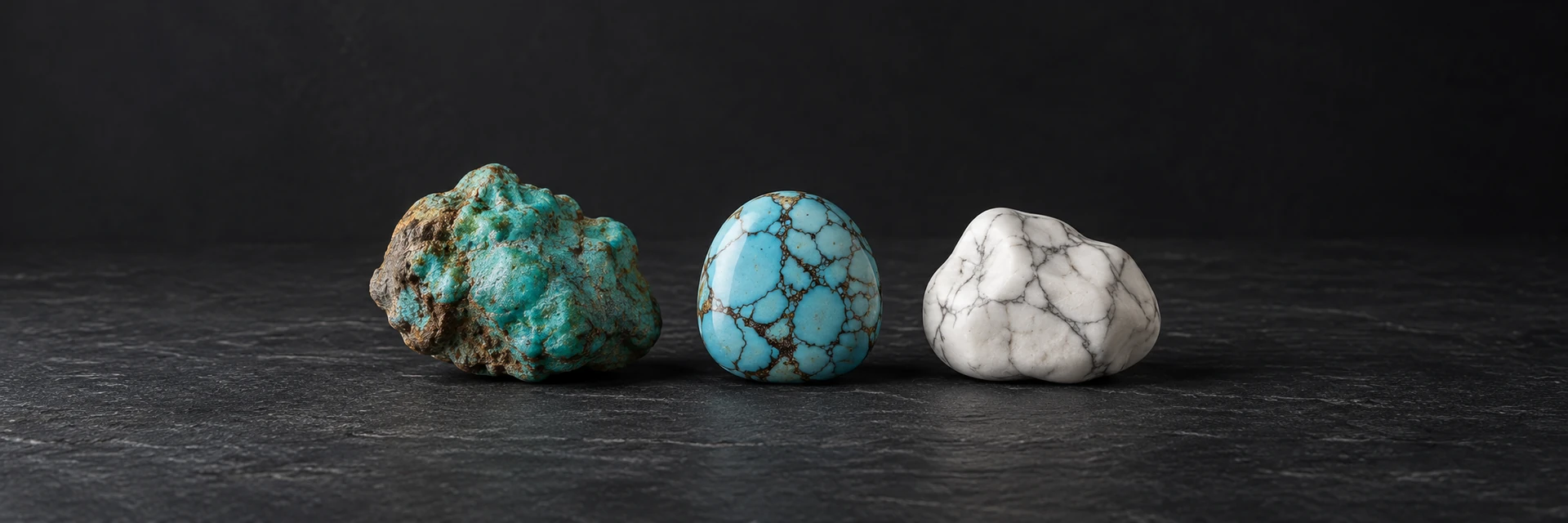
Turquoise · photo by James St. John, CC BY 2.0 · Resized and converted to WebP.
- 01
Upload Photos of One Turquoise Stone
Add one to three views of a turquoise stone: whole stone in daylight, back, edge or drill hole and close view of the matrix. JPG, PNG and WebP files are supported, up to 40 MB each. A location and your own observations are optional.
- 02
Review Matches and Evidence
A result presents a suggested name alongside visible clues, limitations and possible alternatives. Read those explanations together. Compare the explanation with your own photographs and leave the name open when the visible evidence does not distinguish the candidates.
- 03
Ask a Follow-up Question
Use the available follow-up to ask about lookalikes, typical properties or care. The reply stays with that specimen. When you want to investigate another find, start a new identification with its own photos.
Photo-based identification can suggest possible matches, but it cannot definitively confirm a specimen’s actual composition.
Keep exploring
Identify Another Rock, Try a Sample, or View Your History
Choose an identification, a sample walkthrough, or your saved history.

Sample walkthrough
Try the turquoise photo and review its result.
Turquoise · photo by James St. John, CC BY 2.0 · Resized and converted to WebP.
Photo guide
Get practical tips for showing shape, surface details and different angles.
Read the guidePhoto guide updated
How to use the turquoise identifier
The turquoise identifier compares photos of a blue or green stone, bead or piece of jewelry and suggests possible matches. Upload one to three photos of the same stone: the whole stone in daylight, the back, an edge or a drill hole, and a close view of the matrix. Then choose the form that fits: rough nugget, cabochon or bead, set in jewelry, or not sure.
The result lists what the stone may be, the visible clues behind each candidate and the imitations or natural lookalikes still in play. It also says what the photos could not settle, which for turquoise always includes treatment and source. A follow-up question comes last; answer it or ask your own. Where you bought or found the piece is the most useful note you can add.
Natural, stabilized, reconstituted, dyed or plastic
Much of what is sold as turquoise is treated or is not turquoise at all, so the turquoise identifier describes what the photo shows and leaves treatment open. Natural turquoise is a fine-grained, slightly porous copper mineral, opaque and sky blue to green. GIA explains that lower-quality turquoise is bonded at the grain level with polymer resins to make it more stable. That stabilized stone is still turquoise, but a photo cannot tell it from untreated material, so the name becomes “turquoise, treatment unknown.”
Reconstituted or block turquoise is made from chips or powder pressed together with a binder, often with dye. GIA also notes that turquoise is often imitated by dyeing common, inexpensive minerals such as howlite or magnesite. Plastic and resin imitations are common in low-cost jewelry.
Matrix that sits in the surface or is painted on
Matrix is the host rock caught in the turquoise. GIA describes it as dark brown from limonite or tan from sandstone, in patches or veins; fine web-like seams are called spiderweb matrix. In natural stone the matrix is a different and often softer material, so after polishing it tends to sit in slightly low channels. Tilt the stone toward a window and photograph it at a low angle to show this.
Matrix lines that look painted on, pressed in or perfectly level with the surface fit reconstituted turquoise. Gray-black web veins in a white or gray stone dyed blue fit dyed howlite or magnesite, especially when the blue is darkest along those veins. A sharp close-up of the matrix is the most useful single view the turquoise identifier can get.
Luster, texture and the spread of color
Fine, dense turquoise takes a waxy polish, and GIA notes that coarser, more porous stone looks dull. A very glassy, even shine on a light stone can point toward plastic or resin. Then look at how the color spreads. Natural turquoise usually varies gently across a piece, from bluer to greener patches. Very even color with a fine chip or granular texture fits reconstituted material.
Color that collects in cracks, veins and pits is a sign of dye. In dyed howlite or magnesite the cracks often show a deeper blue than the rest of the stone. A bright, perfectly uniform blue with no texture at all keeps imitation candidates on the list.
Chips, drill holes and the turquoise identifier
Edges, chips and drill holes show what lies under the surface. White or pale gray inside a drill hole or chipped edge points toward dyed howlite or magnesite, because the dye has not reached all the way through. Glossy, uniform beads that feel very light and warm, with mold seams or small bubbles, point toward plastic or resin. Bubbles in a glassy piece point toward glass. Photograph one bead hole or chip in sharp focus in daylight.
Use only safe checks: daylight, a ruler or coin for scale, and how heavy the piece feels for its size. Do not scratch, file or heat the stone, or wipe it with solvents. Those tests damage treated stones and jewelry, and the answer still needs a lab. GIA explains that gemological labs use infrared spectroscopy to find polymer resins and to separate turquoise from dyed imitations.
Natural blue-green stones the turquoise identifier compares
Some lookalikes are natural minerals, not imitations. They are real stones that simply are not turquoise.
For a rough crust or a loose specimen, the mineral identifier compares a wider range of minerals.
What you see | What it may point to | Photo that helps next |
|---|---|---|
Bright blue-green, softer-looking, often with quartz, malachite or brown limonite | Chrysocolla | Close view of the surface and any mixed minerals |
Apple-green to blue-green, sometimes with yellow veins | Variscite | Whole stone on white paper in daylight |
Blue-green and blocky with white streaks and flat flashes of light | Amazonite, a feldspar | Low-angle view that catches the flat flashes |
Pale blue with white wavy patterns | Larimar, a blue pectolite | Close view of the pattern in daylight |
Blue-green, grape-like pearly crusts | Smithsonite or hemimorphite; a photo cannot separate them | Side view of the crust surface |
Why mine names cannot be read from a photo
Kingman, Sleeping Beauty, Persian, Royston, Hubei and Number 8 are names buyers often see. A photo cannot read any of them. Turquoise from different mines can share a look, and GIA notes that the trade calls an even, intense blue “Persian blue” whether or not it was mined in Iran. The turquoise identifier describes the look instead, such as “even sky blue without matrix” or “black spiderweb matrix,” and keeps the mine as the seller’s claim.
The Federal Trade Commission advises that sellers should disclose treatments that are not permanent, need special care or significantly affect value. Sales paperwork should include what the seller told you about origin and treatment; if a seller will not put that in writing, the FTC suggests working with someone else. A gemological lab can test a stone for treatment and imitation.
An example with an even blue bead
Suppose a bead looks evenly blue in a seller photo, with a dark line at one end. That image leaves open natural turquoise, treated turquoise and several imitations. In daylight, photograph the line and the existing drill hole from different angles. A pale interior or a seam would add clues, while glare may hide both. Use the same camera settings for the whole bead and the close-up so the color is easier to compare. A lab can address treatment when it matters to a purchase.
Common questions about turquoise photos
Can a photo tell if my turquoise is stabilized?
No. Stabilized turquoise is real turquoise bonded with resin, and in a photo it looks like untreated stone. The result names it “turquoise, treatment unknown.” A gemological lab can test for polymers.
Why is there white inside the drill hole?
White or pale gray inside a hole or chip often means the blue is a dye on a white stone such as howlite or magnesite. It can also be a pale patch of host rock in real turquoise. A sharp close-up of the hole and one chipped edge helps separate the two.
Is green turquoise real turquoise?
It can be. Turquoise ranges from sky blue to green, and GIA notes that green to greenish blue stones are generally less sought after than an even blue. Green stones can also be variscite, chrysocolla or a dyed imitation, so the turquoise identifier compares them.
What is block turquoise?
Block turquoise is a trade name for reconstituted material: chips or powder bonded into a block, often dyed, sometimes with matrix lines pressed in. It tends to look very even with a fine granular texture.