
Gold hallmark identifier by photo
Read a gold stamp by photo. Compare karat and fineness numbers, gold-filled and plated marks and maker’s marks, then ask a follow-up.
- Gold stamps & karat marks
- Explains each match
- 3 free identifications per day
Upload marked gold item photos
Drag your photos here, or choose a file to begin.
JPG, PNG, WebP or HEIC · Up to 3 photos · 40 MB each · You can also paste a photo
Gold hallmark (583) · photo by Star61, CC BY-SA 4.0 · Resized and converted to WebP.
- 01
Upload Photos of One Marked Gold Item
Add one to three views of a marked gold item: whole item in daylight, sharp close-up of the stamp and close view of a worn spot or edge. JPG, PNG and WebP files are supported, up to 40 MB each. A location and your own observations are optional.
- 02
Review Matches and Evidence
A result presents a suggested name alongside visible clues, limitations and possible alternatives. Read those explanations together. Compare the explanation with your own photographs and leave the name open when the visible evidence does not distinguish the candidates.
- 03
Ask a Follow-up Question
Use the available follow-up to ask about lookalikes, typical properties or care. The reply stays with that specimen. When you want to investigate another find, start a new identification with its own photos.
Photo-based identification can suggest possible matches, but it cannot definitively confirm a specimen’s actual composition.
Keep exploring
Identify Another Rock, Try a Sample, or View Your History
Choose an identification, a sample walkthrough, or your saved history.

Sample walkthrough
Try the gold hallmark (583) photo and review its result.
Gold hallmark (583) · photo by Star61, CC BY-SA 4.0 · Resized and converted to WebP.
Photo guide
Get practical tips for showing shape, surface details and different angles.
Read the guidePhoto guide updated
How to use the gold hallmark identifier
The gold hallmark identifier reads the stamp on a ring, chain, watch case or other gold-colored item and explains what the mark claims. Upload one to three photos of the same item: the whole item in daylight, a sharp close-up of the stamp, and a close view of a worn spot or edge. Then choose what it is: a ring, a chain or bracelet, a watch, pen or other item, or not sure.
The result quotes the mark as it appears, gives possible readings with the visible clues behind each one, and names lookalike marks that could explain it. It says what the photos could not settle, which always includes the real gold content, and ends with a follow-up question you can answer or ask about. Where the piece was bought is the most useful note you can add.
Stamps are tiny, so shoot the close-up straight on in daylight, with macro mode or zoom and no glare. Check inside ring bands, clasp tags and watch case backs.
Karat and fineness numbers and how they pair
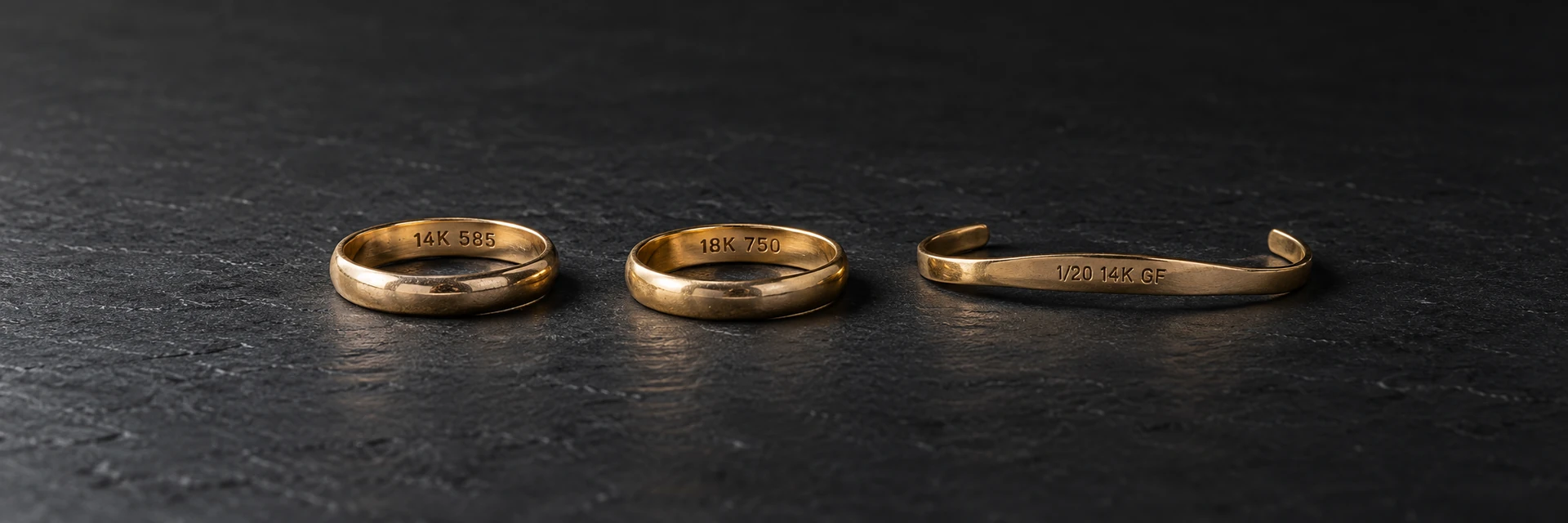
Karats count parts of gold out of 24, written K, Kt or KP for karat plumb, a claim that the gold is at least the karat shown. The Federal Trade Commission explains that 24K is pure gold and 18K is 18 parts gold to six parts other metals. Fineness numbers give parts of gold per thousand.
The usual pairs are 9K and 375, 10K and 416 or 417, 14K and 583 or 585, 18K and 750, 21K and 875, 22K and 916 or 917, and 24K and 999. The Birmingham Assay Office gives the same figures for 9, 14, 18 and 22 karat. A matching pair such as “14K 585” is consistent. A mismatch such as “18K 585” is a warning, and the result flags it.
The FTC also advises looking for the company’s name or US registered trademark beside the karat mark, and passing on a piece that has none.
Gold-filled, rolled gold plate and plated marks
The FTC explains that gold filled, gold overlay and rolled gold plate mean a layer of at least 10 karat gold mechanically bonded to a base metal, marked with the karat and the term, such as “12K RGP”. If the layer is under 1/20 of the metal weight, the mark should give the fraction, as in “1/40 14K gold overlay”. So GF, 1/20 14K GF and 12K GF point toward gold-filled, and RGP toward rolled gold plate.
Gold electroplate, in the FTC’s terms, is at least 10 karat gold at least .175 microns thick, applied electrolytically. GP, GEP, HGE (heavy gold electroplate) and HGP point toward plating; gold flashed or washed means an even thinner coat. Vermeil is gold over sterling silver, so it often carries 925. In each case the gold hallmark identifier names the piece gold-filled or plated, not solid gold.
Wear, color and the gold hallmark identifier
After reading the stamp, the gold hallmark identifier checks whether the piece agrees with it. Silver-white, gray or brassy metal showing under the yellow on worn edges, clasp loops or inside a ring band points toward plating, whatever the stamp says. Solid karat gold keeps the same color right through a worn spot.
Some color changes are normal. White gold is often plated with rhodium and can look slightly yellow where that coating has worn. Rose gold is pink by design.
A fridge magnet is the safe home check. Gold is not magnetic, so a strong pull on the links points to a steel or iron core. Spring-ring clasps hold a small steel spring, so test the chain away from the clasp. A magnet that does not stick does not prove gold.
British, Italian and French gold marks
The Birmingham Assay Office describes a traditional British gold hallmark as a sponsor’s mark, a fineness number in a shaped shield and the assay office mark. A crown is the traditional mark on older British gold, but Sheffield also used a crown on silver, so a crown alone does not mean gold. Scales with a number are the Common Control Mark of the international Hallmarking Convention. The British Hallmarking Council explains the required marks and minimum-weight exemptions for items sold as gold in the UK.
Italian gold usually shows a fineness number such as 750, 585 or 375 beside a maker’s mark. Italian rules define that mark as a polygon holding a five-pointed star, the firm’s registration number and the code of its province, such as AR for Arezzo.
French guarantee marks are a different system. A partial symbol can resemble more than one mark, especially in a worn or mirrored photo. Capture the symbol and surrounding marks together and compare them against the appropriate assay reference.
Russian, Middle Eastern and Asian marks use other symbols and numerals; the gold hallmark identifier quotes what it can read and leaves the country open when the system is unclear.
Gold hallmark identifier: common stamps compared
Each row pairs a stamp with the reading it supports.
What you see | What it may point to | Photo that helps next |
|---|---|---|
14K with 585, or 18K with 750 | Consistent solid gold claim | The stamp and any maker’s mark beside it |
A karat and a number that do not match | Mismatched, misstruck or misread stamp | A sharper macro, straight on |
1/20 14K GF or 12K GF | Gold-filled | A worn edge or clasp loop |
RGP or 1/40 10K RGP | Rolled gold plate | Inside a ring band or a watch case back |
GP, GEP, HGE or HGP | Gold-plated or electroplated | Any spot where the yellow has worn |
925 on a yellow piece, or Vermeil | Gold over sterling silver | Inside surfaces and worn high points |
Stamps can be faked: what a photo cannot confirm
A stamp is a claim, not a test. Stamps can be faked, misstruck or added later, and designer names are copied often, so the gold hallmark identifier names a maker only when the mark is legible and never confirms a brand. A photo cannot measure gold content, weight or value.
Do not use acid kits, scratch, file or heat the piece. A jeweler or an assay office can test it. The Birmingham Assay Office tests gold with X-ray fluorescence (XRF) before hallmarking it.
For a loose nugget, flake or gold-colored rock, use the gold identifier. For a stone set in the piece, use the gemstone identifier.
An example with two separate marks
Suppose the inside of a ring shows 585 while a detachable charm shows GP. Take one photo that shows where each mark sits, then make separate close-ups. The first mark commonly claims 585 parts per thousand gold. The second commonly indicates a plated surface. Those readings apply to the marked parts individually. If the ring photo only shows 58 and a blurred final character, keep that last digit open. A second photo with light coming from the side may make the impression easier to read.
Questions about gold stamps
Is 10K gold real gold?
Yes. 10K is a gold alloy with 10 parts gold out of 24, about 41.7 percent, often paired with 416 or 417. It is the lowest karat among the common US marks; British and European pieces often use 9K, stamped 375.
What does 1/20 12K GF mean?
It is a gold-filled mark. A layer of 12 karat gold is bonded to a base metal and makes up one twentieth of the item’s metal weight. It is not solid gold, though the layer is much thicker than a typical electroplate.
What does 585 mean on a chain?
585 is the fineness number for 14 karat gold, 585 parts gold per thousand. It is a solid 14K claim, and on Italian chains it often sits beside the star maker’s mark. Wear that shows another color underneath would argue against it.
Further reading
- Federal Trade Commission: Buying platinum, gold and silver jewelry, including karat, gold-filled and plated marks
- Birmingham Assay Office: Gold assay and hallmarking explained
- Florence Chamber of Commerce: Italian regulation DPR 150/2002 defining the star maker’s mark (in Italian)
- British Hallmarking Council: How to recognize a hallmark