
If you want to know how to identify a diamond rock, start by separating an uncut crystal, a loose faceted stone and a stone already set in jewelry. Each gives you different clues. Use the guide to document the visible features, then compare them with the right examples. A photo can help organize possibilities and prepare for a professional examination.
Rough diamond, cut stone or lookalike?
| Candidate | Visible clues |
|---|---|
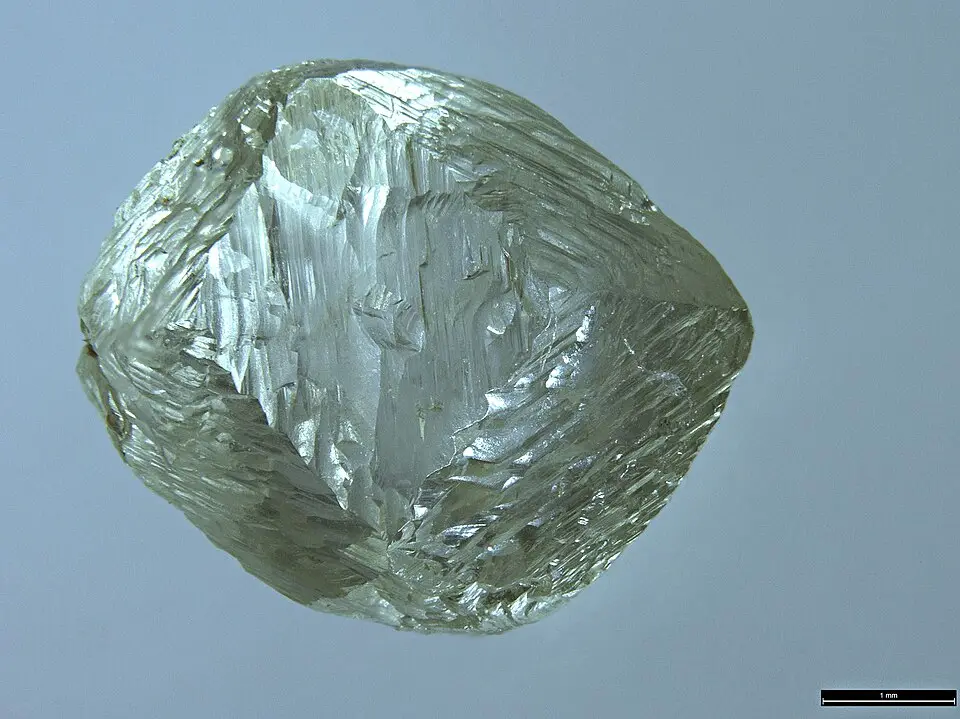
| Rough diamond candidate | Look at the entire outline, the arrangement of faces and any rounded or etched areas. An eight-faced outline is possible; some rough crystals have quite different shapes. |
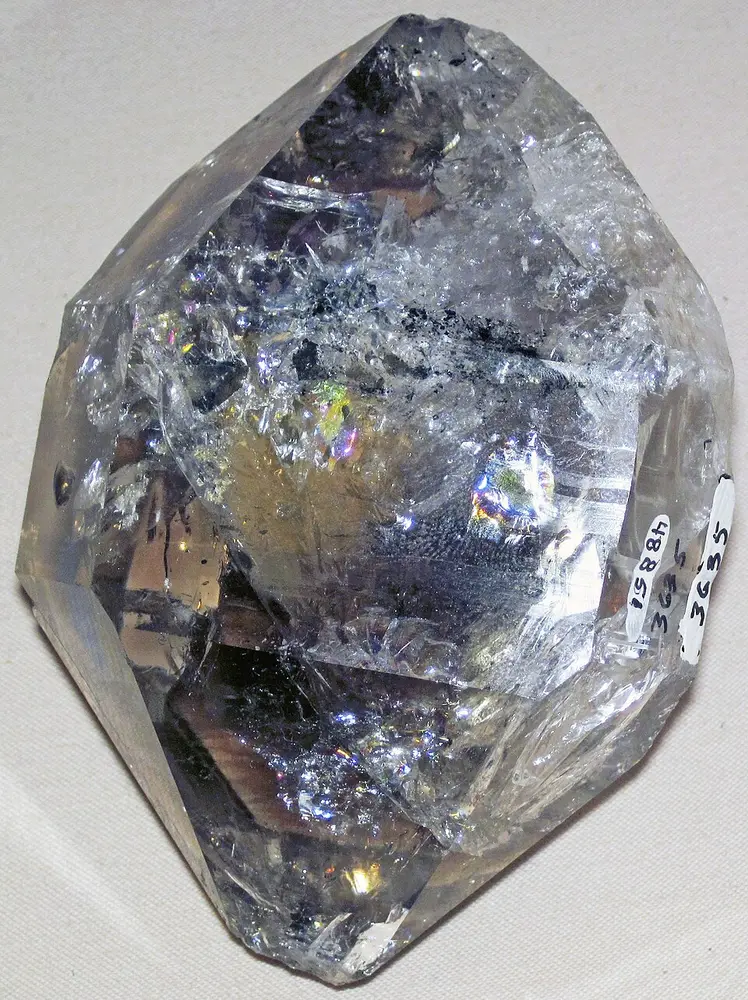
| Clear quartz | Where preserved, a six-sided prism with pointed ends is useful evidence for quartz. An isolated broken face or clear fragment can hide that geometry. |
| Cut stone or simulant | Record the facet layout, girdle and setting. Glass, cubic zirconia and moissanite can be cut to resemble a diamond. Lighting strongly affects their apparent sparkle. |
| Natural or laboratory-grown diamond | Both are diamond. Origin requires appropriate gemological examination. The cut, color or apparent clarity in a photograph leaves that question open. |
Photo examples


Start with the kind of object you have
For a loose piece found outdoors, record its size, find setting and whether the crystal is attached to another material. A clear point on a gray rock is two observations: the clear material and the rock around it. A single close-up of the bright area can make a coarse crystal look like a separate gem. Photograph the whole piece first so the relationship stays visible.
For a ring or pendant, document the whole object and then the individual stone. Keep the center stone separate from any surrounding stones in your notes. They can be different materials, even when their colors match. If you see a stamp on the metal, photograph it in its own frame. The mark may describe the metal or maker. It supplies little evidence for the identity of the stone above it.
A loose stone with a regular pattern of polished faces should go in the faceted category. Even if its edge has a chip or it came from soil, the polished pattern still matters. Compare it with other cut materials. An uncut crystal and a faceted stone should not be judged against the same silhouette.
Compare a rough crystal from more than one angle
One familiar diamond crystal shape is an octahedron, with eight triangular faces arranged like two pyramids joined at their bases. Rotate an apparent pyramid before counting faces. From one angle, an ordinary fragment can look triangular; a second angle may show a long prism, an uneven break or an incomplete outline. Some rough diamonds have rounded edges, flatter forms or irregular outlines, so the textbook shape is only one comparison.
Look for the way the surfaces meet rather than just the brightest patch. A flat face with a straight edge is worth recording, but a fresh fracture can also make a flat-looking area. A curved or dull part of the same piece can change the interpretation. Write what you see in each view: three broad faces, one broken corner, and a rounded ridge, for example. Those notes remain useful when someone else looks at the sample.
At Arkansas’s Crater of Diamonds State Park, the park’s field guidance describes rough diamonds with rounded forms and reports several colors. It also lists other minerals found in the same area. The locality can make diamond a candidate there, while the same pale rounded shape in an unknown gravel mix has much less context. Use the park’s identification service for finds from its search area if you need help with a specimen.
What lookalikes can share with diamond
Clear quartz often looks glassy, and a Herkimer crystal can have a point at each end. Look for the prism between those tips and count sides on the clearest intact part. A cloudy or broken quartz chip may show none of these features. Glass fragments can also be transparent and shiny, especially where a new surface reflects a small lamp. Inspect edge shape and surface texture before narrowing the list.
On a finished stone, the facet design directs the reflections you see. Moissanite and cubic zirconia may look very bright. A phone photograph under direct lighting can saturate the brightest areas and emphasize colored flashes. Compare images taken under a large diffuse light source. Even then, the apparent amount of fire depends on angle and cut, and the picture cannot substitute for testing the material.
Natural and laboratory-grown diamonds share the underlying diamond crystal structure. A bright cut stone may be either, and a pale inclusion or tiny mark in a photograph is not a reliable origin clue. Professional instruments and examination can distinguish origin and help evaluate treatments. The visual comparison is useful for choosing what to examine, while the instrument or laboratory result answers a different question.
Skip tests that can damage a specimen
Keep an unknown stone away from sandpaper, glass-scratching experiments and heat. An imitation can be damaged, and a mounted stone or metal can be marked. Even diamond can chip where a blow hits a vulnerable edge. Record the existing surface without creating a new one. A fog or newspaper test also depends on humidity, cut, angle and surface condition. A result that seems to work once is hard to reproduce with a different stone.
A basic thermal tester may be helpful in a professional workflow, but the device, stone size and setting matter. Moissanite can complicate thermal screening. If a seller gives you a tester reading, ask what instrument and follow-up checks were used. Where a purchase, insurance question or inherited item depends on identity or origin, have a qualified gemologist or laboratory examine the actual piece.
Take photos someone can use
Lay a loose stone on a plain background beside a ruler. Take a view of the complete outline and a side view with the ruler in the same plane. Add a close-up of the best face or edge using diffused daylight. Tap to focus on the stone and check the photo at full size. If a bright reflection hides the feature, move the light instead of increasing contrast or sharpening the file.
For jewelry, take a face-up image and a side view of the setting if you can do so without moving the stone. Keep other jewelry out of the frame. Write down whether the stone is loose or mounted and how you obtained it. If paperwork exists, use the issuing laboratory’s verification service and have a professional match the report to the item when that relationship matters.
The photo tool above compares visible characteristics and helps you note plausible alternatives. Keep the written observations with the photos. If the photo leaves both diamond and a lookalike plausible, write that down and choose a qualified examination as the next step. That is a useful result when surface appearance cannot settle the material.
For a tiny stone, use a plain tray that makes the outline easy to see and prevents the piece from rolling away. Take one frame with the whole tray area and another with the stone filling more of the frame. Keep the original files if a reviewer asks to inspect a surface more closely.