
This rock identification chart starts with clues you can see. Compare grains, layers, mineral bands and small holes to narrow the rock group and choose the next observation. If several examples fit, keep both possibilities and look for a feature that separates them.
Compare the three rock groups
| Rock group | What to look for |
|---|---|
| Igneous | Granite often has visible crystals that fit together. Basalt is usually fine-grained and can have holes left by gas bubbles. |
| Sedimentary | Look for gritty sand grains in sandstone. Some limestone shows layers or shell fragments, while other pieces have few visible grains. |
| Metamorphic | Gneiss can show pale and dark mineral bands. Slate can split along flat, closely spaced surfaces, which may cross the original bedding. |
How to use the chart
- Find the most informative surface. Compare the weathered outside with a face or edge that is already exposed. A river pebble can feel smooth even when its interior is grainy. A dusty or stained surface can hide a pattern. Rotate the specimen under soft light and inspect two sides before deciding which texture repeats. Leave an intact specimen as it is.
- Look at how the grains meet. Hold a ruler next to the rock and examine a small area. Do you see sand-sized pieces with clear outlines, crystals that fit together, or a surface too fine to resolve? If only a few grains stand out, compare those grains with the material around them. A large crystal in a fine background tells a different story from a face covered in crystals of similar size.
- Trace any lines or holes. Follow a line from the broad face around an edge. Changes in grain size across repeated layers can be a clue to bedding. Aligned flakes or bands of different minerals can suggest metamorphic texture. A single pale line that crosses several features may be a vein. For holes, compare their shapes, sizes and distribution across the specimen.
- Write down one reason to keep each candidate. Try a description such as “fine dark material with round holes on two faces” before writing “basalt.” If the best clue is still just color, inspect an edge or take a closer photo. A useful short list can include one rock name and a broader group for the uncertain alternative.
Compare three rock photos
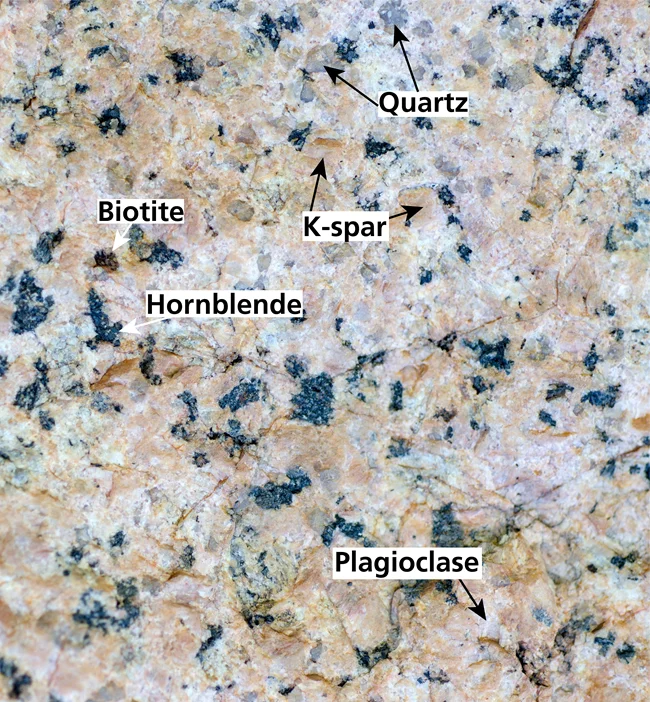
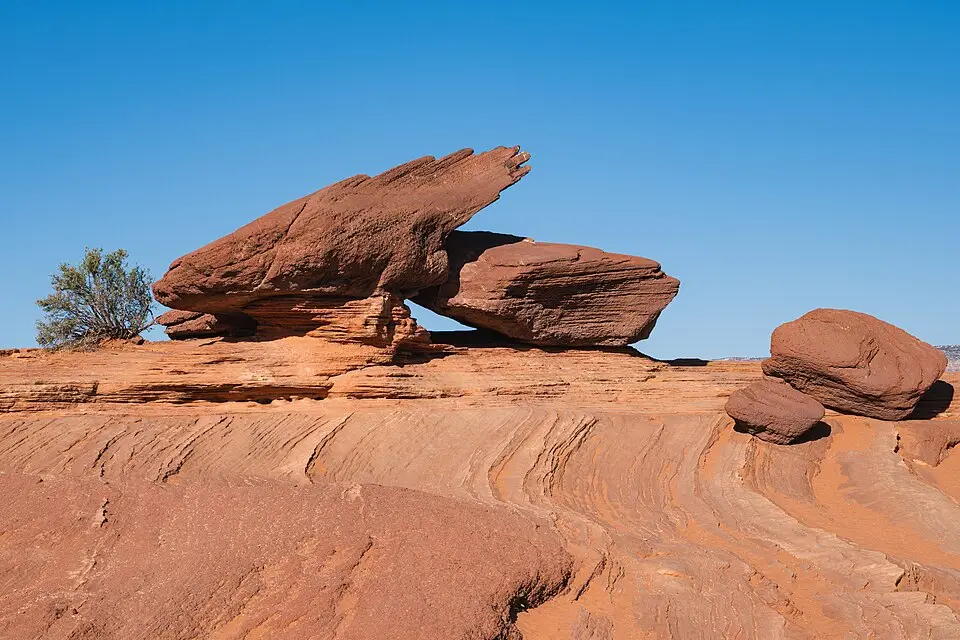

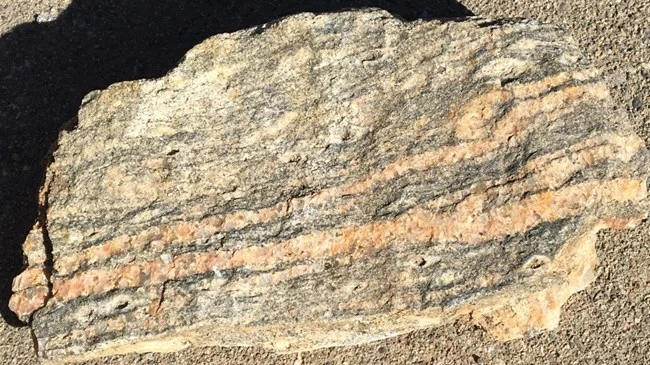
Compare common lookalikes
Sandstone and quartzite
A pale rock with a sandy sparkle could be either. Look along an existing broken edge. In sandstone you may be able to trace the outlines of individual grains, and the break often goes around them. In quartzite, recrystallized quartz grains can look fused, and a break can cut through grains. Well-cemented sandstone and weathered quartzite can blur the difference. Compare more than one spot and use the quartzite photo tool if the boundaries are clear enough to photograph.
Shale and slate
Both can appear dark, fine-grained and flat. Check a side view to see how the splitting surfaces relate to any visible bands. Shale often splits along sedimentary bedding. Slate develops cleavage that can cross the original bedding, so two sets of lines at different angles are worth photographing. One flat face by itself gives little evidence. Compare the edge with the shale specimen guide and the slate example in the chart.
Limestone and marble
A white or gray specimen with veins can fit either name. On an exposed edge, look for shell fragments or a repeated change in sediment size. Those are useful limestone clues. A surface covered with closely fitting carbonate crystals can fit marble. Fine-grained or polished pieces may show little texture. Check the back or side before using a polished face to choose between them.
Vesicular basalt and industrial slag
Round holes are consistent with gas bubbles in lava, and some slag also contains bubbles. Compare the material between the holes. A consistently fine-grained surface can fit basalt. Glassy patches, sharply contrasting materials or a setting with industrial debris make slag worth keeping in the comparison. A loose dark fragment can remain ambiguous even in a sharp image. Photograph the opposite face and note where the piece was found.
Work through an example
Suppose you find a rounded tan pebble. Its broad face looks smooth, with two faint stripes. On one already chipped edge you can see grains about the size of sand. On the opposite side, the stripes appear to continue around the pebble. Start by recording those observations separately. The tan color adds little, while the grain outlines and the way the stripes continue give you something to compare.
Sandstone is a reasonable first candidate if the grains are distinct and the stripes follow changes in texture. Keep quartzite in the list if the edge looks tightly interlocked or cuts through grains. Take a closer view with a ruler beside the chip and a side view that shows where the stripes meet the edge. If those details remain unclear, record “sandstone or quartzite” with the photos. That keeps the useful evidence available for another comparison.
When the chart leaves more than one answer
If the surface hides the texture
If the only view is wet, polished or weathered, describe the surface when you record your guess. Wet surfaces can darken and reflect the surroundings, and a polished surface can make very different rocks look equally shiny. Compare a dry view with an edge where the original texture is still visible. A small chip may also be too narrow to capture a full band or layer. Leave that feature unknown until a wider view is available.
If a single crystal is the strongest clue
A clear crystal attached to a rough gray mass gives you two things to describe. First note the shape and surface of the crystal. Then describe the grains, layers or holes in the material holding it. Use the mineral photo tool when you want to compare the crystal itself. If you want a rock group, include the material around the crystal and where the two meet.
Take a useful next photo
Take one photo of the whole specimen beside a ruler and one close-up of the strongest clue. Keep the ruler in the same plane as the feature you want to measure. Use diffuse daylight to show color and a little side lighting when you need shadows to reveal holes or grain boundaries. If layers are important, include an edge view that shows their direction. Keep these photos together with any known find location.
Upload the views above for a broad photo comparison. If you already have a candidate, choose its tool from the rock identification tools directory. Compare the explanation with the specimen and check which observations support each suggested match. A photo can show texture, shape and visible minerals. Properties such as hardness or the exact mineral composition can remain uncertain when two materials look alike.