
Identification guide
How to identify igneous rocks from texture and color
To identify igneous rocks, read texture before color.
Igneous rocks are frozen melt, and texture records how fast it froze: glass means a quench, froth means escaping gas, a uniform fine surface means a lava flow, visible interlocking crystals mean slow cooling underground, and thumb-sized crystals mean a pegmatite vein. With the texture fixed, the color index sorts the crystalline rocks from pale felsic granite and rhyolite, through gray diorite and andesite, to dark mafic gabbro and basalt. This page shows how to identify igneous rocks by setting them side by side, naming the phone angle that makes each texture visible, and separating the three objects most often mistaken for lava: slag, bottle glass and concrete.
Rock Identify takes one to three photos of the same piece (JPG, PNG, WebP or HEIC, up to 40 MB each), returns up to three candidates with the visible evidence behind each, and allows one follow-up question. Three identifications a day are free without an account.
Guide updated
Read the texture first: six ways a melt can freeze
Glassy texture means the melt chilled before any crystal could grow. Obsidian shows it: a broken face with smooth, curved conchoidal fracture, concentric ripples, cutting-sharp edges and a glassy luster that flares in angled light. Thin edges turn smoky translucent against daylight even when the body looks black. Photograph the broken face at a slant to a window so the ripples catch a highlight; a flat shot of a black lump shows nothing.
Vesicular texture is a froth of gas bubbles frozen in place. Pumice is pale, light enough to float, with bubble walls thinner than paper. Scoria is red-brown to black, heavier, with bigger rounder holes and thick walls. Basalt from the top of a flow carries scattered round vesicles in otherwise solid rock. A close shot a hand-width from the surface shows whether you have a stretched sponge (pumice) or round pits in a dense dark groundmass (scoria or vesicular basalt).
Aphanitic texture means crystals too small to see, so the surface looks uniform, like unglazed ceramic. Basalt (dark), andesite (medium gray, often with small white feldspar specks) and rhyolite (pink, tan or pale gray, sometimes with thin flow bands) share it. The photo clue is a fresh break with no sparkle of grains and no sandy roughness; put a coin in frame so smooth at coin scale is not mistaken for out of focus.
Phaneritic texture means every crystal is visible and interlocking, with no cement between them. Granite shows white or pink feldspar blocks, gray glassy quartz and black mica; diorite is salt-and-pepper with little quartz; gabbro is dark green-black with dull gray plagioclase. In angled light the flat cleavage faces of feldspar flash while quartz stays greasy, so shoot at a slant.
Porphyritic texture is two sizes at once: large phenocrysts in a finer groundmass, such as white feldspar laths in gray andesite or green olivine in basalt. A scale object lets a viewer measure the phenocrysts instead of guessing from the crop.
Pegmatitic texture is granite grown huge: thumb-sized or larger feldspar, books of mica with countable pages, fist-sized quartz, sometimes black tourmaline rods. A hand specimen is often one or two giant crystals and nothing else, so take an overview for size and a close shot of one crystal face.
Tuff is compacted volcanic ash: pale, light in the hand, soft enough to mark with a steel nail, with angular bits of pumice, glass and broken crystals in a dull matrix. In a photo it passes for sandstone until you notice the bits are angular, glassy and mixed in size, not rounded sand.
How to identify igneous rocks by color index
Color index is the share of dark minerals. Felsic rocks (granite, rhyolite, pegmatite) are white, pink or pale gray. Intermediate rocks (diorite, andesite) are salt-and-pepper gray. Mafic rocks (gabbro, basalt, scoria) are dark gray to black. Two rocks break the rule: pumice is pale foam and obsidian is black glass, yet both are usually rhyolitic, so the glassy and frothy rocks must be read by texture alone.
Weathering shifts color. Basalt goes brown or rusty orange, granite feldspar turns chalky, obsidian grows a dull gray skin. Photograph the fresh face for the color index and the weathered face as a second shot.
Compare the common igneous rocks side by side
Grain size is the column that matters most; color narrows it; the distinctive clue is what a good photo should show.
Rock | Grain size | Color | Distinctive clue | Lookalike |
|---|---|---|---|---|
Granite | Coarse, every crystal visible | White, pink, light gray | Glassy gray quartz between feldspar blocks, black mica | Gneiss, concrete |
Diorite | Coarse | Salt-and-pepper gray | Black hornblende needles in white plagioclase, little quartz | Granite, gabbro |
Gabbro | Coarse | Dark green-black | Dull gray plagioclase laths with black pyroxene, no quartz | Diabase, amphibolite |
Pegmatite | Very coarse, thumb-sized or larger | White and pink with black | Giant feldspar faces, mica books, tourmaline rods | Coarse granite |
Rhyolite | Fine | Pink, tan, pale gray | Thin flow bands, scattered quartz or feldspar specks | Tuff, siltstone |
Andesite | Fine, often porphyritic | Medium gray | White feldspar phenocrysts in a gray groundmass | Basalt, diorite |
Basalt | Fine | Black to dark gray, weathers brown | Dense and dull, round vesicles or green olivine | Slag, diabase |
Obsidian | Glassy | Black, brown, or gray snowflakes | Conchoidal fracture, translucent thin edges | Bottle glass, slag |
Pumice | Frothy, no visible crystals | White, cream, pale gray | Floats, foam-like walls | Foam concrete |
Scoria | Frothy | Red-brown to black | Round holes in a solid dark groundmass | Slag, clinker |
Tuff | Fragmental, fine to gritty | Cream, tan, light gray | Angular glass and pumice bits in a dull matrix | Sandstone, concrete |
The igneous grid: texture across, color down
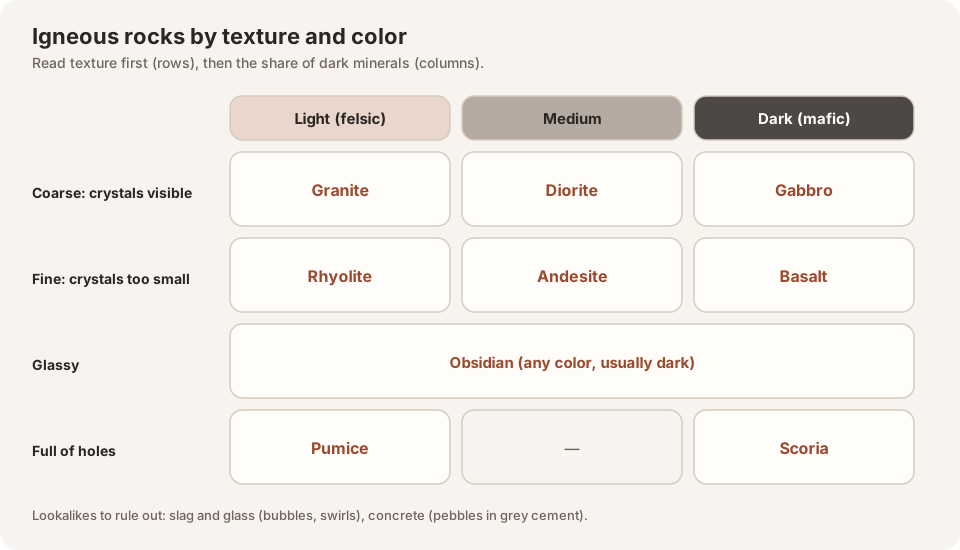
Find the row for the texture first, then the column for how much of the rock is dark minerals. Obsidian sits in its own row because glass can be any composition.
Diagram: Rock Identify. Simplified and not to scale.
Photograph the rock so the texture shows
Most igneous photos fail because only the weathered skin is shown or the light is flat. This order fixes both.
Find a fresh face: a broken edge beats a smooth weathered skin.
Put a coin beside the rock in the first shot so grain and vesicle size can be judged.
Shoot in daylight with light from the side so feldspar cleavage and glass luster flash.
Add a close shot a hand-width away, focused on grain edges or bubble walls.
For dark glassy pieces, hold a thin edge to a window and photograph the translucency.
Upload the three shots to Rock Identify and ask in the follow-up which clue separated the top candidate from the second.
Rule out slag, bottle glass and concrete first
Slag, the waste from smelting, is the usual false obsidian and false scoria. Look for colors no lava has (bottle green, blue, metallic swirls), bubbles stretched in one direction, rusty metal blebs and a flat poured base. It turns up near railroads, old furnaces and fill, not on a lava field.
River-tumbled bottle glass mimics obsidian pebbles. It has uniform color with no inclusions, even thickness, and sometimes mold seams or lettering; obsidian carries tiny crystals or flow bands and a smoky translucent edge.
Broken concrete with coarse aggregate gets uploaded as granite. The giveaway is rounded gravel of mixed rock types in a gray paste; granite's crystals interlock with nothing between them.
Reference photos of three textures
Site reference photos of the material, not finds from any one place; use them to calibrate coarse, fine and glassy at phone distance.
Granite: phaneritic, felsic
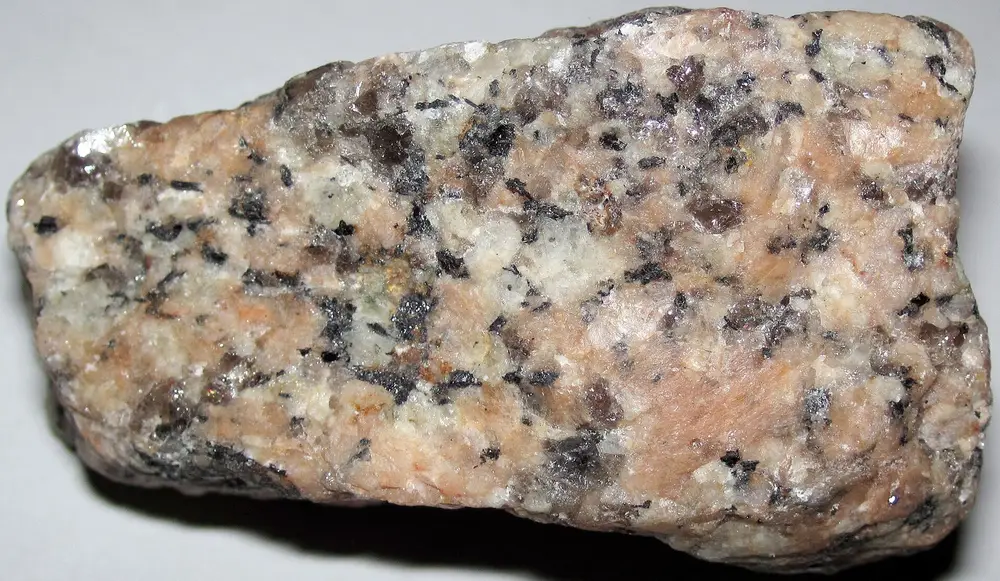
Reference photo of granite. Three separate minerals, flat feldspar faces that catch light, and no cement between grains.
Granite reference photo, not a find from the area this page covers. James St. John · CC BY 2.0 · Encyclopedia entry

Basalt: aphanitic, mafic
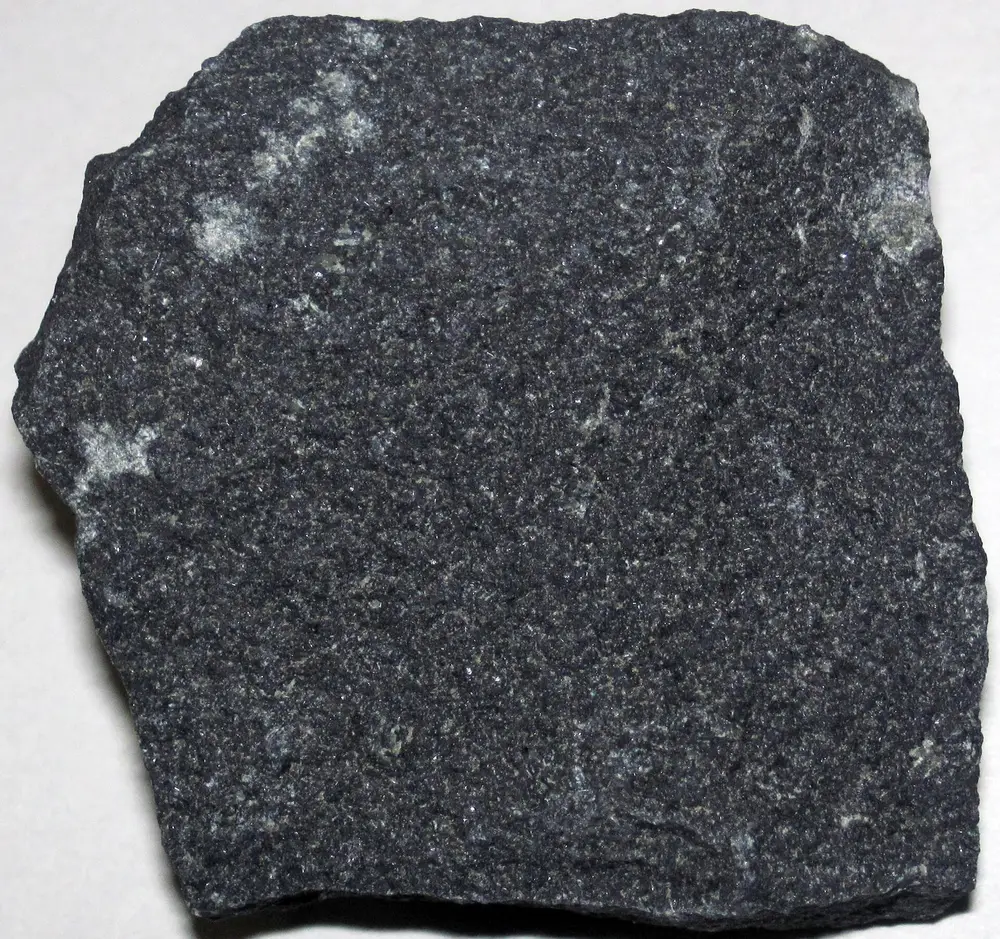
Reference photo of basalt. Dense and dull with no visible grains; any holes are round vesicles, not the stretched bubbles of slag.
Basalt reference photo, not a find from the area this page covers. James St. John · CC BY 2.0 · Encyclopedia entry

Obsidian: glassy
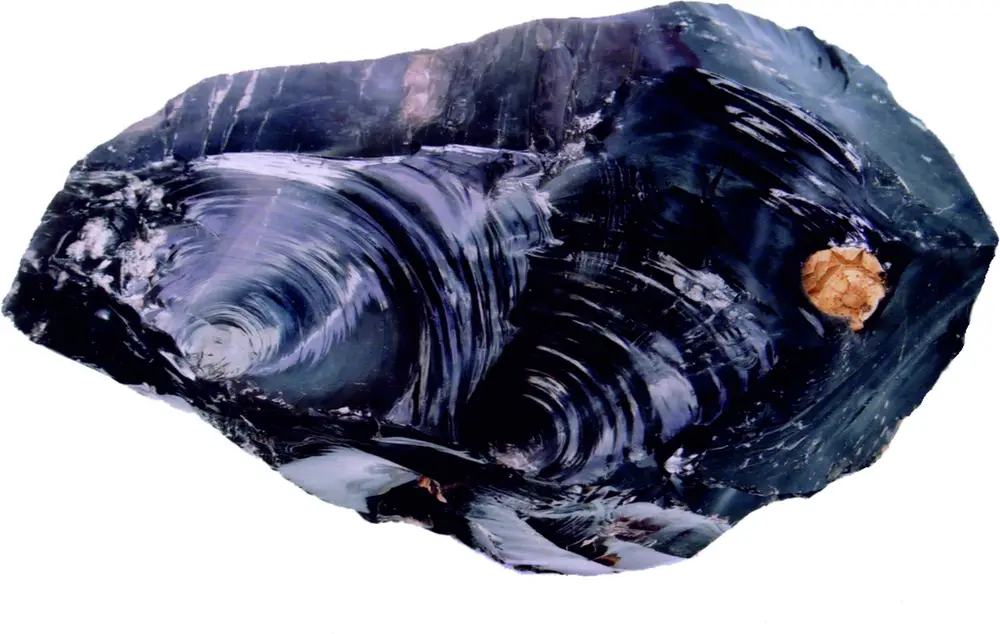
Reference photo of obsidian. Curved conchoidal ripples and glassy luster; a thin edge against daylight would show smoky translucency.
Obsidian reference photo, not a find from the area this page covers. IbrZulya · CC BY-SA 4.0 · Encyclopedia entry

Questions readers ask about igneous rocks in photos
Two questions that arrive with nearly every igneous upload.
Can a photo tell basalt from gabbro?
Yes, with a scale object in frame. They share chemistry; grain size is the whole difference. Gabbro shows individual gray plagioclase laths and black pyroxene grains, basalt shows none.
Is my black shiny rock obsidian or slag?
Hold a thin edge to a window: obsidian goes smoky translucent, slag usually stays opaque. Slag bubbles are stretched and often lined with metallic or green color, and the find spot is usually fill or an old industrial site. Obsidian fracture is clean and even in every direction.