
Identification guide
How to identify metamorphic rocks by foliation and sheen
To identify metamorphic rocks, look for a grain direction before anything else.
Heat and pressure rebuild a rock's minerals, and under directed pressure the flat and needle-shaped ones line up, producing foliation: a planar fabric the rock splits along or shows as bands. Foliated rocks climb a ladder of rising grain size and sheen, slate to phyllite to schist to gneiss. Non-foliated rocks are named by what they are made of: quartzite from sandstone, marble from limestone, hornfels from baked mudstone, amphibolite from basalt, serpentinite and soapstone from altered mantle rock. This page shows how to identify metamorphic rocks from a phone photo: the angle that reveals foliation, the pairs that confuse everyone (slate against shale, quartzite against sandstone and marble), and what a picture cannot decide.
Rock Identify takes one to three photos of the same specimen (JPG, PNG, WebP or HEIC, up to 40 MB each), returns up to three candidates with the visible evidence behind each, and allows one follow-up question; three identifications per day are free without an account.
Guide updated
Ask first whether the rock has a grain direction
Turn the piece under a window and watch for one orientation that behaves differently: a face that splits flat, a side with fine parallel lines, a glint that appears only from one direction, or light and dark bands all running one way. Any of those is foliation. A rock that looks the same from every side and breaks irregularly is non-foliated.
In a photo, foliation shows edge-on. Shoot the side of the piece, not the flat top, with light raking across at a low angle, then rotate ninety degrees and shoot again. Include any split face, since its quality (dull, silky, glittering or banded) places the rock on the ladder.
Climb the foliation ladder from slate to gneiss
Slate is the lowest rung: fine-grained, splitting into flat plates with a dull sheen, in gray, black, green or purple, with no visible grains. Photograph a plate edge-on for the thin flat parting and a plate face in soft light for the sheen.
Phyllite is slate with a silky luster. Grains are still invisible, but mica has grown enough to give the split face a satin shine, often crinkled. That luster is the whole identification and shows only in angled light: tilt the face until a sheet of soft reflection sweeps across it and shoot at that angle. Front-lit, phyllite looks like slate.
Schist is where mica becomes visible. The split face glitters with flakes of muscovite or biotite, the fabric is wavy, and round red garnets, staurolite or kyanite may sit in it. A close shot a hand-width from a fresh face in side light resolves the flakes; garnets with a coin deserve their own frame.
Gneiss is the top rung: coarse, with light bands of quartz and feldspar alternating with dark bands of mica or hornblende. It is mistaken for granite because the minerals match; granite scatters them evenly, gneiss sorts them into stripes. Frame the banding running across the picture with a coin at one edge.
The foliation ladder in one view
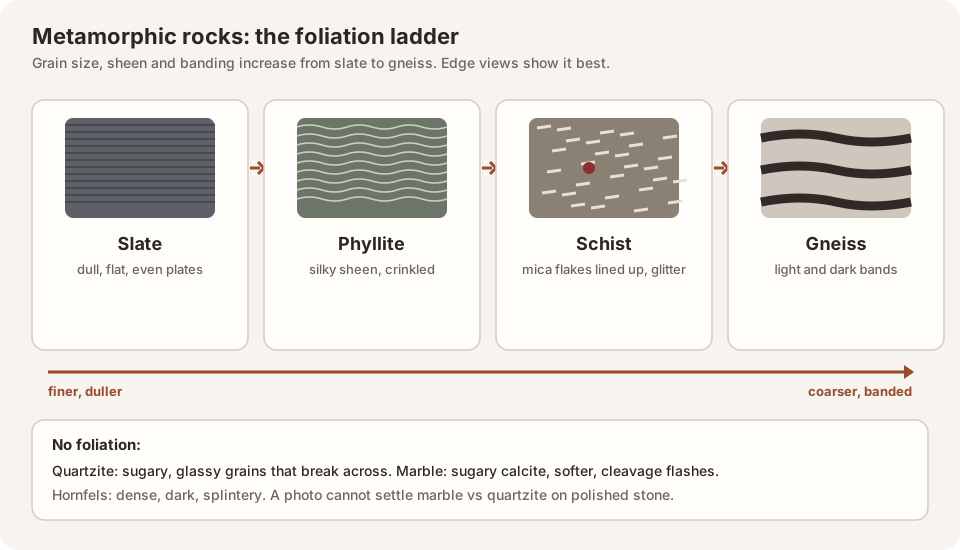
Each step to the right has coarser crystals and stronger layering. Photograph the edge of the rock as well as the face so the fabric shows.
Diagram: Rock Identify. Simplified and not to scale.
Slate or shale: the split and the ring
Both are gray, fine, and split into sheets, and the photos look alike. The safe home check is sound: tap two pieces together or tap one with a coin. Slate rings with a clear note; shale thuds. Slate plates are flatter, cleaner-edged and harder with a faint sheen, and the split often cuts across the original bedding, so color bands may cross the plate at an angle. Shale splits along the bedding, crumbles at the edges and stays matte.
Show the edge of the stack and one split face in side light, and report the ring test in the follow-up.
Non-foliated rocks: name them by what they are made of
Quartzite is sandstone whose grains have fused: hard, white, gray, pink or tan, breaking through the grains with a glassy, slightly conchoidal surface and shedding nothing when rubbed. Marble is recrystallized limestone: white to gray, often veined, with a sugary texture of calcite grains that flash flat cleavage faces when tilted in light.
Hornfels is mudstone baked by an intrusion: dark, dense, very fine, with no fabric and a slight conchoidal break, easily taken for basalt or chert. Amphibolite is metamorphosed basalt: black to dark green, built of hornblende needles that give a faint grain even without bands, often with white plagioclase specks. Serpentinite is altered mantle rock, mottled green to black with a waxy luster and slick, polished-looking surfaces. Soapstone is mostly talc: gray-green, fingernail-soft and soapy to the touch, a safe check on a common carving stone.
Quartzite against sandstone and against marble
Quartzite against sandstone can be settled from a good photo. Sandstone breaks around its grains, so the face is sugary with each grain standing proud; quartzite breaks through them, so the face is smoother and glassier, with old grain outlines faintly visible like ghosts. A close shot of the fracture in side light shows it.
Quartzite against marble cannot be settled by a photo when both are white and sugary. Marble often gives rhombic cleavage flashes and softer, rounded weathering; quartzite stays sharp-edged and glassy. The real difference is hardness, which is a test to describe, not to perform on a polished piece.
Photograph a metamorphic rock so the fabric shows
Foliation hides from front light and top-down shots.
Place the rock on a plain surface beside a coin and shoot the side of the piece edge-on.
Move the light, or the rock, so it rakes across the surface at a low angle and shoot again.
Tilt the split face until the sheen or glitter appears and photograph it at that tilt, not flat.
Take a close shot a hand-width away for mica flakes, garnets, calcite flashes or fused quartz grains.
If bands are present, frame them running across the picture with the coin at one edge.
Upload the edge view, the tilted face and the close-up to Rock Identify, then report the ring test or the soapy feel in your follow-up question.
How to identify metamorphic rocks side by side
Grain size and fabric rise together down the foliated rows; in the non-foliated rows, luster decides.
Rock | Fabric | Grain size and sheen | Distinctive clue | Lookalike |
|---|---|---|---|---|
Slate | Foliated, splits into plates | Invisible grains, dull sheen | Flat plates, rings when tapped | Shale |
Phyllite | Foliated, wavy | Invisible grains, silky sheen | Satin reflection sweeps across the tilted face | Slate, schist |
Schist | Foliated, crinkled | Visible mica flakes, glittering | Garnet or staurolite crystals in a mica fabric | Phyllite, gneiss |
Gneiss | Banded | Coarse, light and dark stripes | Feldspar eyes, folded bands | Granite |
Quartzite | None | Fused grains, glassy | Breaks through grains, sheds nothing | Sandstone, marble |
Marble | None, may be veined | Sugary, calcite flashes | Rhombic cleavage glints, soft weathering | Quartzite, dolomite |
Hornfels | None | Very fine, dull | Dense and dark, slight conchoidal break | Basalt, chert |
Amphibolite | Weak or none | Needle grains, silky | Black hornblende needles with white specks | Gabbro, diorite |
Serpentinite | None, often sheared | Fine, waxy to greasy | Mottled green with slick polished surfaces | Jade, soapstone |
Soapstone | None | Fine, dull | Fingernail-soft, soapy feel | Serpentinite |
Reference photos of three fabrics
Site reference photos of the material, not finds from any one place.
Gneiss: banded
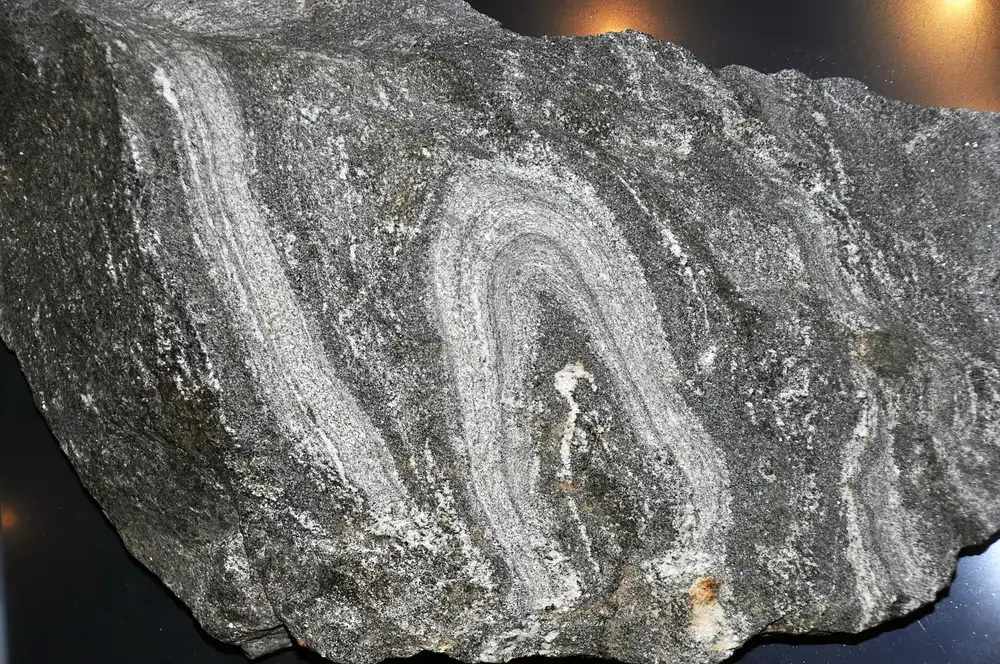
Reference photo of gneiss. Light quartz-feldspar bands alternate with dark mica or hornblende bands; granite would scatter the same minerals evenly.
Gneiss reference photo, not a find from the area this page covers. James St. John · CC BY 2.0 · Encyclopedia entry

Schist: glittering mica
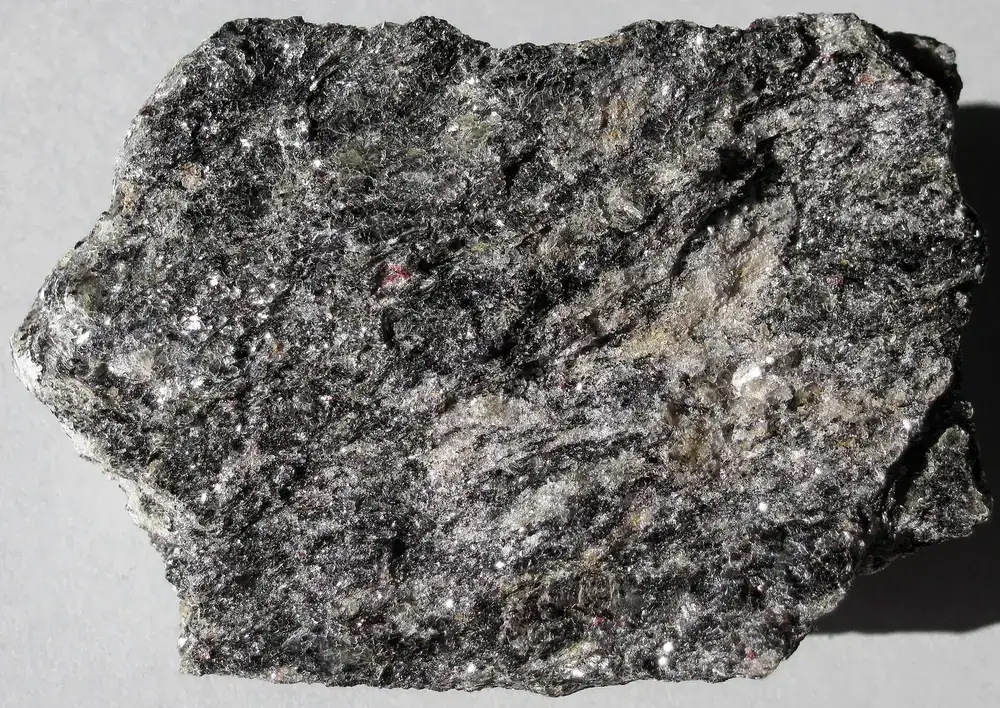
Reference photo of schist. Mica flakes line up along the foliation and catch side light, which is why a tilted shot is needed.
Schist reference photo, not a find from the area this page covers. James St. John · CC BY 2.0 · Encyclopedia entry

Quartzite: fused grains
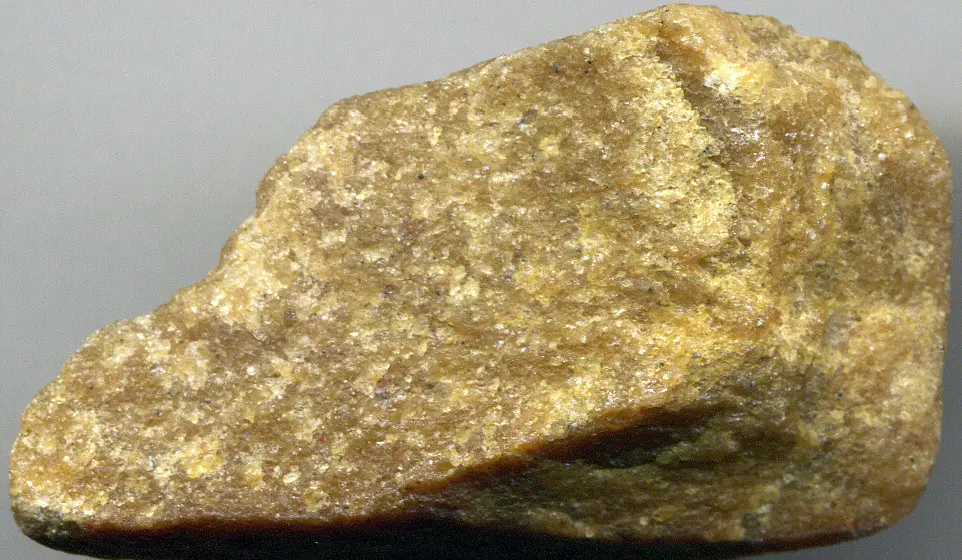
Reference photo of quartzite. The fracture runs through the grains and looks glassy; sandstone would show a sugary surface instead.
Quartzite reference photo, not a find from the area this page covers. James St. John · CC BY 2.0 · Encyclopedia entry

Questions readers ask about metamorphic rocks in photos
Two questions that arrive with nearly every metamorphic upload.
My rock looks like granite but has stripes. Gneiss?
Probably. Granite and gneiss share quartz, feldspar and mica; gneiss sorts them into light and dark bands. If the dark minerals form distinct stripes rather than scattered specks, gneiss is the answer.
Is a white sugary rock quartzite or marble?
A photo cannot settle it. Look for flat calcite flashes and rounded weathering (marble) against glassy fused grains and sharp edges (quartzite), and say in the follow-up whether the piece is a natural find or a polished stone, which should not be scratched.