
Identification guide
How to identify sedimentary rocks by grain size and layering
To identify sedimentary rocks, ask two questions in order: can you see the individual grains, and does the rock have layers?
Sedimentary rocks are pieces of older rock, shells or chemical crusts that settled in beds and were cemented, so the pieces and the beds are the identification.
Pebbles cemented together are conglomerate or breccia; sand grains you can see are sandstone; mud too fine to see is siltstone, mudstone or shale; shell and lime are limestone, coquina or chalk; chert, coal and the evaporites each have a single giveaway. This page shows how to identify sedimentary rocks in that order from the clues a phone can capture, and says what a picture cannot settle.
Rock Identify takes one to three photos of the same specimen (JPG, PNG, WebP or HEIC, up to 40 MB each), returns up to three candidates with the visible evidence for each, and allows a follow-up question; three identifications per day are free without an account. Because this group leans on grain size, put a coin in the frame.
Guide updated
Decide first whether you can see individual grains
Hold the rock at reading distance in daylight. If separate grains show, grain size names the rock: larger than a pea is gravel (conglomerate, breccia), down to the finest grit a fingernail can feel is sand (sandstone), and finer is silt or mud. If the surface is smooth and even with no grains, the rock is a mudstone, a limestone or chalk, or a chert, and the next clues are splitting, fossils and luster.
Rub a broken face with a fingertip: sandstone feels like sandpaper and sheds a grain, siltstone is faintly gritty, mudstone and shale feel like dried clay, chert feels waxy.
Grain sizes and the rocks they make
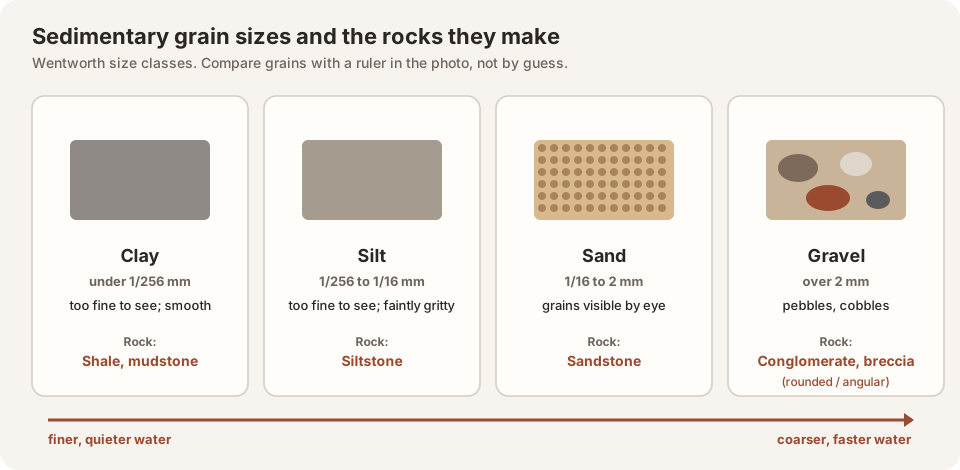
Clay and silt are too fine to see; sand grains show by eye; anything over two millimeters is gravel. Put a ruler in the photo so the grain size can be read.
Diagram: Rock Identify. Simplified and not to scale.
Pebble-sized pieces: conglomerate against breccia
Both are cemented gravel. Conglomerate clasts are rounded and usually of several rock types; breccia clasts are angular and often one rock type, because they broke in place and never traveled. The cement may be white calcite, rusty iron or gray silica, and deserves its own close shot.
Shoot straight down on a face with at least ten clasts beside a coin so roundness can be judged. Concrete is the lookalike: rounded aggregate, but in a uniform gray paste with air pockets and usually a flat formed face.
Sand-sized grains: sandstone and its sugary surface
Sandstone is sand grains, usually quartz, glued together. A fresh face is sugary, each grain catches a tiny highlight, and a fingernail can dislodge one. Cement sets the color: red and brown mean iron oxide, white means calcite, gray and glassy means silica. Bedding shows as parallel lines of changing grain size or color; cross-bedding shows those lines meeting at low angles.
Photograph the broken face at a slant so the grains sparkle, then the edge so bedding shows. If the rock breaks through the grains with a glassy surface and sheds nothing, it is quartzite and belongs on the metamorphic page.
Grains too small to see: siltstone, mudstone and shale
These are the fine end and the hardest for a camera. Shale is fissile: it splits along bedding into thin flat sheets, and a weathered piece looks like a stack of stiff paper. Mudstone has the same grain size but breaks into blocks. Siltstone is slightly gritty with faint laminations. All three run gray, black, red-brown or olive.
The photo that works is an edge view in side light, where fissility shows as fine parallel lines like a closed book; a top-down shot of a smooth gray surface identifies nothing. Slate is the lookalike: harder, with a dull sheen, and it rings when tapped.
Limestone, coquina and chalk: rocks made of shell and lime
Limestone is usually gray, sometimes tan or near white, dull and fine, and often holds visible fossils: crinoid stems like stacked discs, brachiopods, coral, shell hash. It weathers to a pitted surface with solution grooves. A gray fine rock with a fossil is a strong limestone case; without one it could equally be mudstone, dolomite or hornfels. Limestone fizzes in acid, but a photo cannot show that; fossils, pitting and the weathered rind are the evidence.
Coquina is limestone made of loosely cemented shell fragments, cream to tan, full of voids like granola. Chalk is very fine, soft, white and marks your fingers. Shoot both with a coin in side light so fragments throw shadows.
Chert, coal and the evaporites
Chert is silica, not lime, and sits in limestone as gray, tan or black nodules and bands. It is hard, breaks with a waxy conchoidal fracture and sharp edges, and often shows a white weathered rind over a darker core. Shoot a broken nodule so rind and core are both in frame.
Coal is black, light and blocky. Bituminous coal shows alternating dull and bright bands; anthracite is glossy with conchoidal fracture and passes for obsidian until you feel the weight.
Evaporites, mainly gypsum and rock salt, are rare as loose finds: gypsum is white, pink or clear with satin faces, rock salt is clear to orange with cubic cleavage, and both are soft enough for a fingernail to mark.
How to identify sedimentary rocks from clues a photo carries
Photographable clues are bedding planes, clast roundness, cement color, fossils, fissility on an edge, the weathering rind against a fresh break, and shell voids. A photo cannot show fizz, hardness, weight, grit or smell.
Rock | Grain size | Layering and fabric | Distinctive clue | Lookalike |
|---|---|---|---|---|
Conglomerate | Gravel, rounded | Crude beds | Mixed rounded pebbles in cement | Concrete |
Breccia | Gravel, angular | Usually none | Sharp-cornered clasts, often one rock type | Fault rubble, road fill |
Sandstone | Sand, visible grains | Beds, cross-beds | Sugary face that sheds grains | Quartzite, tuff |
Siltstone | Silt, barely gritty | Thin laminations | Smooth with faint lines, breaks in slabs | Mudstone |
Shale | Mud, none visible | Fissile, splits into sheets | Edge like a closed book, chips at the base | Slate |
Limestone | Fine, none visible | Thick beds | Fossils, pitted weathering, gray | Dolomite, mudstone, hornfels |
Coquina | Shell fragments | Crude beds | Loose shell hash full of voids | Beach rock |
Chalk | None visible | Massive | Soft, white, marks fingers | Diatomite, kaolin |
Chert | None visible | Nodules or bands in limestone | Waxy conchoidal fracture, white rind | Quartzite, jasper |
Coal | None visible | Dull and bright bands | Black, very light, blocky | Obsidian (anthracite) |
Gypsum, rock salt | Crystalline | Beds | Fingernail-soft, satin or cubic faces | Calcite, quartz |
Photograph a sedimentary rock for identification
Three shots cover nearly every sedimentary rock: a face, an edge and a close-up.
Find a fresh face; the weathered rind on limestone and chert hides the real color and grain.
Lay the rock on a plain background with a coin and shoot straight down on the broken face.
Turn it on its side and shoot the edge in side light to catch bedding, laminations or fissility.
Move the lens a hand-width away and focus on a patch of grains, shell fragments or clasts.
If a fossil, nodule or rind is present, make that the third photo instead of a second overview.
Upload the set to Rock Identify and report grit, weight or splitting in the follow-up.
Reference photos of three grain sizes
Site reference photos of the material, not finds from any particular place.
Sandstone: sand-sized grains
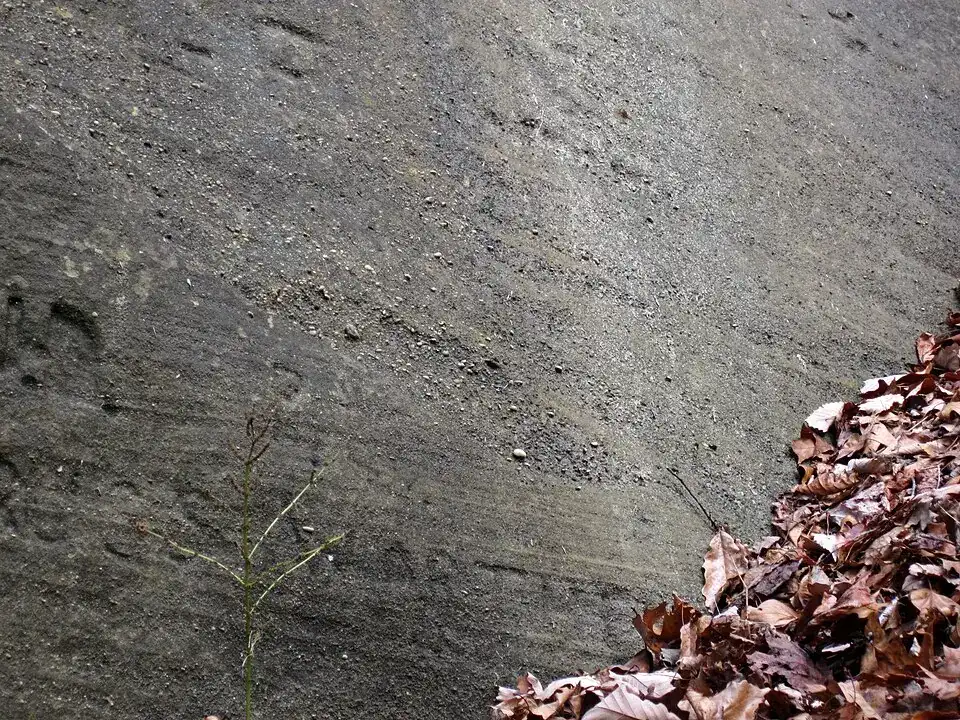
Reference photo of sandstone. The sugary surface and warm cement color are the clues; grains are separate, not interlocking.
Sandstone reference photo, not a find from the area this page covers. James St. John · CC BY 2.0 · Encyclopedia entry

Conglomerate: rounded gravel
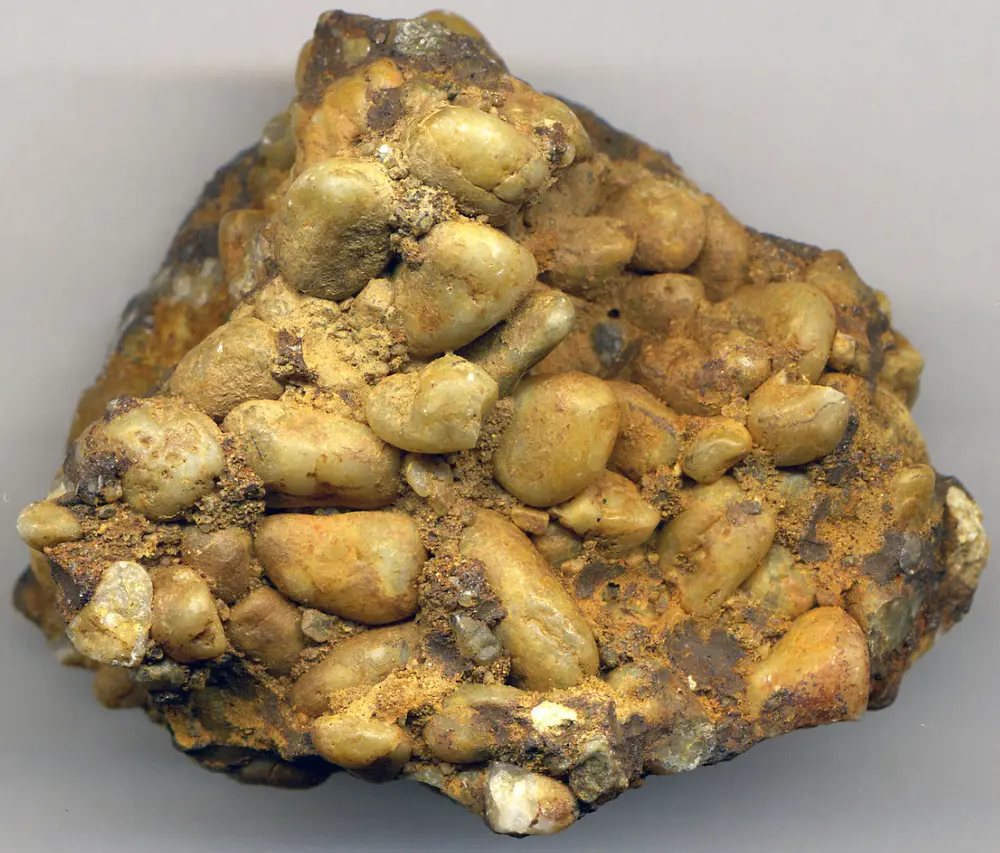
Reference photo of conglomerate. Rounded clasts of more than one rock type sit in finer cement; angular clasts would make it breccia.
Conglomerate reference photo, not a find from the area this page covers. James St. John · CC BY 2.0 · Encyclopedia entry

Shale: mud that splits
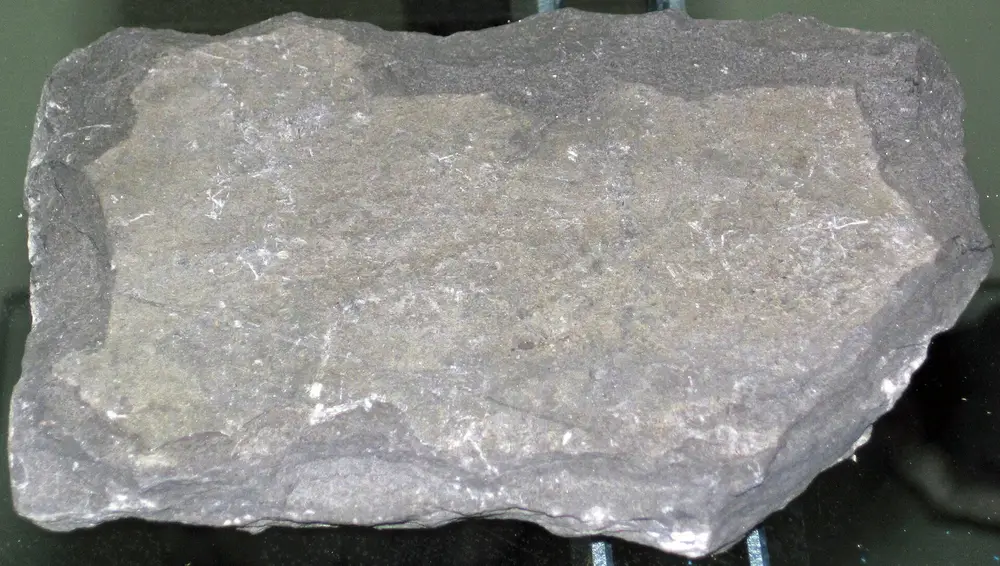
Reference photo of shale. Fine parallel partings along the edge show fissility, which separates it from blocky mudstone.
Shale reference photo, not a find from the area this page covers. James St. John · CC BY 2.0 · Encyclopedia entry

Questions readers ask about sedimentary rocks in photos
Two questions that arrive with nearly every sedimentary upload.
Can a photo confirm limestone without an acid test?
It can make a strong case, not a proof. Visible fossils, a pitted rind, gray color and soft rounded edges together point to limestone. Without a fossil, a photo cannot separate limestone from dolomite or a fine gray mudstone, and this site does not ask you to apply acid.
How do I tell river conglomerate from old concrete?
Look between the pebbles. Concrete has a uniform gray paste with trapped air bubbles and often a flat formed face or rust stain from rebar. Conglomerate cement is sandy and varies in color across the piece.