
Identification guide
Mineral identification key: one property at a time
Start this mineral identification key by checking the luster of one specimen under a lamp. Does it reflect light like metal?
Work through streak, a household hardness ladder, cleavage or fracture, crystal shape and heft to narrow the candidates. Use an area that appears to be a single mineral. A rock with several minerals may give different answers across the same surface.
Follow the steps in order and write each answer down. A photo settles luster, crystal form and visible breaks; it cannot settle hardness, streak, heft or magnetism, so each step says whether it is yours or something Rock Identify can read.
Guide updated
Step one: metallic or non-metallic luster
Tilt a fresh, dry surface under a lamp. A metallic mineral is opaque even in thin slivers and reflects like polished or tarnished metal: brassy pyrite, lead-grey galena, black magnetite, steel-grey hematite. Everything else is non-metallic, and the kind matters: glassy like quartz, pearly like a mica face, greasy like talc, dull like earthy hematite. A photo in angled light settles this step if the specimen is dry; water fakes a glassy shine.
Pyrite: metallic luster on striated cubes
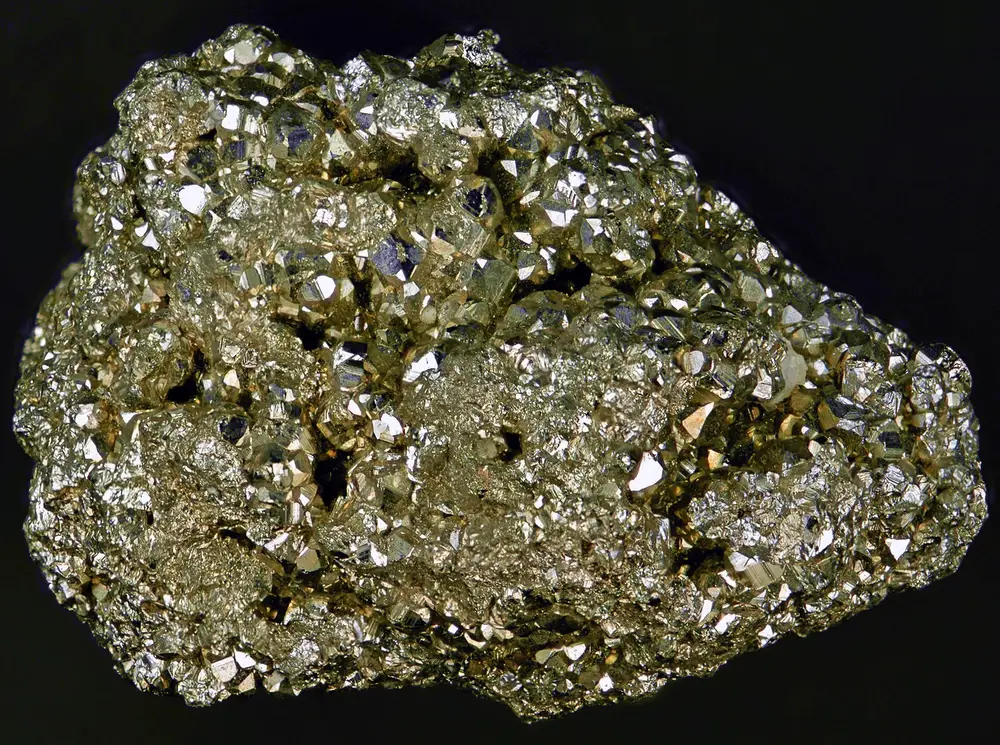
Reference photo of pyrite, not a find from any particular place. Brassy metallic faces with fine parallel lines on each cube; a photo reads the luster and cube habit, not the greenish-black streak.
Pyrite reference photo, not a find from the area this page covers. James St. John · CC BY 2.0 · Encyclopedia entry

Step two: color and the streak you cannot photograph
Color is the least reliable property for non-metallic minerals: quartz, calcite and fluorite each come in many colors, so record it but do not decide on it. For metallic minerals the powder color, the streak, is diagnostic. Rub an inconspicuous corner of a common specimen on the unglazed back of a white tile: hematite leaves red-brown whatever its surface color, pyrite greenish black, magnetite black, galena lead grey.
Streak needs that tile; a finger, paper or a photo cannot give it. A mineral harder than the tile, about Mohs 6.5, leaves no streak and scratches the porcelain instead. Never streak a polished piece, a crystal cluster or anything of possible value.
Step three: the hardness ladder with household objects
Work up the ladder from the softest tool: a fingernail is about 2.5, a clean copper coin about 3, a steel nail or a glass plate about 5.5. Press the tool on an inconspicuous spot of a common specimen, wipe it, and check with a lens for a groove rather than a metal smear. The first tool that truly scratches brackets the hardness: fingernail marks talc and gypsum, coin marks calcite, nail marks fluorite and feldspar, and nothing household marks quartz or garnet.
Mohs numbers are rankings, not measurements, and each mineral sits in a range, so use the ladder to bracket rather than pin. Do no scratch test on a gem, a cut stone or a specimen you may sell.
Step four: cleavage planes or fracture surfaces
Look at every broken edge, not the crystal faces. Cleavage shows as flat, mirror-like planes that repeat in steps and flash together when you tilt the specimen. Count the directions and judge the angle: one direction gives sheets (mica); two at right angles gives blocky steps (feldspar); two at about 60 and 120 degrees gives splinters (hornblende); three at right angles gives cubes (galena); three oblique gives rhombs (calcite); four gives octahedral corners (fluorite).
No flat planes means fracture. Curved, shell-like conchoidal surfaces with fine ribs are typical of quartz, garnet and olivine; uneven fracture is common in pyrite. Lit from the side, a photo shows stepped cleavage and conchoidal ribs well enough for the tool to use.
Calcite: three cleavages that are not at right angles
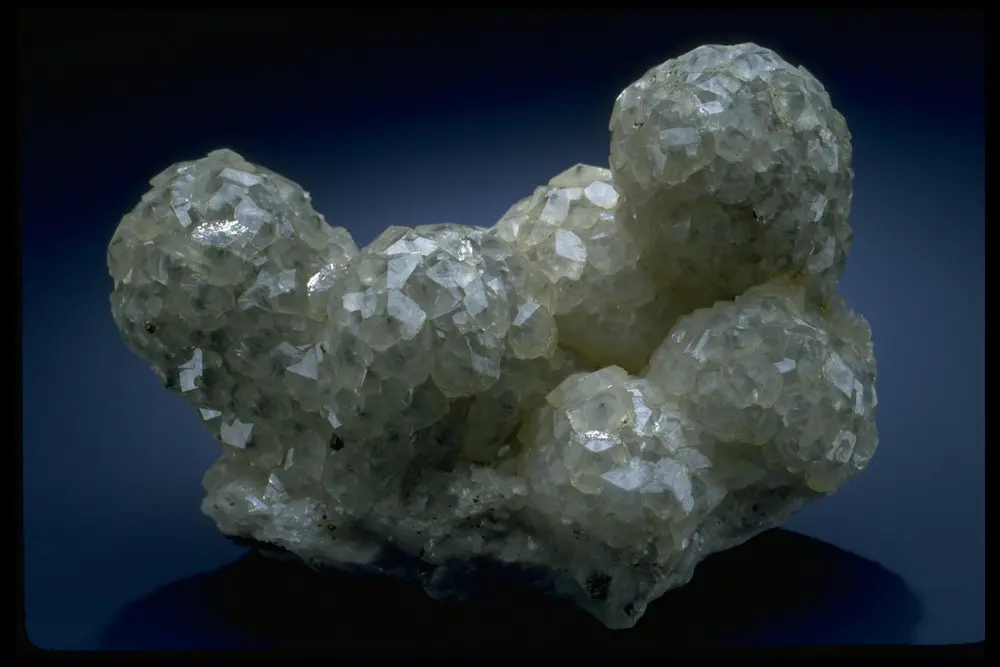
Reference photo of calcite. Every broken fragment is a rhomb with slanted faces, and the pearly to glassy flash from those cleavage planes shows in angled light; its softness to a coin does not.
Calcite reference photo, not a find from the area this page covers. Smithsonian Institution, National Museum of Natural History, Mineral Sciences Department · CC0 1.0 · Encyclopedia entry
Step five: crystal habit, then heft
If any crystal faces survive, name the shape: striated cubes for pyrite, cubes for galena and fluorite, six-sided prisms for quartz, rhombs for calcite, flat books for mica, twelve-sided balls for garnet, bladed crystals for gypsum, long prisms for hornblende. Habit photographs well and is the main thing the tool reads beyond luster.
Then weigh the specimen in your hand against a quartz pebble of the same size. Galena feels nearly three times as heavy, magnetite, hematite and pyrite about twice, while most pale minerals feel like quartz. A fridge magnet that clings firmly points to magnetite. Heft and magnetism do not show in any photo.
The mineral identification key in six couplets
1a. Metallic luster, opaque, reflects like metal: go to 2. 1b. Non-metallic: glassy, pearly, greasy, silky or dull: go to 3.
2a. Brassy cubes or masses, hard, greenish-black streak: pyrite. 2b. Lead-grey cubic cleavage, very heavy, soft: galena. 2c. Black, strongly magnetic: magnetite. 2d. Steel-grey or red-brown, red-brown streak: hematite.
3a. Fingernail or coin scratches it: go to 4. 3b. Only a steel nail scratches it, or nothing household does: go to 5.
4a. Greasy feel, fingernail marks it easily: talc. 4b. Fingernail marks it, clear tabular or satin fibrous crystals: gypsum. 4c. Thin flexible sheets peel off: mica. 4d. Coin marks it, rhomb cleavage: calcite.
5a. Breaks on flat planes: go to 6. 5b. No flat planes, conchoidal or uneven fracture: quartz if glassy six-sided prisms; garnet if red-brown and twelve-sided; olivine if olive-green sugary grains.
6a. Four cleavage directions, cubes, often purple or green: fluorite. 6b. Two cleavages at right angles, blocky, pink, white or grey: feldspar. 6c. Two cleavages at about 60 and 120 degrees, dark prisms: hornblende.
The six couplets as a flowchart
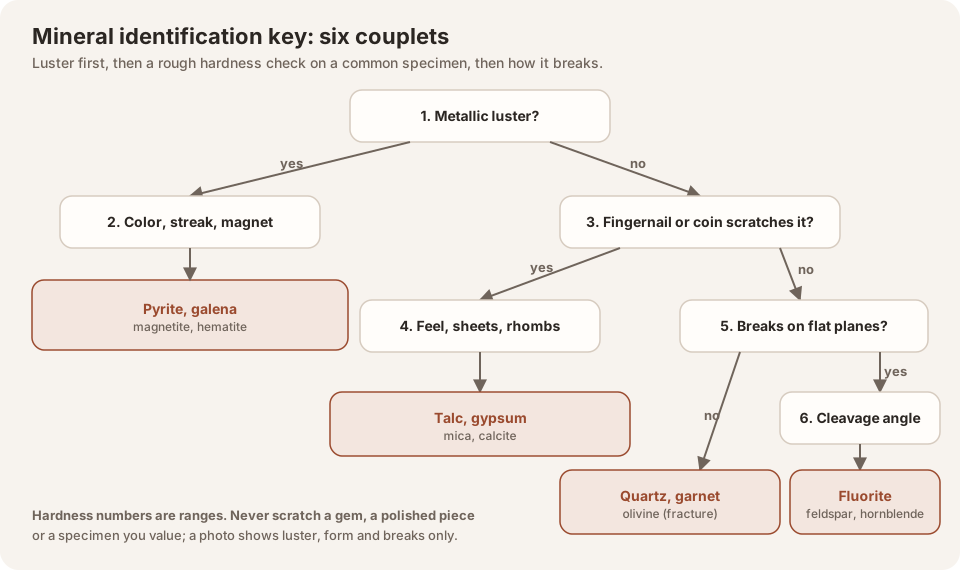
The same key as the numbered couplets, drawn as branches. The hardness steps apply only to common specimens you are willing to mark.
Diagram: Rock Identify. Simplified and not to scale.
Worked example: a pale pink blocky mineral
The specimen is pale pink and blocky with a glassy to slightly pearly shine, so couplet 1 goes to 3. A fingernail and a coin leave nothing and a steel nail skates off, so 3b goes to 5. The broken corner shows two sets of flat faces meeting at about a right angle, stepping down like a staircase, so 5a goes to 6, and two cleavages at right angles in a pink blocky habit is potassium feldspar.
Had the same pink specimen been rounded and greasy-glassy, with curved conchoidal breaks and no flat planes, 5b would have ended at rose quartz. That difference, stepped planes versus shell-like curves, is what to photograph from the side.
Fluorite: four cleavage directions in a cube
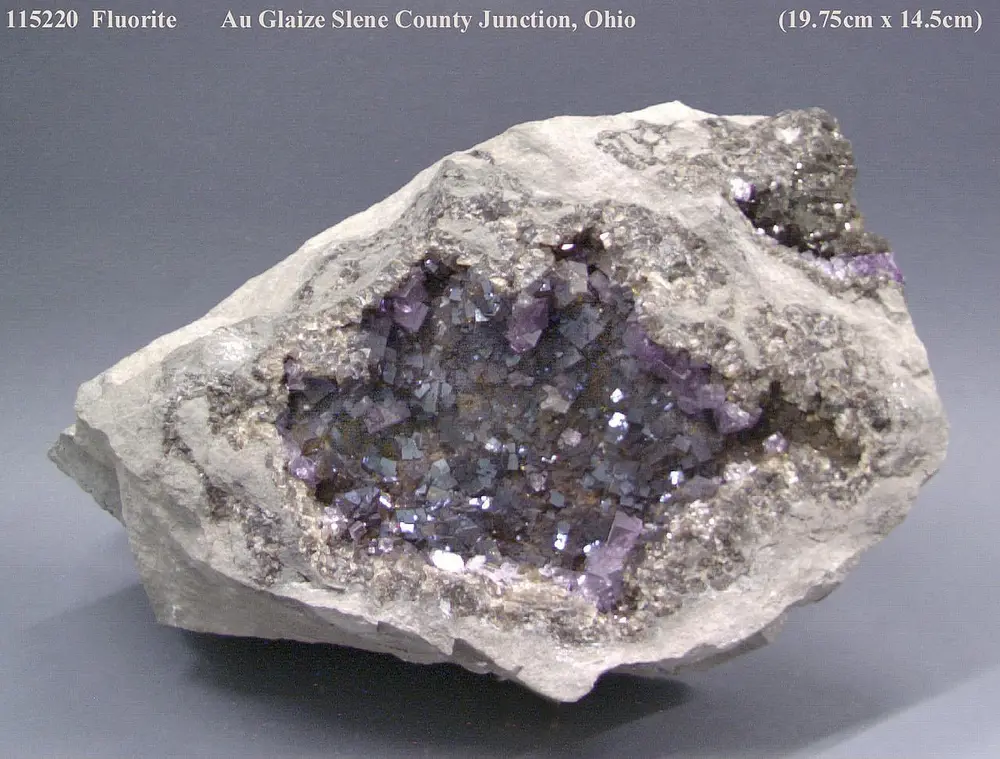
Reference photo of fluorite. Cubic crystals whose corners break off as flat triangles, the sign of octahedral cleavage; a photo shows the cubes and glassy luster, while a steel nail marking it is your step.
Fluorite reference photo, not a find from the area this page covers. Smithsonian Institution, National Museum of Natural History, Mineral Sciences Department · CC0 1.0 · Encyclopedia entry
Common minerals compared by what the photo shows
Typical hardness is a range to bracket with, not to pin. The last column is what Rock Identify can read from one to three JPG, PNG, WebP or HEIC photos, up to 40 MB each, before returning three candidates with the visible evidence for each and taking a follow-up question; three identifications a day are free without an account.
Mineral | Luster | Cleavage or fracture | Typical hardness | What the photo shows |
|---|---|---|---|---|
Quartz | Glassy | None; conchoidal fracture | 7 | Six-sided prisms, curved glassy breaks |
Feldspar | Glassy to pearly | Two cleavages near 90 degrees | 6 to 6.5 | Blocky, flat stepped faces that flash |
Calcite | Glassy to pearly | Three cleavages, rhombs | 3 | Rhomb fragments, often translucent |
Mica | Pearly | One perfect cleavage, sheets | 2 to 3 | Thin flexible flakes in books |
Pyrite | Metallic, brassy | None; uneven fracture | 6 to 6.5 | Striated cubes, brass color |
Galena | Metallic, lead grey | Three cleavages at 90 degrees | 2.5 | Bright cubic steps, dull tarnish |
Hematite | Metallic or earthy | None; uneven | 5 to 6.5 | Kidney-shaped masses or glittery plates |
Magnetite | Metallic, black | None; octahedra | 5.5 to 6.5 | Black octahedra or granular masses |
Fluorite | Glassy | Four cleavages, octahedral | 4 | Cubes with cut corners |
Gypsum | Glassy, pearly or silky | One perfect cleavage, bends | 2 | Clear tabular crystals or satin fibers |
Talc | Pearly to greasy | One cleavage, usually massive | 1 | Soapy-looking pale masses |
Garnet | Glassy to resinous | None; conchoidal to uneven | 6.5 to 7.5 | Red-brown twelve-sided crystals |
Hornblende | Glassy to dull | Two cleavages at 60 and 120 degrees | 5 to 6 | Black or dark green elongated prisms |
Olivine | Glassy | Poor cleavage; conchoidal | 6.5 to 7 | Olive-green sugary grains |
How do I tell quartz from calcite in a photo?
Look at the broken edges. Calcite breaks into rhombs with flat slanted faces; quartz breaks in curved, shell-like surfaces with no flat planes. If polish hides both, only a coin on an inconspicuous spot of a rough piece separates them: it marks calcite, not quartz.