
Identification guide
Rock Identification Key for 27 Common Rocks
Start this rock identification key with a dry, fresh surface. Choose the better match at each numbered step to narrow the rock type.
The key covers twenty-seven common rocks. Look for glass, holes, cemented fragments, aligned minerals or interlocking grains, using a hand lens if you have one.
Read both halves of every couplet before choosing, take the half that fits better, and go to the number it gives. Where eyes alone cannot settle a split, the key says so and names the check, so you know when to stop and when to upload a photo to Rock Identify for a second opinion.
Guide updated
What the key assumes you are looking at
Work in angled light on a dry, clean chip or other existing break. Weathering can obscure grains and change the color. Keep valuable or unfamiliar samples intact.
Use a hand lens to compare coarse grains you can see separately, a fine texture without distinct grains, and a smooth glassy or dense face. If the whole specimen seems to be one crystal, use the mineral key.
The rock identification key, couplet by couplet
Start at couplet 1. Follow the arrow to the next number or keep the suggested rock as a candidate. If neither choice fits, keep the result open and compare a second surface.
1a. A continuous glassy face, or abundant rounded gas holes throughout the fresh surface → 2. 1b. A solid or layered surface, including dense fine rock with scattered holes → 4.
2a. Continuous dark volcanic glass with sharp edges and curved, shell-like breaks: obsidian. 2b. Abundant holes separated by a dull or finely textured matrix → 3.
3a. Very light for its size, usually pale, with a tight froth of fine holes and thin walls: pumice. 3b. Heavier, commonly dark or reddish, with larger holes → 27.
4a. No bedding, mineral bands, aligned flakes or cemented fragments. The face is solid and fine or has interlocking grains → 28. 4b. Bedding, aligned minerals, sheet-like splitting, shell fragments, or visibly cemented grains → 12.
5a. Crystals coarse enough to see one by one across the whole rock → 6. 5b. Crystals too fine to separate by eye, with or without a few larger ones → 9.
6a. Most crystals thumbnail size or larger, often with big mica sheets or long feldspar bars: pegmatite. 6b. Crystals a millimeter to pea size and fairly even → 7.
7a. Mostly light, with pink or white feldspar and grey glassy quartz, dark minerals in the minority: granite. 7b. Dark minerals half or more → 8.
8a. Salt-and-pepper white and black, little or no visible quartz: diorite. 8b. Dark grey to black throughout, sometimes greenish, heavy in hand: gabbro.
9a. Light colored, pink, cream or pale grey → 10. 9b. Medium grey to black → 11.
10a. Hard, with flow bands or small glassy quartz crystals: rhyolite. 10b. Soft, dull and chalky-looking with visible ash shards, pumice bits or rock fragments: tuff.
11a. Medium grey or purplish with small white feldspar crystals scattered through it: andesite. 11b. Dark grey to black, dense, with or without round vesicles: basalt.
12a. Mineral bands, lined-up mica or pervasive planar cleavage, especially where it crosses bedding → 21. 12b. Sedimentary beds, cemented fragments or shells, or thin splits along mud layers → 13.
13a. Fragments larger than a pea in a finer matrix → 14. 13b. Nothing larger than a pea → 15.
14a. Fragments rounded like stream pebbles: conglomerate. 14b. Fragments angular and sharp-edged: breccia.
15a. Sand-size grains you can see and feel, gritty: sandstone. 15b. Grains too small to see one by one → 16.
16a. Black and light in hand, with a sooty or shiny surface and blocky breaks: coal. 16b. The specimen lacks that combination → 17.
17a. Smooth, very hard, waxy to glassy, curved fracture, no grains; grey, brown, red or black: chert. 17b. Softer, or clearly mud, silt or shell → 18.
18a. Visible shell fragments loosely cemented, full of gaps: coquina. 18b. Fine and even → 19.
19a. Pale grey, cream or tan, dull to finely crystalline, may hold fossil fragments: limestone. 19b. Grey, brown, red or green mudrock → 20.
20a. Splits into thin flat plates, smooth to the touch: shale. 20b. Does not split readily, faintly gritty to a fingertip: siltstone.
21a. Splits into flat sheets, grains not visible → 22. 21b. Grains or crystals visible, or no sheet-like splitting → 23.
22a. Dull flat surfaces, splits into thin even slabs: slate. 22b. Silky sheen on slightly crinkled surfaces: phyllite.
23a. Continuous sparkle of mica flakes all lined up, sometimes with garnets: schist. 23b. No continuous mica sheen → 24.
24a. Alternating light and dark bands of coarse crystals: gneiss. 24b. No bands → 25.
25a. Very fine, hard and splintery, with no layering and evidence of heating near an intrusion: hornfels. 25b. Sugary interlocking grains dominated by one mineral → 26.
26a. Very hard, with a fracture that cuts across the grains. A steel nail cannot scratch a clean grain: quartzite. 26b. Softer, often white, grey or veined. A steel nail can scratch a clean calcite grain: marble candidate.
27a. Open holes dominate the rock and little solid material separates them: scoria candidate. 27b. Rounded holes sit in a substantial, dark, fine-grained groundmass: vesicular basalt candidate. If texture falls between these, keep both candidates.
28a. Sugary interlocking grains dominated by one mineral, or a fine splintery rock from a known baked contact → 25. 28b. Several recognizable minerals or dense, unbanded groundmass without those clues → 5.
The first branches of the key
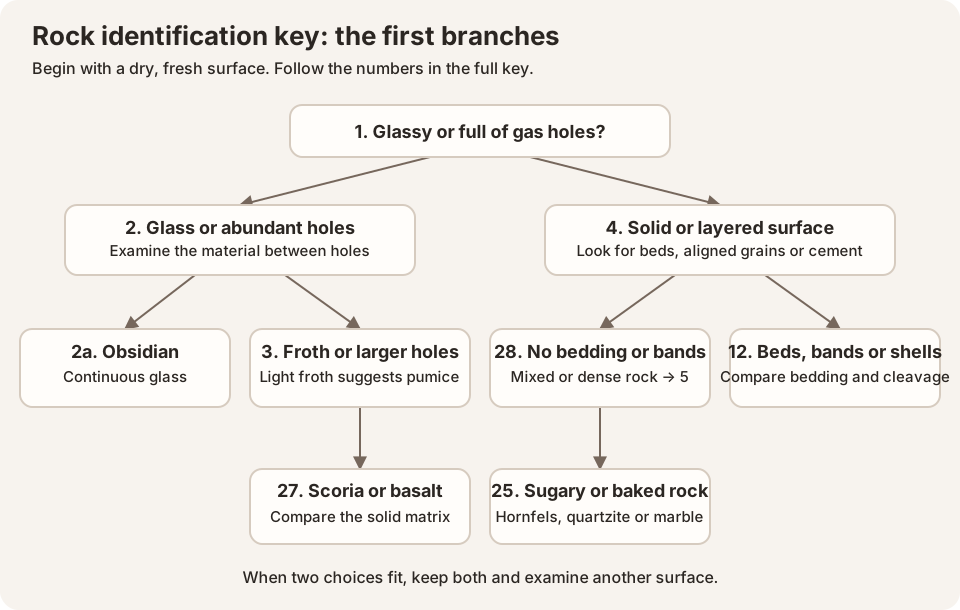
Use the numbered branches to return to the full key. Compare the amount of solid material between holes and look for mineral bands before moving on.
Diagram: Rock Identify. Simplified and not to scale.
Worked examples from the rock identification key
Diorite: A fresh face shows interlocking white feldspar and dark minerals. Follow 1b, 4a and 28b, then 5a, 6b and 7b. The salt-and-pepper pattern and lack of obvious quartz fit 8a.
Vesicular basalt: A dark cobble has many rounded holes but substantial dense material between them. Follow 1a, 2b, 3b and 27b. With just a few scattered holes, take 1b, 4a, 28b, 5b, 9b and 11b instead. Both paths keep basalt in view.
Quartzite or marble: An unbanded, sugary pale rock goes through 1b, 4a, 28a and 25b to 26. On a rough, expendable chip, a nail skates over quartz grains but can scratch calcite. Leave the candidates open when the sample is polished or the scratch is unclear.
Diorite: the salt-and-pepper end point
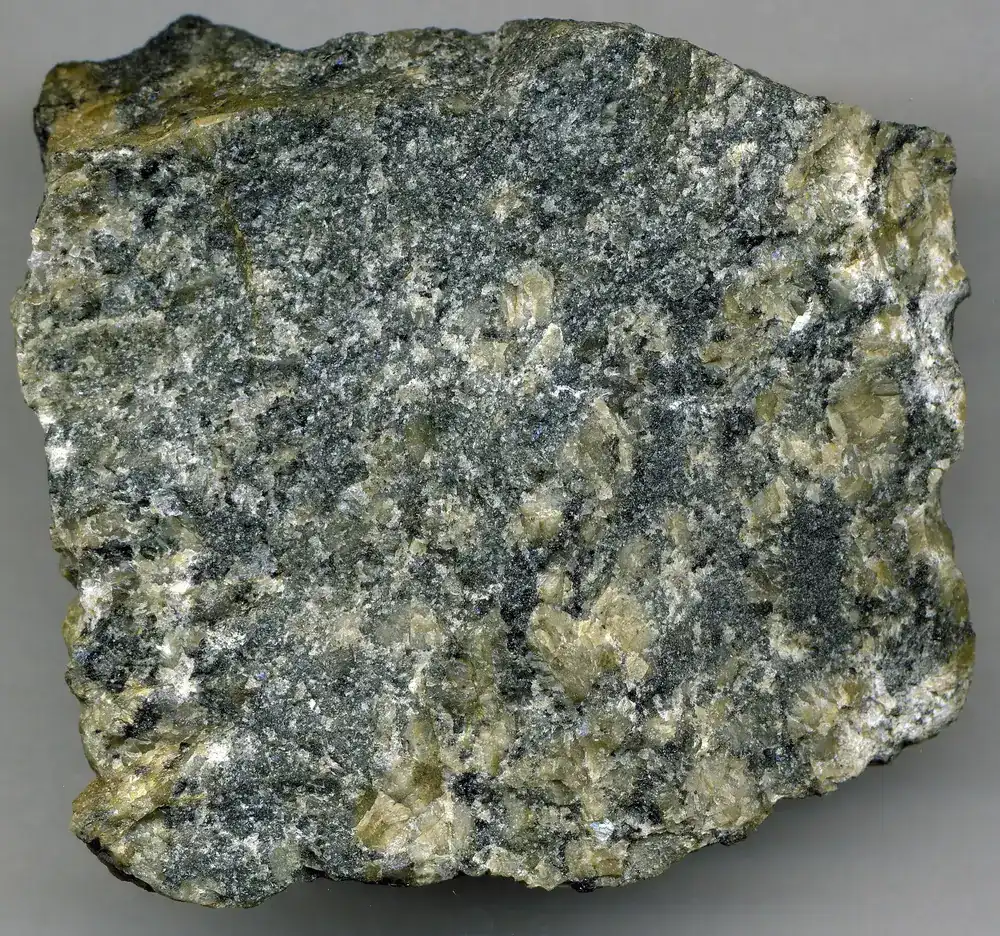
Reference photo of diorite, not a find from any particular place. White feldspar and black hornblende in roughly equal amounts, interlocking, with no glassy quartz and no bands: the texture of couplet 8a.
Diorite reference photo, not a find from the area this page covers. James St. John · CC BY 2.0 · Encyclopedia entry

Where a photo stops the key
Quartzite and marble can both show sugary interlocking grains of one pale mineral in photos. Use the hardness comparison at couplet 26 only on a hidden chip of a rough field specimen. Leave polished slabs, carvings and tumbled stones intact.
Couplet 19 is the second. Limestone and dolostone look the same by eye and in any photo, so the key stops at limestone as shorthand for carbonate rock. Couplets 8 and 11 depend on color, which lighting shifts: wet basalt looks blacker and shaded diorite darker, so photograph dry rock in daylight. The dull-versus-silky sheen in couplet 22 shows in angled light, but the ring of tapped slate does not photograph. Obsidian cannot be told from bottle glass or slag by fracture alone; look for trapped bubbles and an unnaturally even color.
Quartzite: sugary grains that a photo cannot separate from marble
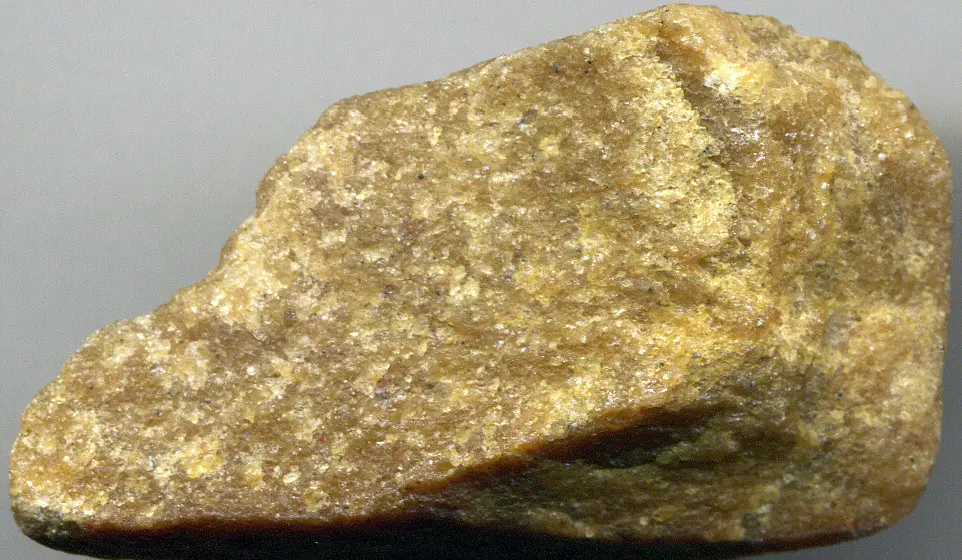
Reference photo of quartzite. Fine interlocking quartz grains with a glassy luster and a fracture that cuts across the grains; only a hardness check on a rough chip separates it from marble.
Quartzite reference photo, not a find from the area this page covers. James St. John · CC BY 2.0 · Encyclopedia entry

Check the end point with a photo
Once the key gives a name, photograph the fresh face in angled light, the whole rock, and the feature that decided the last couplet. Rock Identify takes one to three JPG, PNG, WebP or HEIC photos of the same specimen, up to 40 MB each, and returns up to three candidates with the visible evidence for each; three identifications a day are free without an account. If its candidates come from a different branch, return to the couplet where the paths split.
What if neither half of a couplet fits my rock?
Go back one couplet; the earlier choice is usually the wrong one, and a tuff mistaken for sandstone at couplet 4 is the classic case. If both halves still fail, the rock may be a mixture, a weathered surface or a manufactured material such as slag or concrete, which the key does not cover.
Can I use the key on a tumbled or polished stone?
Only partly. Polish hides fracture, grain plucking and sheen, and you must not scratch it. Grain size, bands, pebbles and vesicles still show through, so the key reaches a group and often a name, but leave quartzite versus marble open.