
Identification guide
How to identify rocks with one specimen on the table
Start with the broken face, not the worn outside.
Wash the rock, find a fresh surface and hold it in angled daylight: grain size against your fingernail, any layers, bands or holes, and the way the surface shines tell you which rock group you are holding before you reach for a name. This page is the hands-on procedure for how to identify rocks with one specimen, a lens, a coin and a nail.
Work through the checklist in order and decide igneous, sedimentary, metamorphic, single mineral or manufactured first. Only then pick a candidate name, and only then upload photos to Rock Identify so its candidates can be checked against your notes.
Guide updated
Clean the rock and find a face that shows the inside
Scrub the specimen with water and an old toothbrush, then let it dry. Dust and lichen hide grain boundaries, and a wet surface fakes a glassy luster that vanishes once the rock is dry. If orange or brown color rinses off, that was iron staining, not the rock's own color.
Turn the rock until you find a chip, corner or crack where the interior shows. The weathering rind is often a few millimeters of altered material that looks nothing like the fresh inside, so judge every step below on the fresh face. Never hammer a possible gem, fossil or anything you might sell; with no broken face, photograph the cleanest corner and note it.
Judge grain size against your fingernail
Hold the fresh face a hand's width from your eye in good light. If you can pick out separate grains wider than the ridge of a fingernail, about a millimeter and up, the rock is coarse grained. If you see a texture but cannot separate grains, it is fine grained. A smooth, glassy or waxy surface with no grain at all is worth writing down too.
Then ask how the grains meet. Interlocking crystals fit like puzzle pieces with no space between them and flash as small flat faces when you tilt the rock. Rounded or angular grains in a finer matrix, like sand in cement, were deposited and glued. Grains flattened or lined up in one direction have been squeezed.
Look for layers, bands, holes and glass
Flat, parallel beds that run through the whole rock, sometimes a shade different in color or grain size, point to sediment. Light and dark bands that wrap, fold or pinch out, with crystals visible inside each band, point to a metamorphic rock, as does a rock that splits into thin sheets along one direction.
Round or slightly stretched holes were gas bubbles, called vesicles, and they mean lava. Dense dark rock with pinhead vesicles is usually basalt; a pale frothy rock that floats is pumice; a red or black rock full of large rough-walled holes is scoria. Glass with curved, shell-like fracture and sharp edges is obsidian, or chert if waxy and grey, brown or red.
Granite: coarse, speckled and interlocking
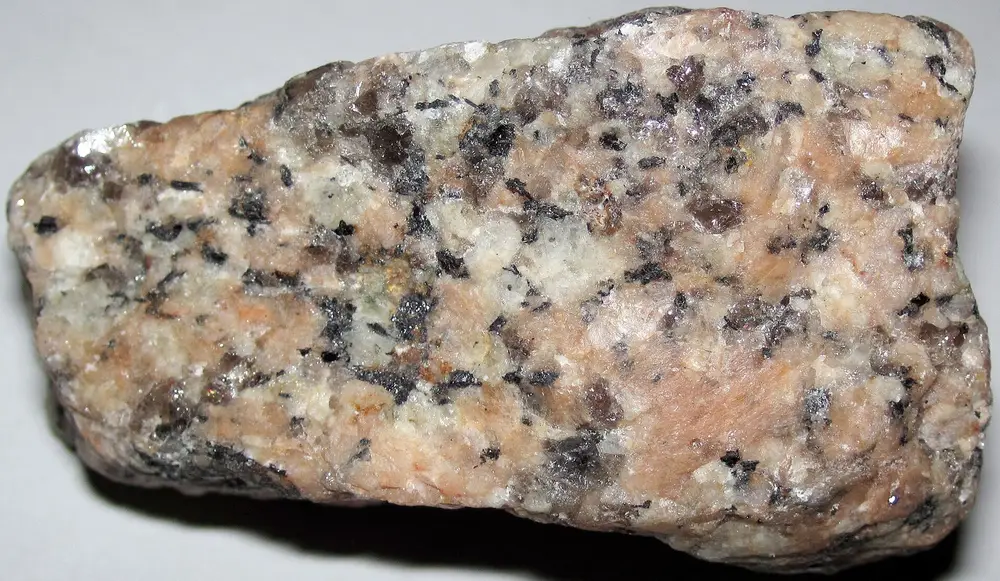
Reference photo of granite, not a find from any particular place. Pink or white feldspar, grey glassy quartz and black mica sit tightly together with no cement and no layers, each grain larger than a fingernail ridge.
Granite reference photo, not a find from the area this page covers. James St. John · CC BY 2.0 · Encyclopedia entry

Gneiss: coarse crystals in bands
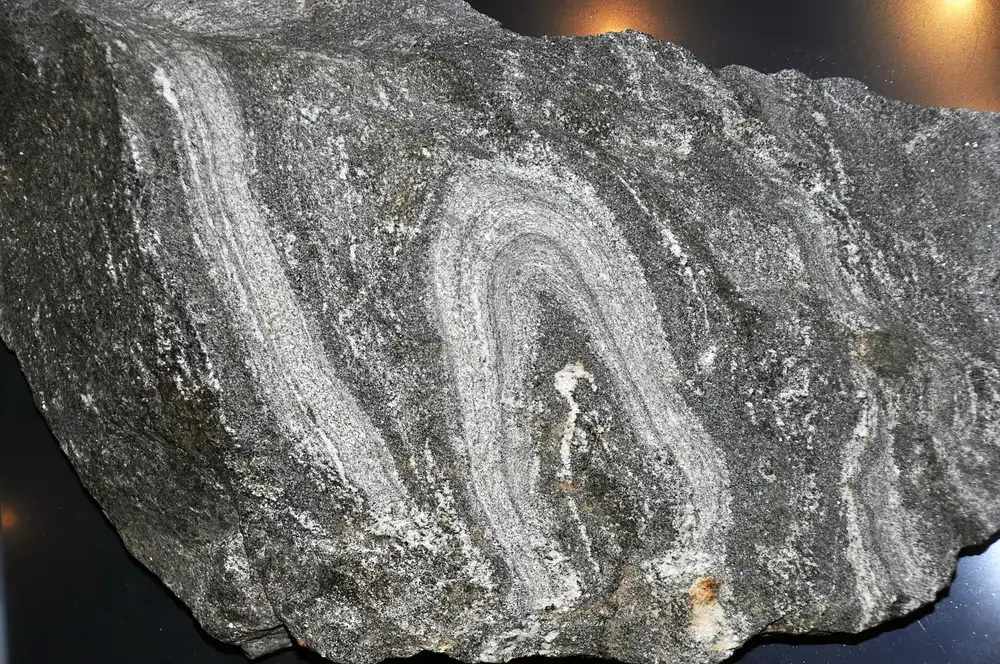
Reference photo of gneiss. Light bands of feldspar and quartz alternate with dark bands of mica or hornblende, and the bands bend rather than lying flat, which marks metamorphism rather than deposition.
Gneiss reference photo, not a find from the area this page covers. James St. John · CC BY 2.0 · Encyclopedia entry

Read luster, translucency and weight in hand
Tilt the face under a lamp and watch how it reflects. Glassy flashes from flat crystal faces, a pearly sheen along a split surface, a metallic glint, or a dull earthy look are different lusters, and a photo taken at the same angle records them well. Sparkle from hundreds of tiny flakes that shift as you turn the rock is almost always mica.
Hold a thin edge up to daylight. Quartz, calcite and agate let light through at the edges; nearly all whole rocks stay opaque. Then weigh the specimen in your hand against a known rock of similar size and write heavy, normal or light. Heft is a hint, not a measurement, and no photo can read it.
Make a rough hardness note on common rocks only
On a specimen you are sure is an ordinary rock, choose a spot on the back and try, in order, your fingernail, a copper coin and the point of a steel nail. A fingernail marks talc and gypsum, a coin marks calcite, and a steel nail marks most minerals up to feldspar but is stopped by quartz. Wipe the spot and look with a lens; a soft tool can leave a metal smear that is not a scratch.
This is a rough check, not a Mohs test; never do it on a polished stone, a crystal cluster, a fossil or anything that may have value, because the mark is permanent. A photo cannot show hardness either, so your scratch note is a check you add to the tool's candidates.
How to identify rocks by group before name
Put the notes together. Interlocking crystals with no layers, or glass and vesicles, mean igneous. Cemented grains, fragments, shells or flat beds mean sedimentary. Folded bands, foliation or stretched grains mean metamorphic. One consistent color, luster and crystal shape throughout, often with flat faces or clean breaks, means a single mineral rather than a rock. Even color, bubbles in a glassy mass or a flat poured base point to slag, brick or glass.
Only now go to a candidate. Coarse, light, speckled and igneous is probably granite; fine, dark and vesicular is basalt; sand grains cemented in beds is sandstone; coarse crystals in folded bands is gneiss. Treat each as a hypothesis and name the feature that would rule it out.
Wash and dry the rock; note any stain that rinsed off.
Find a broken face or the cleanest corner; never break a possible valuable.
Grain size against a fingernail: coarse, fine or none.
How grains meet: interlocking, cemented, or flattened and aligned.
Layers, folded bands, vesicles or glass: present or absent.
Luster in angled light: glassy, pearly, metallic, dull or mica sparkle.
Translucency at a thin edge: yes, slightly or no.
Weight in hand: heavy, normal or light.
Rough hardness, common rocks only: fingernail, coin or nail marks it first.
Group: igneous, sedimentary, metamorphic, mineral or manufactured.
Candidate name, plus the one feature still needed to confirm it.
What you see | What it usually means | What it does not prove |
|---|---|---|
Interlocking crystals, no layers | Slowly cooled igneous rock such as granite | Which feldspar; coarse marble can mimic it |
Grains in a finer cement | Sedimentary rock such as sandstone or conglomerate | Whether the cement is quartz or calcite |
Light and dark bands that fold | Gneiss or a banded schist | Which minerals make the bands |
Round holes in a dark rock | Gas-bubble lava, usually basalt or scoria | That it is not bubbly slag |
Curved glassy fracture | Obsidian, chert or a quartz mineral | Obsidian rather than bottle glass |
Metallic glint on the fresh surface | Pyrite, galena, magnetite or a similar ore | A meteorite; see the question below |
Photograph what you checked and compare the candidates
Take one photo of the whole rock on a plain background, one close-up of the fresh face in angled light, and one of the most telling feature. Rock Identify accepts one to three JPG, PNG, WebP or HEIC photos of the same specimen, up to 40 MB each, and returns up to three candidates with the visible evidence for each; three identifications a day are free without an account. If its first candidate disagrees with your group decision, ask in the follow-up which feature it weighted, then check that feature yourself.
Can a photo tell me the hardness?
No. Hardness is a scratch property and only a scratch reveals it. A photo shows luster, grain size, color and visible breaks, which narrow the candidates; your fingernail, coin and nail note on a common rock is what separates calcite from quartz.
Is a heavy black rock a meteorite?
Almost never. Most heavy dark finds are magnetite-rich basalt, hematite, slag or scrap iron. Vesicles, a pale interior, rusty crumbly patches or a melted-looking skin all argue against a meteorite, and heft alone proves nothing. The meteorite guide in the related links covers the checks that matter.