
Beach rock identification starts with the surface beneath the shine. A rounded pebble can be a piece of volcanic rock, sandstone, a mineral nodule or something made by people. Compare the dry face, the thinnest edge and any existing chip. Then use the beach setting to narrow your list of possibilities.
Beach rock identification chart
| Candidate | Visible clues |
|---|---|
| Agate or chalcedony | Look for curved or nested bands and light passing through a thin edge. Some chalcedony has little visible banding. A red surface stain by itself is weak evidence. |
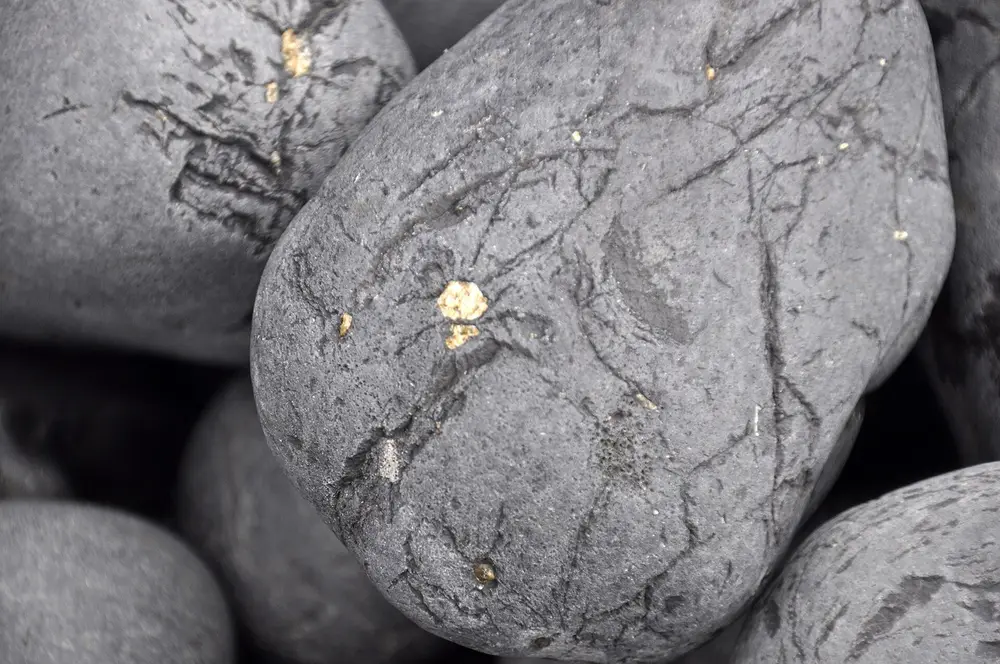
| Dark volcanic rock | A dark cobble with fine texture and a few round cavities may fit basalt. Compare its dull and shiny areas, then check for glass or metallic patches that complicate the guess. |
| Sandstone | Search an existing edge for sand-sized grains and bedding. A water-polished face can feel smooth even when the side still shows distinct grains. |
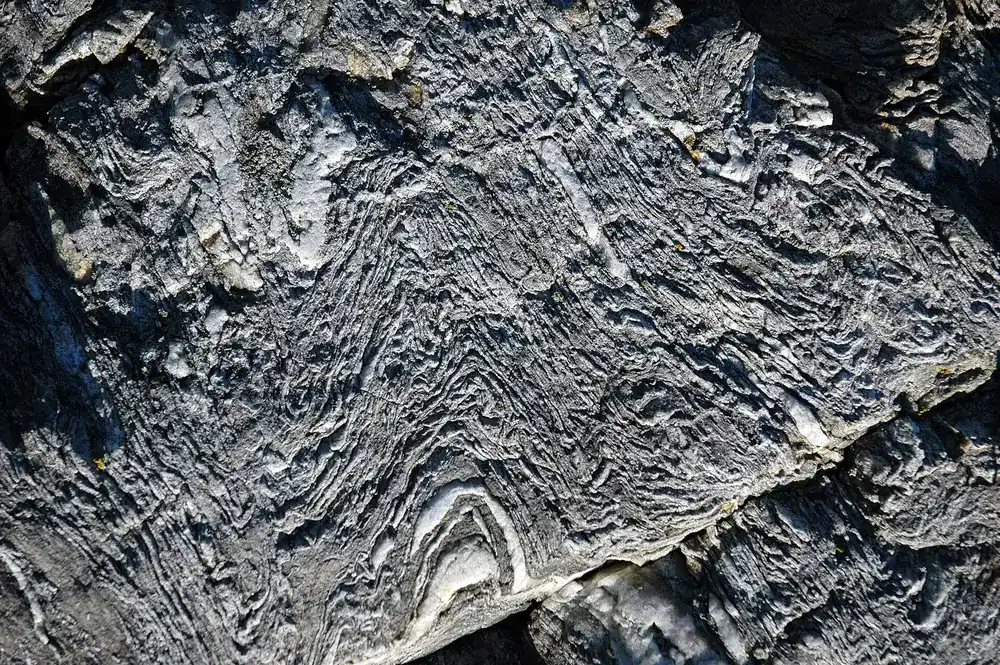
| Shell or fossil-bearing rock | Inspect ridges, curved outlines and repeating chambers. A loose shell can be thin and layered; a fossil can sit inside a heavier matrix with grains of its own. |
| Beach glass or worn ceramic | Look for repeated thickness, an even curve, a remaining glaze or parallel faces. A frosted surface alone can resemble a pale mineral. |
Photo examples


Read the beach before you read the pebble
Start with where the specimen is lying. A pocket of mixed gravel below a rocky headland is a different setting from a wide beach with mostly sand. Note whether the specimen is common among its neighbors or stands out in the patch. A stretch with many similar fine dark cobbles gives you a better context for a dark cobble than an isolated piece on a beach full of shells. Even a patch of similar stones can contain a few materials with a different source.
Waves and currents move sediment, and the shape of the coast changes how much energy reaches a beach. The National Park Service describes exposed cobble beaches and quieter sandy settings at Acadia. It also notes that glacial debris or local cliffs can supply beach material. The size mix tells you something about transport and the shape of the shore. It is not a direct inventory of the bedrock immediately underneath your feet.
A smooth outline records wear. Softer parts can erode away, sharp corners can round off and sand can polish a face that already lacked obvious crystals. Compare the outline with a close view of the surface. You are looking for clues that survive the rounding, such as grain boundaries, a vein, shell walls or a band that continues around the stone.
Check bands, grains and the edge against light
For a waxy-looking pebble with several colored arcs, trace one line around its visible face. In a banded nodule the arcs may repeat or wrap around a central area. A single pale stripe crossing a darker pebble may instead be a vein. Straight parallel lines accompanied by visible grains or layers can point toward a sedimentary rock. On a heavily worn piece, the best evidence may be only a small patch near one edge.
When conditions are safe, hold a small loose specimen you are permitted to handle beside a bright background. Look through a naturally thin edge. Light can pass through some chalcedony, quartz and glass, so translucency narrows the comparison without deciding it. An opaque red or yellow pebble may fit jasper, but iron staining can also color an otherwise different rock. Compare the thin edge with the dry center.
Use a close-up at a low angle if you suspect sandstone. Side lighting can reveal grain boundaries where a straight-on image shows only a uniform color. If the face contains larger rounded pieces embedded in finer material, consider whether those pebbles belong to the rock itself. A pebble-sized specimen can be a fragment of conglomerate, just as it can be a piece of granite or basalt.
Separate worn shell, fossil and manufactured material
A shell fragment can carry parallel ribs, growth lines or a remnant of a curved wall. Compare its thickness at two edges. A fossil enclosed in a rock often has a recognizable outline surrounded by a different material. Look for where the pattern stops and the host rock starts. A hole, pit or white streak may be useful, but you need more than one spot to show that an apparent structure repeats.
A flat frosted fragment with nearly parallel faces can fit worn glass. An edge that preserves a consistent thickness or a regular curve adds context. Ceramic can show a layer of glaze above a differently colored body. A rounded corner can hide the original form, so examine the edge rather than judging by color. Modern materials and natural glass can share smooth or curved breaks, especially in small pieces.
Here is one comparison to try. A milky pebble shows a pale band when dry and a brighter rim when backlit. Trace the band first. If it crosses the pebble as one continuous seam, keep a veined rock in mind. If it follows several curved boundaries and the rim is evenly translucent, keep chalcedony in the list. If the side is flat with very even thickness, include glass. Photograph the face that best separates those possibilities.
Make a useful record without moving the beach
Photograph the stone in place if the site protects its material. An overview showing whether the spot is a pebble ridge, an exposed rock platform or a sandy patch will help you interpret the close-up later. If you can photograph safely from a stable place, make a second frame with a ruler or scale beside the specimen and a third frame of the best existing edge.
If you have both a wet and a dry image, label them. Water deepens color and can make unrelated pebbles look similarly glossy. Include the coast or lake, a named beach if known, and the feature you want help with. A phrase such as “waxy thin edge, one narrow white seam” gives the photo tool a more specific comparison than color alone.
Shore conditions and site rules vary. Observe from a permitted area, check the managing agency before removing anything, and keep the photo comparison separate from permission to collect. An uncertain name is worth retaining with a good photo. A close view showing which feature is still missing can make a second comparison much more productive.
If the beach has a mix of sand and stones, put your observation in that context. A patch of pale fragments beside broken shells deserves a shell comparison even if one fragment feels dense. Check whether its curved ridges are raised, pressed into the surface or simply drawn by color. A second frame lit from the side can show that difference. On a dark rock platform, pale circles confined to holes suggest a different starting point. Compare the material between the circles with the rock around them.