
Identification guide
How to Identify a Meteorite Rock and Common Lookalikes
To identify a meteorite rock, check the outside, an existing broken face and the overall density. Get a specialist to examine a promising specimen.
A thin dark fusion crust, an irregular rounded outline, metal flecks or small round chondrules can support a meteorite candidate. Some specimens have shallow thumbprint-like dents called regmaglypts. A sponge-like surface with many gas holes usually points to slag or volcanic rock. Use the clues together and keep the original surface intact for examination.
This guide covers what to photograph, how to read each clue, two safe kitchen-table checks, and what to do once a rock passes the screen. Rock Identify takes one to three photos of the same specimen and returns up to three candidates with the visible evidence for each; it can screen a rock out, but no photo can confirm a meteorite.
Guide updated
How to identify a meteorite rock: check for holes first
Turn the rock in daylight and look for rounded holes, frothy patches or a sponge-like texture. Abundant gas holes strongly favor volcanic rock or furnace slag. Rare meteorites can contain vesicles. Check the matrix, fusion crust and broken face together before ruling out a specimen.
Slag is the most common meteorwrong. It is glassy, often with a rainbow or metallic sheen, with bubbles of many sizes and a ropy or flowed surface. It turns up along old railway lines, near former foundries and in fill; landscaping lava rock has the same holes with a dull gray or red surface.
Photograph the whole rock on a plain background with a coin or ruler for scale.
Photograph the surface close up in side daylight so pits and crust show.
Photograph any existing broken, chipped or cut face without making a new one.
Note weight, location and magnet pull, then upload all three.
Fusion crust and regmaglypts on the outside
A fresh fall has a fusion crust: a thin black rind under a millimeter thick, matte like charcoal on stony meteorites, glossy or lightly ridged on irons. It wraps the whole stone smoothly and stops at any later break, where the lighter interior shows. Old finds weather brown or rusty and the crust may be mostly gone, so a brown rock is not ruled out.
Regmaglypts are shallow, rounded depressions that look like thumbprints pressed into clay, left as the surface melted and streamed away. Weathered Earth rocks show pits too, so look at the edges: regmaglypts are smooth and rounded, dissolution pits in limestone are sharp and angular, and bubbles in slag are round holes with thin glassy rims.
Shape helps a little: irregular with rounded corners, because sharp edges melt first; not a sphere and not a flat river-worn pebble.
Density, metal flecks and chondrules on a cut or broken face
Stony meteorites run about 3.3 to 3.6 grams per cubic centimeter and irons about 7.5 to 8, so both feel heavier than a granite or sandstone pebble of the same size. Weigh it on a kitchen scale; density is a clue no photo carries, and a lab will want the weight.
Do not cut, grind or break the rock to look inside; photograph any existing broken or cut face in daylight at an angle. Most stony meteorites show scattered bright silver flecks of iron-nickel metal, like tiny bits of foil, through a gray or tan groundmass. Many also show chondrules: round grains about a millimeter across, packed like grit in concrete. Earth rocks do not contain chondrules, and pyrite, with its brassy color and cube shapes, is the usual false metal.
An iron meteorite shows uniform silvery metal on a cut face. Industrial iron does too, but it tends to show casting lines, a flat machined face, rust scale or a hollow interior.
Two safe checks: a magnet and a streak tile
Hold a strong magnet near the rock. Nearly all meteorites pull on it because of their iron-nickel metal. The pull is useful but not decisive: magnetite, some hematite, many basalts and most slag are magnetic too, and a few rare meteorite types are not. A rock that ignores a magnet is very unlikely to be a meteorite; a rock that grabs one still has to pass the other clues.
Rub a hidden corner of the rock once across the unglazed back of a ceramic tile. Hematite leaves a red-brown streak and magnetite a black one; a stony meteorite leaves a faint gray mark or none at all. Done on the underside it leaves no visible damage; keep it to one stroke.
Meteorite versus slag, magnetite, hematite and basalt
A rock has to fit the meteorite column in most rows, not just one.
Clue | Meteorite | Slag | Magnetite or hematite | Basalt |
|---|---|---|---|---|
Holes or bubbles | Unusual | Round bubbles of many sizes; frothy | None; rust pits at most | Common; round vesicles |
Outer surface | Thin black crust; thumbprints; brown when weathered | Glassy, ropy; rainbow or metallic sheen | Dull black or steel gray; rusty brown rind | Dull gray to black; weathered rind |
Weight for size | Heavier than expected | Light to medium; variable | Heavy | Average |
Magnet pull | Strong in most types | Often weak | Magnetite strong; hematite weak or none | Weak and patchy |
Streak on tile | Faint gray or none | Gray or none | Magnetite black; hematite red-brown | Gray |
Broken face | Silver metal flecks; chondrules in many stones | Glassy, bubbly; often green or blue | Uniform metallic gray or red-brown | Fine dark grains; olivine or feldspar specks |
Possible meteorite, slag and basalt side by side
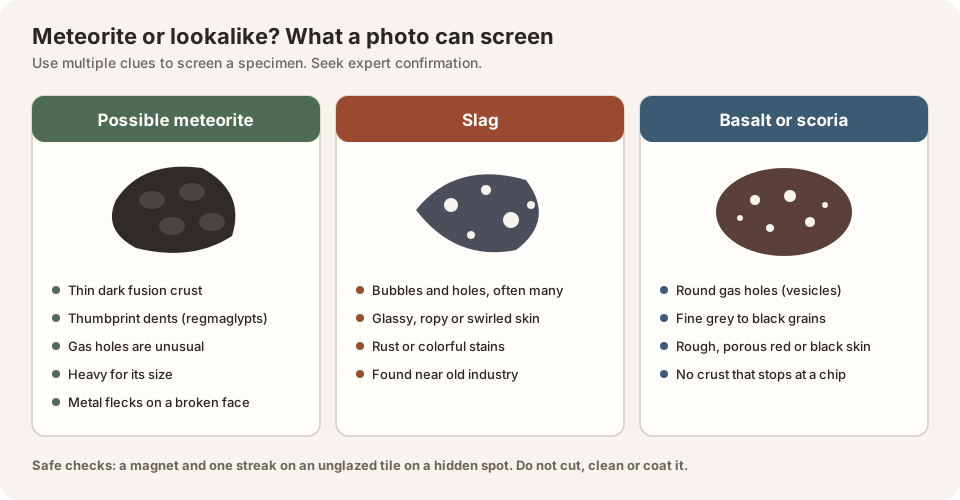
The clues from the table above in one view. A frothy surface is strong evidence for a terrestrial lookalike. Look at the crust and texture together.
Diagram: Rock Identify. Simplified and not to scale.
Real meteorites beside a lookalike
Two licensed meteorite photos show fusion crust and thumbprint-like dents. The scoria reference shows abundant gas holes to compare with those surface features.
Park Forest meteorite: a dark fusion crust
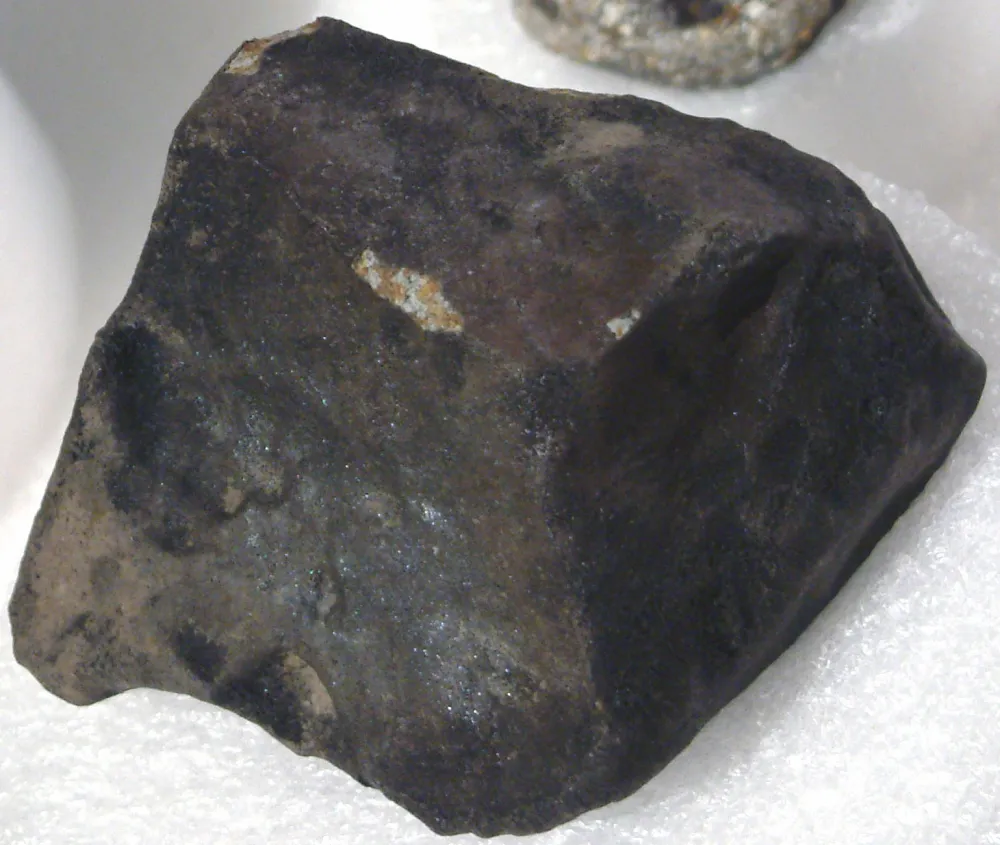
A stony meteorite that fell on Park Forest, Illinois, in 2003. The thin black crust wraps the whole stone and stops sharply where a chip shows the paler interior.
Photo: James St. John · CC BY 2.0 · resized

Sikhote-Alin iron meteorite: thumbprint dents
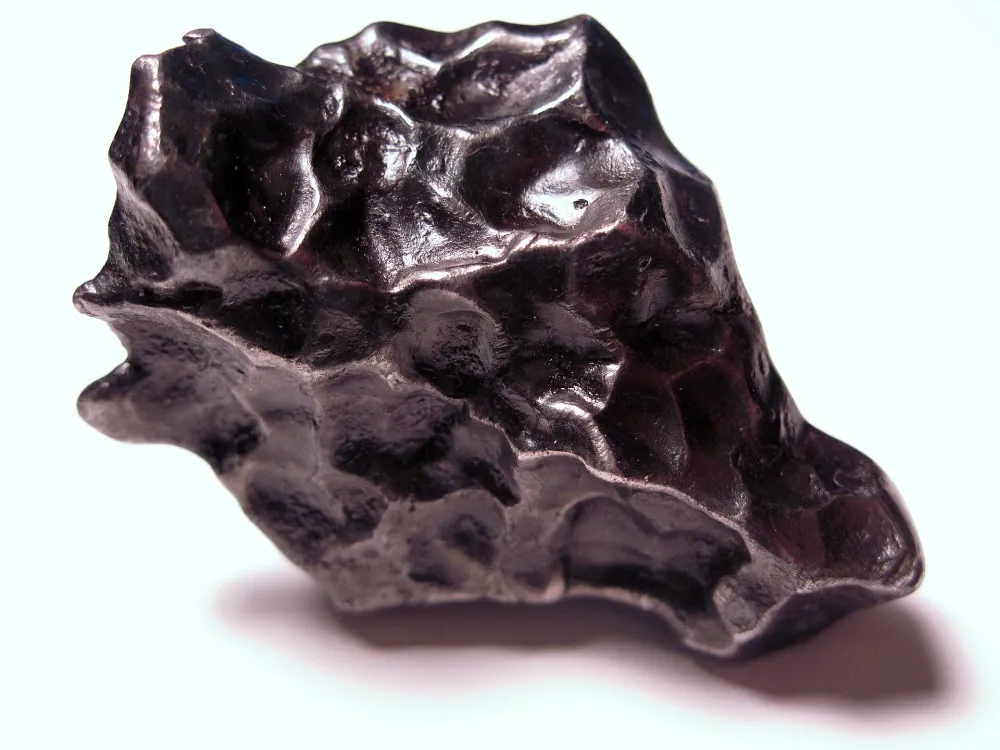
An iron meteorite from the 1947 fall in eastern Russia. The smooth, shallow regmaglypts formed as the surface melted in flight; they are dents, not gas holes.
Photo: Jon Taylor · CC BY-SA 2.0 · resized

Scoria: the holes say volcanic
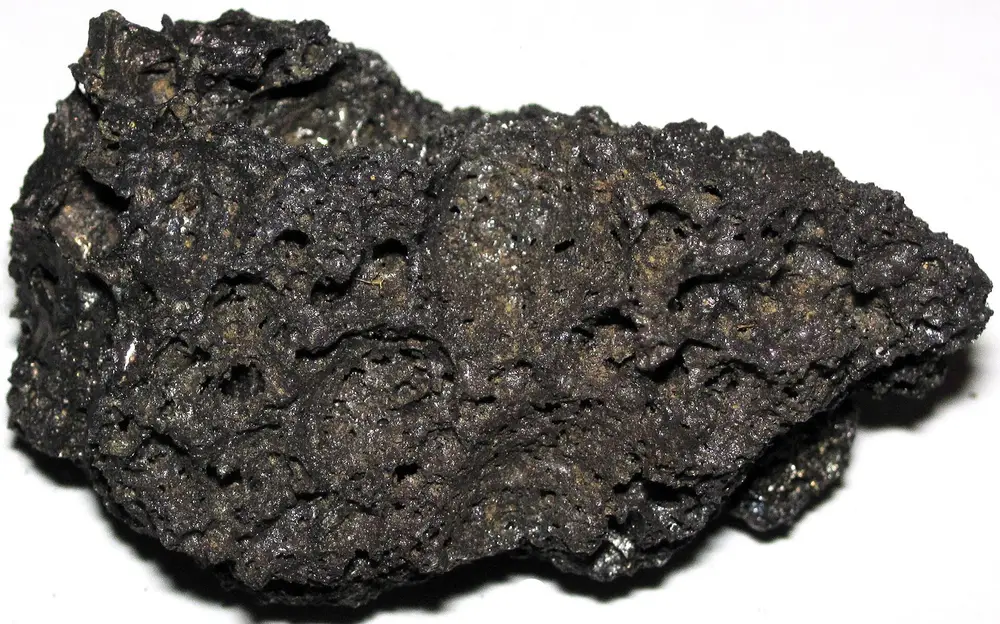
Reference photo of scoria. Every one of those holes is a gas vesicle. Vesicular basalt and slag can share this texture. Such abundant holes are unusual in meteorites.
Scoria reference photo, not a find from the area this page covers. James St. John · CC BY 2.0 · Encyclopedia entry

What to do if your rock passes the screen
Handle it as little as possible and do not clean, cut, polish, coat or glue it; labs want the original surface, and oils, lacquer and acids destroy evidence. Record the GPS location where it was found, the date and the weight. Keep it dry in a sealed bag.
Contact a nearby university geology department or meteorite laboratory and send the photos, weight and location first. Most will look at photos first and say whether to send a small sample. A classification takes months and involves a cut, a polished section and chemical analysis; nothing short of that confirms a meteorite.
Moldavite and other tektites are a different question. They are natural glass from impact melt, green or black, with pitted, grooved surfaces and no crust or metal; they are not meteorites, and a glassy green pebble found outside the known Central European strewn field is almost always bottle glass.
Questions people ask about a suspected meteorite
It sticks to a magnet and it is heavy. Is that enough?
No. Magnetite and hematite ore pass both checks and are far more common than meteorites. Look for a fusion crust that stops at a break, thumbprints with soft edges and metal flecks on a broken face. If the streak is red-brown, it is hematite.
The surface is black and shiny. Is that fusion crust?
Possibly, but desert varnish, basalt glass and slag are all black and shiny. Fusion crust is thin and uniform, wraps the stone and shows a sharp boundary against a lighter interior at any chip. Glossy ropy swirls and bubbles point to slag.
I saw a fireball and found a dark rock the next morning. Is it from the fireball?
Almost never. Fireballs are seen hundreds of kilometers from where anything lands, and most burn up entirely. Judge the rock on its own evidence.
Can I sell it if the tool says meteorite?
The tool does not say meteorite; it says which candidates fit the photo. A meteorite has a name and a value only after a laboratory classifies it, and buyers expect that paperwork.