
Identification guide
How to Identify Jade Rock: Jadeite, Nephrite and Lookalikes
To identify jade rock in a photo, start with a chip or unpolished edge and compare the texture, luster and translucency.
Jadeite jade and nephrite are two common jade materials. Nephrite is an aggregate of tightly packed tremolite–actinolite fibers. Jadeite jade is typically a granular aggregate rich in jadeite, a pyroxene mineral. On an existing chip, nephrite may look fibrous or splintery, while jadeite jade can look granular. Treat those as comparison clues and check how color and translucency vary across the piece.
This page takes those clues in the order they settle the most, compares jade with eight common green lookalikes, and says plainly which questions a photo cannot answer. Rock Identify takes one to three photos of the same piece and returns up to three candidates with the visible evidence for each, and you can ask one follow-up question.
Guide updated
Read the chip or edge before the polished face
A polished surface hides texture, so find any place where the material is broken, chipped or left rough: the drill hole of a bead, the back of a pendant, the underside of a carving, the sawn edge of a slab. Photograph that spot with a macro lens or a loupe held over the phone camera.
Nephrite shows a matted, fibrous or splintery surface at a break, sometimes with a faint silky sheen where bundles of fibers catch the light. Jadeite shows a granular surface like fine sugar or a broken piece of fine marble. Serpentine and soapstone look smooth or soapy at a break with no fibers and no grains; green glass shows a curved, shell-like fracture with a glassy skin.
Find the least finished spot on the piece.
Shoot a macro of it in daylight with light from the side.
Shoot the whole piece on a neutral background with a coin or ruler for scale.
Shoot a third frame with a phone flashlight behind the piece to show translucency.
Judge luster and translucency against a light
Hold the piece in angled daylight. Nephrite has a waxy to greasy luster, as if lightly oiled, even when well polished; jadeite takes a brighter, almost glassy polish. Serpentine is waxy too, which is why it sells as new jade, but it usually looks softer and slightly cloudy. Prehnite and chrysoprase look glassy and wet; green aventurine quartz shows a glassy polish with glittering green mica flakes just under the surface.
Put a phone flashlight behind the stone and photograph the lit side. Nephrite glows with a soft, even, cloudy light and often shows dark specks or a faint fibrous grain inside. Jadeite ranges from opaque to clearly translucent, with a cellular or mottled interior. Glass lights up cleanly and shows round bubbles, swirls or flow lines; no jade contains bubbles.
A photo of the backlit stone, together with a macro of the edge, is the most useful pair you can upload.
How to identify jade rock against its lookalikes
Color alone sorts nothing; every material below comes in jade green.
Material | What the photo shows | What separates it from jade |
|---|---|---|
Jadeite | Granular, sugary texture at an edge; bright polish; green, white or lavender in patches | Interlocking grains in a chip; color in clouds and veins, not in cracks |
Nephrite | Fibrous, felted texture at a chip; waxy to greasy luster; even spinach green to cream | Soft even glow when backlit; silky sheen on fiber bundles |
Serpentine, sold as new jade | Waxy, slightly soapy polish; yellow-green to dark green; veined or spotted | No fibers or grains at a break; softer, cloudier look |
Green aventurine quartz | Glassy polish; fairly uniform green with glitter | Sparkling fuchsite mica flakes under the surface |
Prehnite | Pale apple to yellow-green; glassy; translucent | Radiating fan or bundle structure when backlit |
Chrysoprase | Bright apple green; glassy; very even color | Waxy conchoidal fracture with no grains or fibers |
Green glass | Flawless uniform color; wet-looking polish | Round bubbles, swirl lines, mold seams, conchoidal fracture |
Dyed quartzite | Grainy sparkle; green darkest along cracks | Color webbing in fractures with pale grains between |
Soapstone | Dull to waxy; edges worn or scratched | Scratches from normal handling; greasy, soft look |
Hydrogrossular garnet, sold as Transvaal jade | Massive, fine-grained; green to pink; black specks | Looks like jadeite; black chromite specks; lab settles it |
Reference photos of jadeite, nephrite and serpentinite
These are reference photos of the materials, not finds from any location.
Jadeite: patchy color and a granular surface
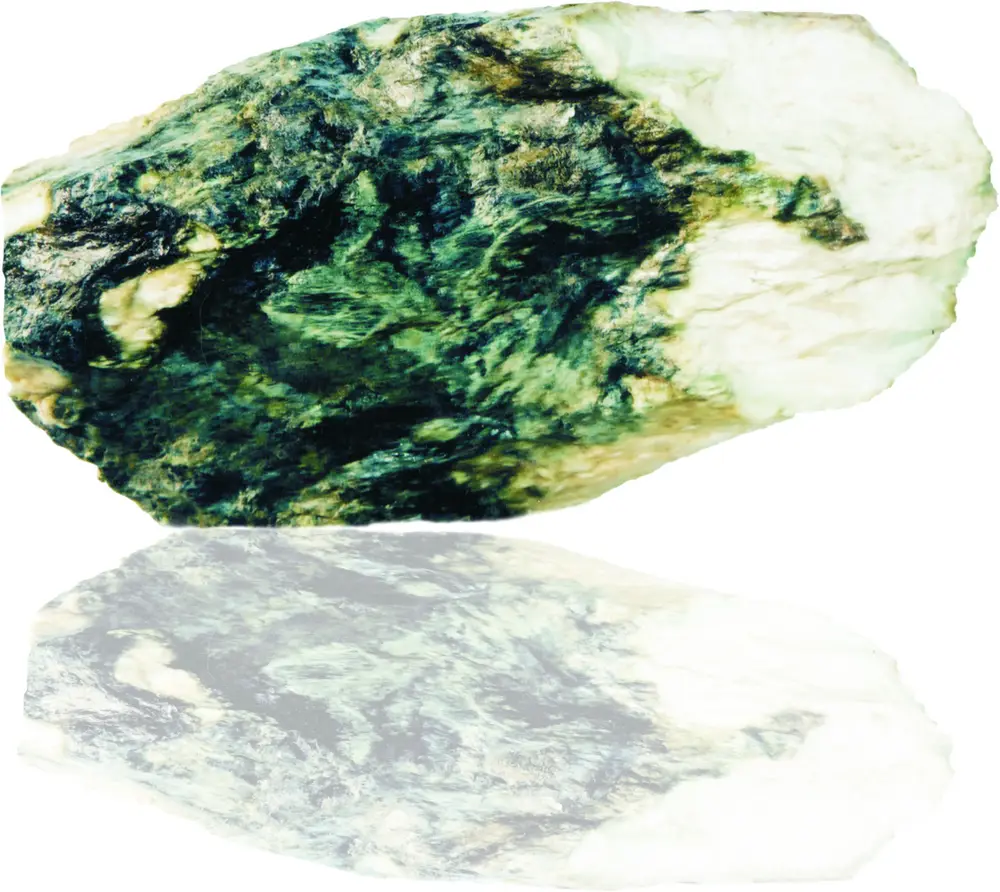
Reference photo of jadeite. The green sits in patches and veins rather than evenly through the piece, and any rough area looks granular rather than fibrous. Use it to compare color pattern and polish, not provenance.
Jadeite reference photo, not a find from the area this page covers. IbrZulya · CC BY-SA 4.0 · Encyclopedia entry

Nephrite: even color and a waxy polish
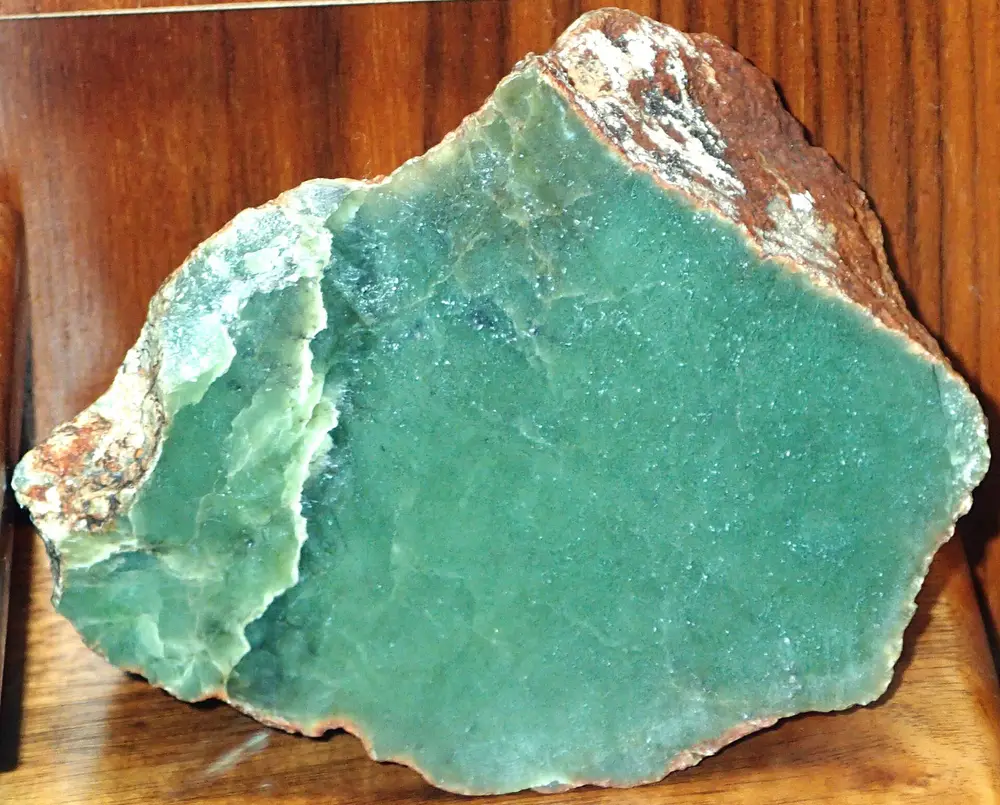
Reference photo of nephrite. The color is more even than in jadeite, the polish looks waxy rather than glassy, and dark specks of other minerals are common. Compare luster and tone against your own piece in similar light.
Nephrite reference photo, not a find from the area this page covers. James St. John · CC BY 2.0 · Encyclopedia entry

Serpentinite: the usual new jade
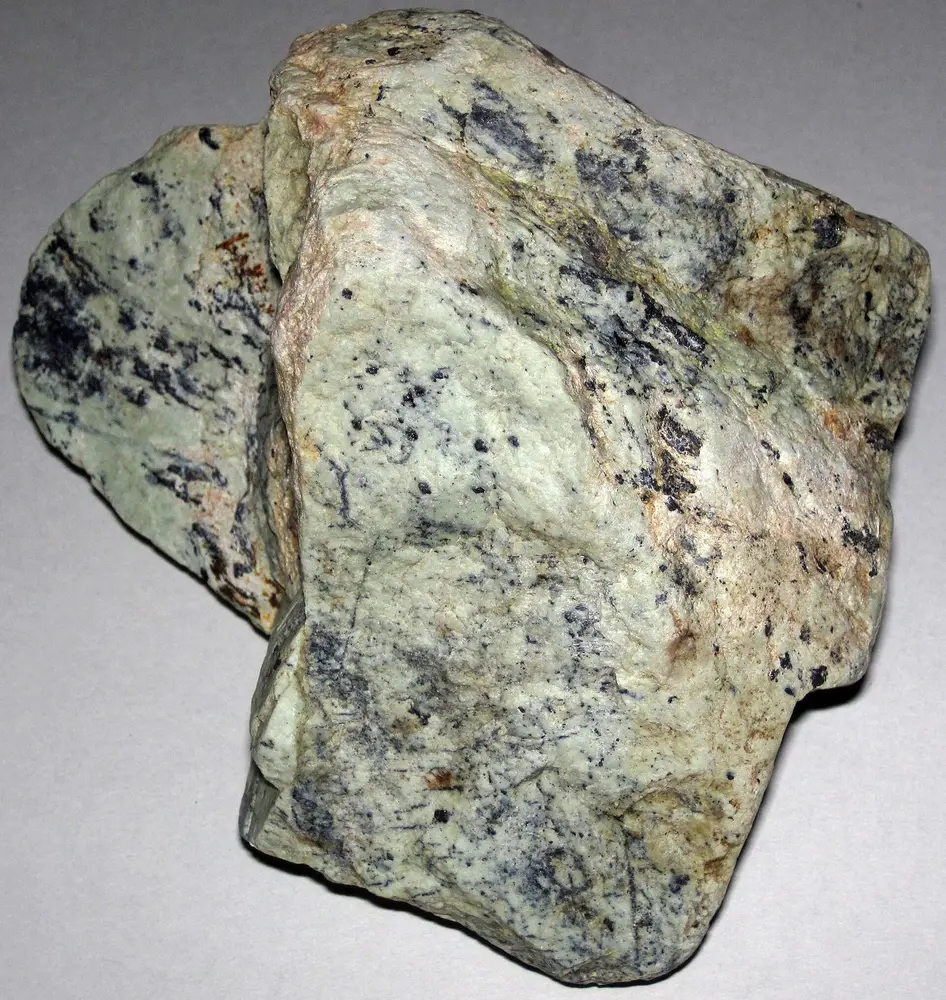
Reference photo of serpentinite, the rock most often sold as new jade or Korean jade. Its surface looks slightly soapy and veined, and a break shows neither fibers nor grains. Reference material only.
Serpentinite reference photo, not a find from the area this page covers. James St. John · CC BY 2.0 · Encyclopedia entry

Color distribution: mottling versus dye in cracks
Natural jade color is uneven in a way that follows the stone's structure. Jadeite shows clouds, patches and veins of green that fade into white or gray; nephrite shows gentle banding, dark specks and lighter zones. Dyed material shows the opposite pattern: color concentrated in a web of cracks and grain boundaries with paler grains between. On a macro of dyed quartzite or dyed pale jadeite, the green looks like ink soaked into a network of lines.
Uniform, flawless color with no structure at all is a glass or chrysoprase warning, not a jade quality sign. Fine jadeite can be very even, but it still shows a cellular texture when backlit.
Two things experienced buyers rely on cannot be photographed. Jade feels cool and stays cool in the hand, and it feels heavier than it looks because both jades are denser than quartz, serpentine or glass. Mention them in your follow-up question, but treat them as a feel, not as evidence.
What a photo cannot settle and what does
A photo screening sorts a green stone into likely jade, likely lookalike or undecided. It cannot grade jade, cannot tell natural untreated jadeite from bleached and polymer-filled jadeite, and cannot tell a well-dyed stone from a natural one. Do not scratch jewelry, use acids or apply heat; each can damage a piece and still leaves the question open.
The tests that settle it are physical. A specific gravity measurement separates nephrite, at about 2.9 to 3.1, and jadeite, at about 3.3, from serpentine, quartz and most glass, which are lighter; prehnite overlaps the low end of nephrite, which is one reason a refractometer is used as well. A refractometer reading separates jadeite from nephrite and from hydrogrossular garnet. Spectroscopy, including infrared, is how a gem lab detects polymer impregnation and dye. For any piece bought as jade at a serious price, ask for a report from a recognized gem laboratory.
Use the photo result to decide whether lab testing is worth paying for.
Questions buyers and finders ask
I found a green pebble on a river bar. Could it be jade?
Possibly, near serpentinite belts where nephrite forms, but most green river pebbles are serpentine, chert or green quartzite. Look at a worn edge: nephrite is tough and wears to a smooth, waxy surface with a fibrous look in any fresh chip, and it feels heavier than a quartz pebble of the same size. Photograph the pebble dry and wet and upload both.
The seller calls my bangle Grade A jade. Can a photo confirm that?
No. Grade A is a trade term meaning natural and untreated, which only a lab can confirm by spectroscopy. A photo can flag dye pooled in cracks, bubbles or a soapy serpentine look, but a clean photo does not prove the piece is untreated.
My carving feels greasy and cold. Is that jade?
Both jades feel that way, but so does serpentine. Treat feel as a reason to look closer, not as a result. The chip texture and the backlit interior carry more weight.
Can the tool tell nephrite from jadeite?
Sometimes, when a chip shows fibers or grains clearly and the color pattern fits. Often it returns both as candidates with the evidence for each, and a refractometer or specific gravity test is the next step.