
Identification guide
What Rock Is White? Compare Texture and Luster
Common white finds include milky quartz, calcite, marble, quartzite and limestone. Compare the broken face and how light passes through an edge.
Curved glassy breaks point toward quartz. Flat stepped faces that flash together suggest calcite. Tiny interlocking grains fit marble or quartzite. A dull, powdery surface may suggest chalk or another limestone. If you are asking what rock is white, start with the texture and keep more than one candidate when clues overlap.
This is the site's color hub. It groups the white rocks and the green rocks people most often pick up, gives each a table of luster, translucency and texture, then points gray, black, red and brown finds to their own guides. Upload one to three photos to Rock Identify and compare each candidate's evidence against the table row.
Guide updated
Why color is the weakest clue and texture is the strongest
Color shifts with weathering, wetness, iron staining and the light you shoot in. The same milky quartz pebble reads bright white dry, gray wet and yellow where iron has soaked into cracks, and a white limestone pebble beside it looks identical from a step away. Texture does not shift like that. How a rock breaks, how big its grains are against your fingernail, and whether light passes a thin edge stay the same in every photo.
So the order here is color first, texture second. Pick the color group, then narrow with luster in low angled light, translucency against daylight, and grain size. A photo shows all three. It cannot show hardness, streak, density or chemistry, so the last column of each table lists what still needs a hand check.
What rock is white? Eleven candidates and how they split
Turn the specimen so window light rakes across it and ask three questions. Does the broken surface show curved glassy fracture (quartz or chert), flat faces that flash in steps (calcite, feldspar or gypsum), or tiny interlocking grains (marble or quartzite)? Then hold a thin edge toward daylight. Quartz and calcite glow at the rim, marble glows faintly, chalk and limestone stay dead.
Material | Usual luster | Translucency | Texture | What separates it in a photo | What a photo cannot show |
|---|---|---|---|---|---|
Milky quartz | Greasy to glassy | Edges glow, body cloudy | No grains, curved conchoidal breaks | No flat faces; iron stains follow cracks | Hardness; white glass not excluded |
Calcite | Pearly to glassy | Clear to cloudy | Rhomb-shaped blocks, stepped cleavage | Flat faces at repeating angles flash together | Hardness; whether it fizzes |
Marble | Sugary sparkle | Faint at thin edges | Even interlocking grains, gray veins | Grains glitter one by one; veins smear, not band | Marble or quartzite: rough scratch check |
Quartzite | Glassy grains | Slight at edges | Fused sand grains, breaks across grains | Glassier sugar than marble; faint bedding; no veins | Hardness against marble |
Chalk or limestone | Dull, earthy | None | Powdery or fine, shell pieces | Pits, fossil bits, white dust on fingers | Acid reaction; chalk against plaster |
Feldspar-rich granite | Grainy, scattered flashes | None | Coarse white, pink and black crystals | Separate crystals bigger than a rice grain | Which feldspar |
Gypsum or alabaster | Satin or pearly | Soft glow | Fibrous or fine; shows handling scratches | Satin sheen along fibers; scuffed corners | Softness; a rough fingernail check |
White chert | Waxy, dull rind | Thin edges only | No grains, sharp conchoidal chips | Sharper edges than quartz; chalky rind over waxy core | Hardness |
Dolomite | Pearly | Cloudy | Slightly curved faces; fine grain in rock | Saddle-shaped faces, cream or pink tint | Weak acid reaction |
Pumice | Dull | None | Frothy, full of tiny holes | Vesicles across every surface | Lightness; float it in water |
Concrete or plaster | Dull, chalky | None | Rounded gravel in gray-white paste, one flat side | Mixed pebbles in uniform paste; molded face | Age and origin |
Milky quartz: cloudy body, glowing edges, no flat faces
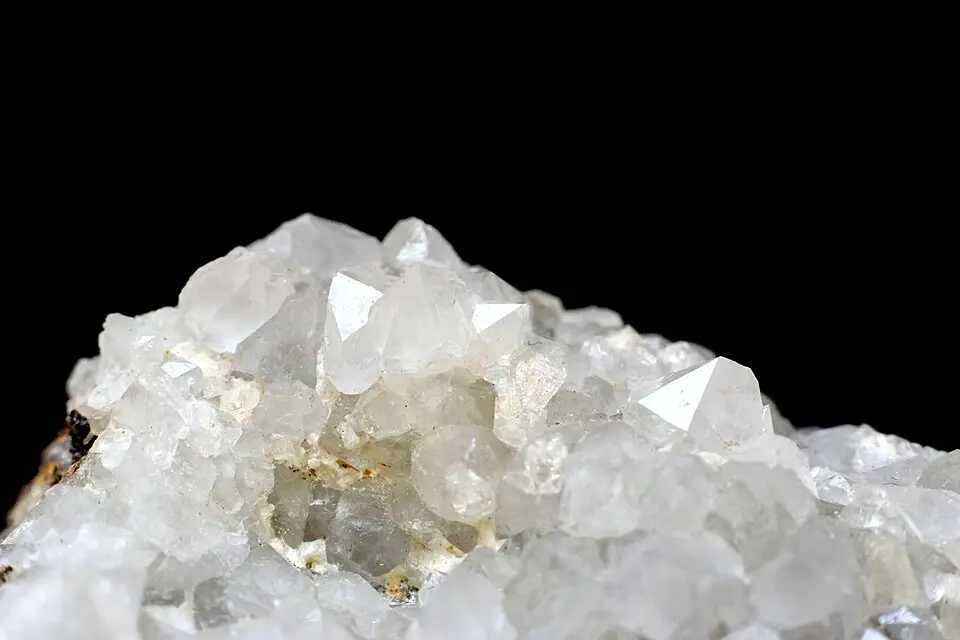
A reference photo of milky quartz. Note the greasy luster and curved break; nothing on the surface is a flat crystal face, the quickest separation from calcite.
Milky quartz reference photo, not a find from the area this page covers. Jan Helebrant · CC BY-SA 2.0 · Encyclopedia entry

The three white pairs that cause most wrong answers
Quartz against calcite: quartz has no cleavage and breaks with curved, shell-like surfaces, while a broken calcite crystal usually shows flat, mirror-like faces meeting at slanted angles, so a close-up of an existing broken face often settles it. Marble against quartzite: both are sugary, but marble turns dull where handled and carries smeared gray veins, while quartzite looks glassier grain by grain. Chalk against plaster: plaster shows a flat molded side, sometimes paint; chalk shows pits, shell fragments and a natural shape.
Green rocks: separate the serpentine family from the glass
Green is less common than white, so the list is shorter, but it holds the costliest mistake on this page: calling a green pebble jade. Most green stones from beaches, river bars and landscaping gravel are serpentinite, chlorite schist or epidote-stained rock. A photo rules out glass, malachite and aventurine quickly; it cannot confirm jade.
Material | Usual luster | Translucency | Texture | What separates it in a photo | What a photo cannot show |
|---|---|---|---|---|---|
Serpentinite | Waxy to greasy | Slight at edges | Smooth, mottled, slick streaks | Mottled greens with white veins; slick surfaces | Jade or serpentine: hardness, density |
Jade lookalikes (nephrite, jadeite) | Waxy to oily | Even glow at thin edges | Fibrous (nephrite) or finely granular (jadeite) | Dense, even color, no vesicles or glitter | Authenticity, density, hardness |
Epidote | Glassy | Translucent in small crystals | Pistachio-green needles or crusts | Yellow-green against pink feldspar, as in unakite | Composition beyond the color |
Green aventurine quartz | Glassy with sparkles | Translucent edges | Granular quartz with mica flakes | Flecks that flash as you tilt it | Dye on tumbled beads |
Chlorite schist | Dull to silky | None | Flaky, splits into sheets | Parallel sheen that moves in lines | Chlorite against talc softness |
Malachite | Silky in bands | Opaque | Concentric bands, rounded bumps | Light and dark green bands over a lumpy crust | Resin-bound or reconstituted pieces |
Olivine in peridotite | Glassy grains | Grains translucent | Olive-green sand-sized grains in a dark host | Glassy green grains inside black rock | Fresh against weathered grains |
Chrysoprase | Waxy | Even apple-green glow | No grains, conchoidal | Even color without bands, flakes or sparkle | Dye, common in cheap beads |
Green glass or slag | Glassy | Clear to cloudy | Bubbles, swirl lines, sharp chips | Round bubbles and flow lines in a close-up | Bottle glass against furnace slag |
Serpentinite: mottled waxy green with white veins
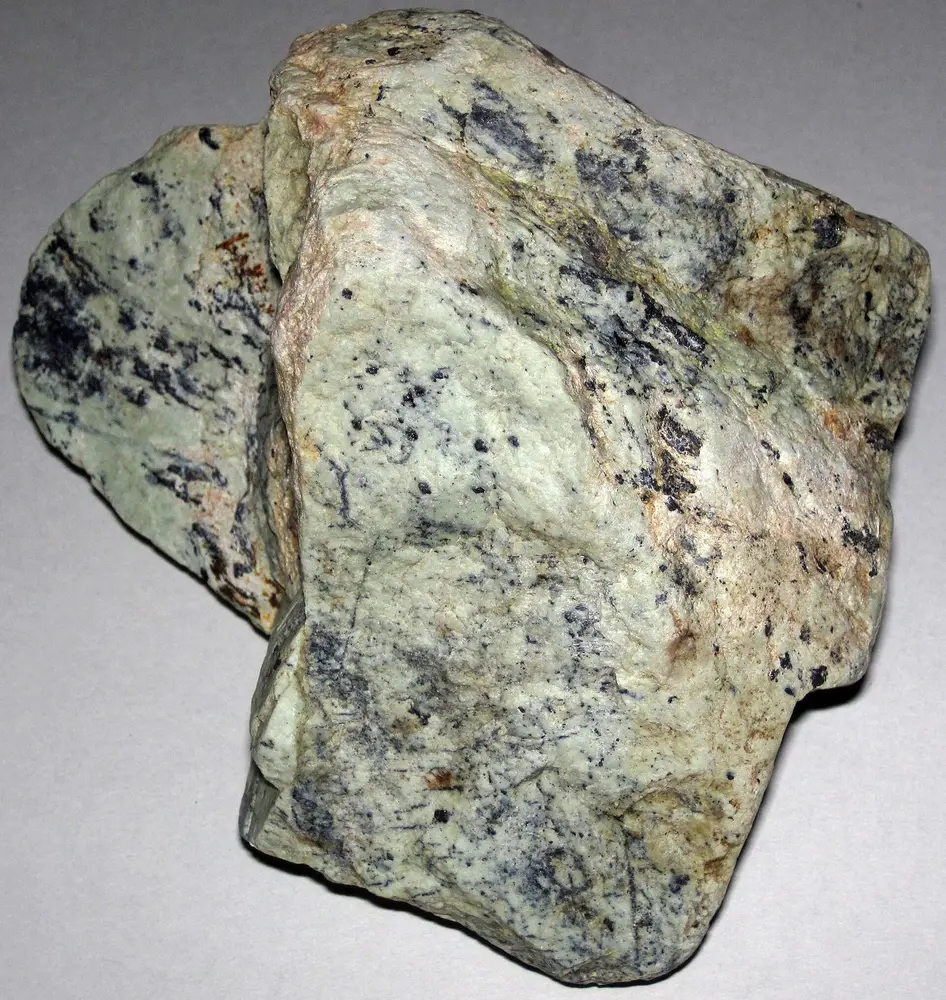
A reference photo of serpentinite. The surface looks pre-polished and the greens are mottled rather than even, which is the usual giveaway against jade in a photo.
Serpentinite reference photo, not a find from the area this page covers. James St. John · CC BY 2.0 · Encyclopedia entry

Gray, black, red and brown rocks: where they go next
Gray and black rocks are usually basalt, gabbro, slate, shale or dark limestone, and the deciding clue is grain and holes. Basalt is fine-grained with scattered vesicles, gabbro shows coarse black and gray crystals, slate splits into flat sheets, shale crumbles in thin layers, dark limestone is smooth and may hold fossils. Obsidian is the glossy exception, with conchoidal fracture. The metamorphic guide covers slate, schist and gneiss; the general guide covers the igneous ones.
Red and brown are almost always iron. Hematite coats a sandstone, jasper is red through and through, quartzite picks up a rust tint, and many plain pebbles wear a rust rind over a gray interior. Photograph a broken face beside the weathered one; if the inside is gray, the color is a skin. Jasper has no visible grains and takes a waxy polish, which is why it also appears on the polished rock page.
Photograph it so the tables and the tool both work
Shoot the whole rock on a plain dark background in daylight, with a coin for scale.
Take a close-up of the broken face at a low angle so luster and fracture show.
Hold a thin edge toward the window and photograph the glow for translucency.
Wet half the rock if it is dull; the wet half shows true color and veins.
Upload one to three of these photos, read each candidate's evidence against its table row, then ask the follow-up question about the clue that still conflicts.
One question people ask about green rocks
Can a photo tell jade from serpentinite?
It can rule jade out when it sees mottling, white veins, flakes or bubbles, and it can say a stone is consistent with jade. It cannot confirm jade, because that rests on density and hardness. Treat a jade candidate as a reason to read the jade guide, not a result.