
Identification guide
Polished Rock Identification for Tumbled and Cut Stones
For polished rock identification, compare bands, inclusions, grain and the way light moves across the surface.
Polishing can hide a rough fracture and give different materials a similar shine. Check for agate bands, dendrites, the sugary grain boundaries of quartzite, moving light in tiger’s eye or the flash in labradorite. Hold the edge to a light and look for pits that survived the polish.
This page lists what polishing takes and what it leaves, shows how to catch dyed stone and glass, and gives a photo routine for tumbled stones, cabochons and slabs. The crystal identifier has a Tumbled or polished option that tells the model the surface is processed; choose it, upload one to three photos, and compare each candidate's evidence against the clues below.
Guide updated
What polishing removes and what it leaves
Hold the stone under a lamp and tilt it. On a rough rock you would read luster from the broken face; here every material reads glassy, so ignore the shine and look through and into the stone instead. The table pairs each rough-rock clue with its polished replacement.
Clue on rough rock | What polishing does to it | What to read instead on the polished stone |
|---|---|---|
Fresh fracture (conchoidal or flat) | Gone; every face is ground smooth | A chip or nick on the edge; glass chips in clean curved flakes |
Luster in angled light | Made uniform and glassy on everything | Sheen that moves inside: chatoyant band, schiller flash, fibrous silk |
Surface color | Deepened and evened out | Color concentrated in cracks means dye; even color through the body is natural |
Grain size against a fingernail | Flattened, hard to feel | Grain boundaries still visible as a sugary mosaic in quartzite and aventurine |
Layering and bands | Cut across, so bands show as curves | Concentric or parallel bands in agate and onyx; the bands follow the stone's old cavity |
Vesicles and pits | Mostly filled or ground away | Small pits that stayed open: jasper, dyed howlite, some obsidian |
Translucency at a thin edge | Improved; polishing clears the surface | Back-lit pattern: cloudy zones, dendrites and inclusions show best this way |
Weathering rind | Removed entirely | Nothing; provenance is lost, so do not guess a source from the stone |
Read the pattern: bands, dendrites, grain and sheen
Banding is the strongest survivor. Agate shows fine concentric or parallel bands that follow the shape of a former cavity, often with a cloudy center, and the bands stay visible against a lamp. Onyx is the same with straight parallel bands. Jasper has no bands, is opaque, and keeps small pits and dull patches because its grain is finer and less even; a jasper and an agate from the same batch are told apart by whether light passes through the edge.
Dendrites are the black fern-like growths in dendritic agate; they sit at one depth and look flat when you tilt the stone, unlike moss agate's green inclusions, which float at different depths. Rutilated quartz shows straight golden needles; phantom quartz shows ghost outlines of an earlier crystal.
Grain boundaries survive in anything made of fused grains. Tumbled quartzite looks like a sugar cube under a thin glaze, and green aventurine adds flashing mica flakes. Nephrite shows no grains but a fine fibrous sheen when you roll it under the lamp. Tiger's eye shows a single bright band that slides across the stone as you tilt it, called chatoyancy; labradorite shows a sheet of blue, green or gold flash, called schiller, that appears from certain angles and vanishes from others.
Translucency pattern is the last check. Hold the stone against a phone torch. Agate glows with its bands, chalcedony glows evenly, rose quartz glows soft pink and cloudy, quartzite glows at the grain edges, jasper and most howlite stay dark, and glass glows evenly with no internal structure at all.
Agate: concentric bands that follow an old cavity
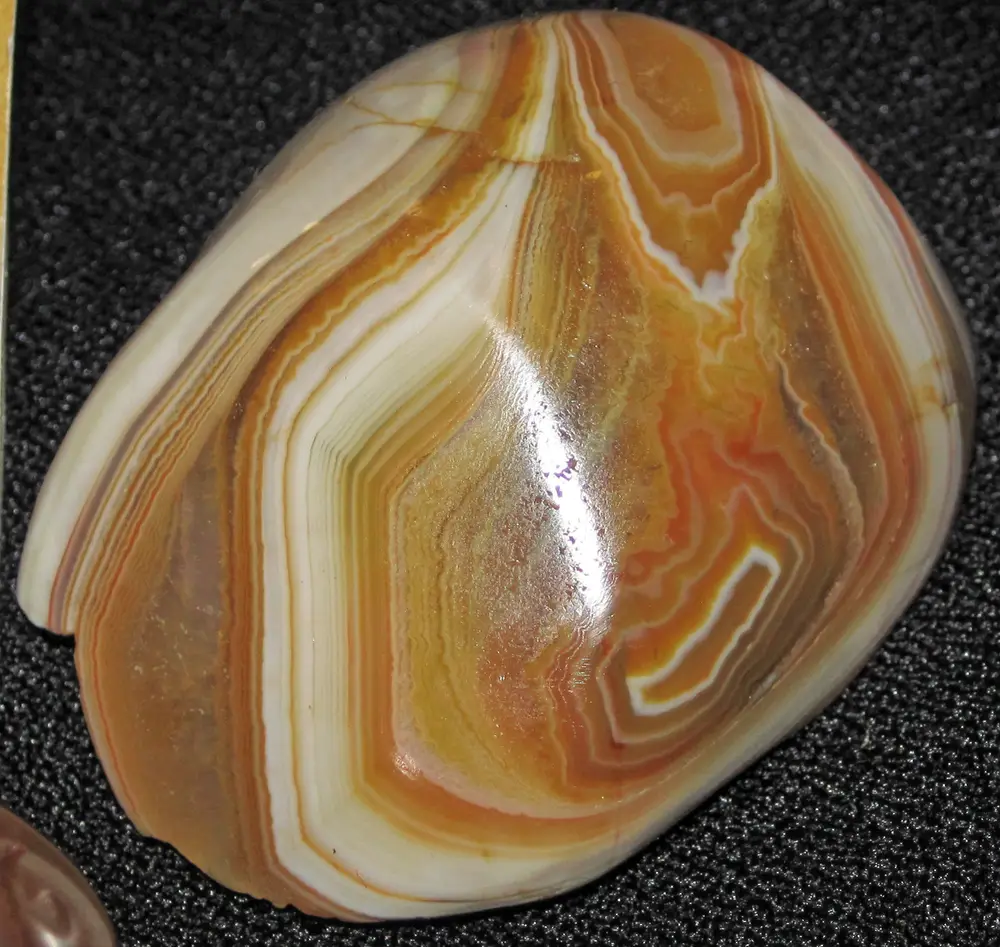
A reference photo of agate. The bands curve around a former pocket and stay visible when the stone is back-lit, which is the quickest separation from jasper.
Agate reference photo, not a find from the area this page covers. James St. John · CC BY 2.0 · Encyclopedia entry

Labradorite: schiller that shows only from one angle
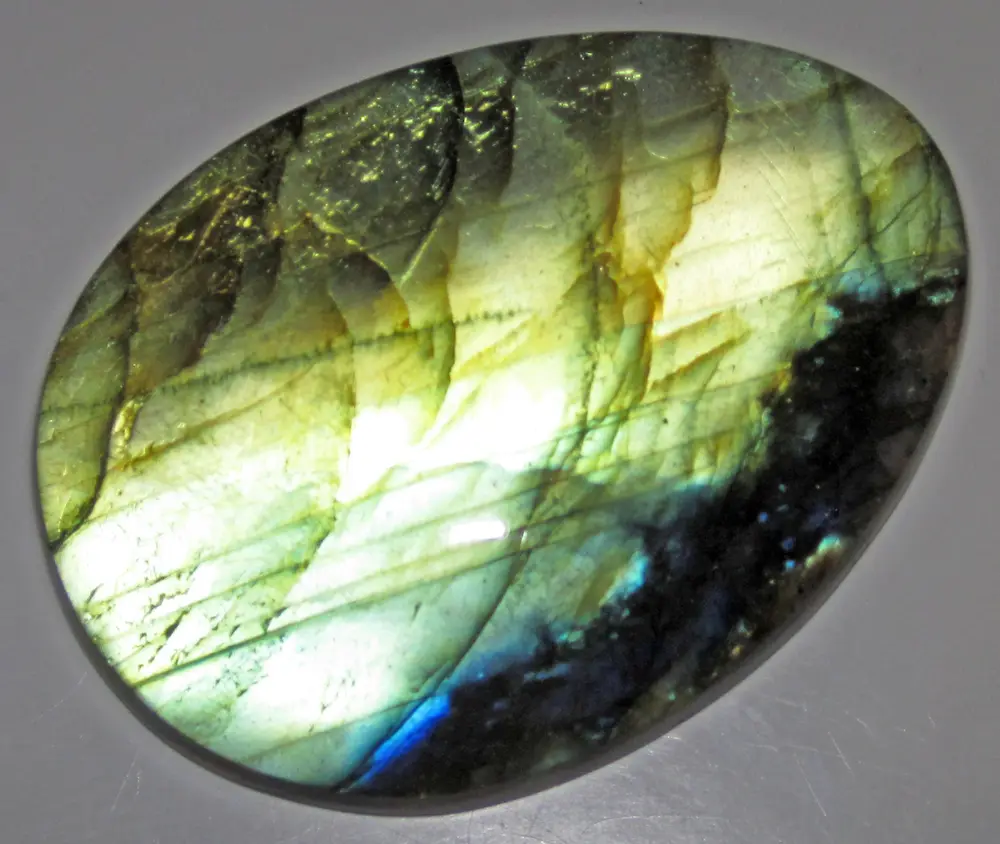
A reference photo of labradorite. The flash is a sheet of color inside the stone, not a surface shine; tilt a polished piece and it switches on and off.
Labradorite reference photo, not a find from the area this page covers. James St. John · CC BY 2.0 · Encyclopedia entry

Spot dyed stone, glass and manufactured material
Dye concentrates where the stone was porous. Dyed howlite shows bright blue or green with the gray spider-web veins darkest of all; natural howlite is white with gray veins. Dyed agate shows band colors that do not occur together in nature, with the dye deepest in the cloudiest band and in any crack. Diffuse light shows the concentration; flash hides it.
Glass gives itself away at the edge and inside. Look for round bubbles, curved swirl lines, and chips on the rim that break in clean conchoidal flakes. Goldstone is glass with copper flakes, opalite is glass with a milky blue glow and an orange flash in transmitted light, and sea-glass pebbles tumble to the same frosted finish as quartz. None is a rock, and the identifier will say so when the bubbles are in the photo.
A photo cannot show hardness, density, authenticity or value. It cannot confirm jade, tell natural from heated color, or prove a stone is untreated. For a suspected gem, never scratch or heat it; photograph it, ask the follow-up question about the specific clue, then see a jeweler if the answer matters.
Howlite: the gray veins that dye collects along
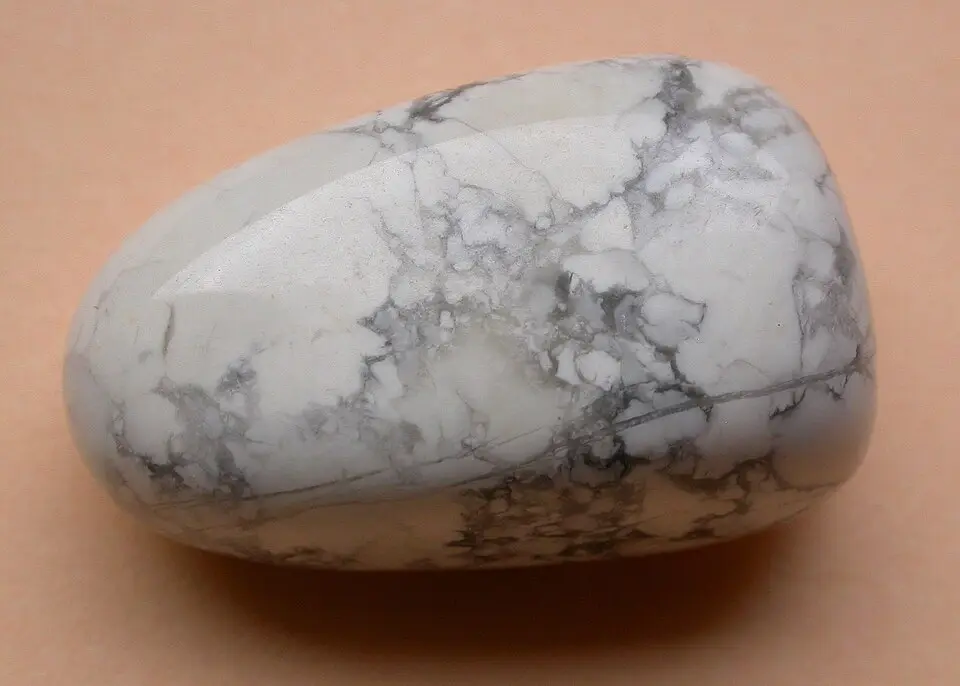
A reference photo of howlite in its natural white state. When a tumbled piece is bright blue with the same veins showing darker, the color is dye.
Howlite reference photo, not a find from the area this page covers. Ra'ike (see also: de:Benutzer:Ra'ike) · CC BY 3.0 · Encyclopedia entry

Photograph a polished stone so the clues show
Polished surfaces reflect, so the usual outdoor shot returns a white glare and a mirror image of your phone. Use diffuse light from a window with paper taped over it, or a lamp bounced off a wall, and a dark matte background so the edge is visible. Skip the wet shot; the surface is already as wet-looking as it will ever be.
Set the stone on black card or a dark cloth under diffuse light and photograph it straight down with a coin for scale.
Tilt the stone and shoot again at the angle where any band of light, flash or silk appears; that frame carries the chatoyancy or schiller.
Back-light it against a phone torch or a bright window and photograph the glow; bands, dendrites, inclusions and dye concentration show here.
Photograph the edge close up, including any chip or nick, because that is the only place fracture and bubbles survive.
Open the crystal identifier, choose Tumbled or polished, upload the one to three best frames, and read each candidate's evidence.
Polished rock identification with the Tumbled or polished option
The option tells the model that the uniform shine and deepened color come from processing, so it stops treating luster as evidence and weighs pattern, translucency and inclusions instead. Each candidate comes back with its visible clue, such as concentric banding, sugary grain mosaic or spherical bubbles. If two candidates share the same clue, the deciding photo is almost always the back-lit one or the edge close-up, and the follow-up question is where to ask about the clue it did not mention.
A tumbled stone also has no provenance. Even if it came from a Lake Superior beach bag, the polish removed the rind, so read the candidates as material names and use the location pages for the beach itself.
Questions people ask about tumbled stones
Is my tumbled stone agate or jasper?
Hold it against a phone torch. Agate lets light through and shows bands; jasper stays dark and keeps a few tiny pits in the polish. A stone with a translucent banded zone next to an opaque red zone is usually jasper-agate and the tool will name it that way.
Why does the identifier call my blue stone howlite instead of turquoise?
Because the gray veins show darker than the blue around them, which is how dye sits in porous howlite. Natural turquoise shows brown or black matrix that is part of the stone, not a stain along cracks.